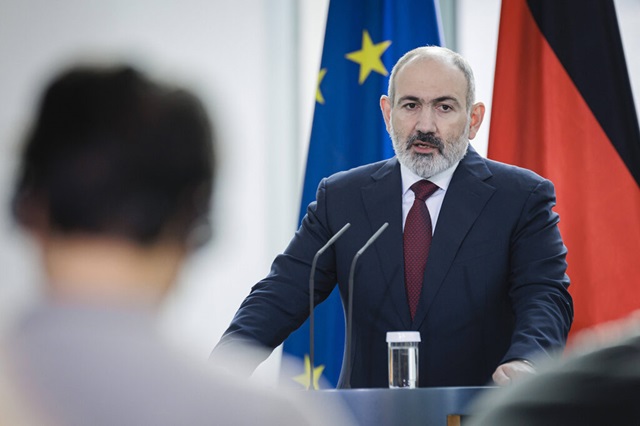
Armenia is likely to formally withdraw from the Russia-led Collective Security Treaty Organization (CSTO), Prime Minister Nikol Pashinyan announced Wednesday, signaling a dramatic shift in the country’s foreign policy and a growing rift with Moscow.
The announcement comes nearly a year after Armenia froze its participation in the alliance, accusing it of failing to provide support during the 2023 conflict with Azerbaijan — a war that ended with the forced handover of the contested Nagorno-Karabakh region.
“Regarding the issue of leaving or not leaving the CSTO, I will say that it is most likely that Armenia will leave the CSTO rather than unfreeze its participation,” Pashinyan stated at a press conference, underscoring deepening dissatisfaction with the bloc.
Formed in 1992 by six former Soviet republics — Russia, Belarus, Kazakhstan, Kyrgyzstan, Tajikistan, and Armenia — the CSTO was intended as a collective defense mechanism. However, Moscow has argued that it had no mandate to intervene during the Azerbaijan-Armenia clash, pointing out that Armenia has never officially recognized Nagorno-Karabakh as part of its own territory.
Russian officials also noted that Yerevan had repeatedly rejected territorial compromise proposals brokered by Moscow in prior negotiations with Baku.
Kremlin spokesman Dmitry Peskov responded to Pashinyan’s latest comments by stating that CSTO membership is a “sovereign decision” for Armenia. “The membership in the CSTO brings certain benefits to Armenia… the CSTO is an organization that has repeatedly demonstrated its efficiency,” he said.
Meanwhile, Pashinyan’s administration has taken a decidedly pro-Western turn. During Wednesday’s press conference, the prime minister reaffirmed his government’s goal of joining the European Union, citing legislation passed earlier this year as a formal expression of that ambition. “Armenia wants to be a member of the EU,” he said, though he acknowledged the process would be “complicated” and contingent on meeting European standards and securing unanimous approval from EU member states.
The geopolitical realignment comes at a time of heightened domestic tension. The arrest of two senior clerics of the Armenian Apostolic Church and influential Russian-Armenian businessman Samvel Karapetyan has sparked protests. All three have been accused of plotting to overthrow Pashinyan’s government following his controversial decision to transfer several border villages to Azerbaijan.
Moscow has expressed concern over the unrest. “Russia is interested in the preservation of law and order in Armenia,” Peskov said last month, noting that the large Armenian diaspora in Russia is watching the situation unfold “with pain.”
Should Armenia move forward with quitting the CSTO, it would represent a historic rupture with its traditional ally Russia and accelerate the country’s pivot toward Western institutions — a transformation with profound implications for the balance of power in the South Caucasus.