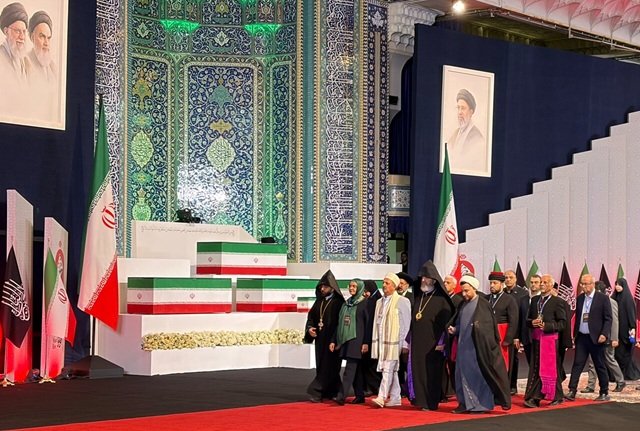
Millions of people are thronging through the streets of Tehran this week as the state funeral for Iran’s Supreme Leader Ayatollah Ali Khamenei takes place; Khamenei ruled Iran for three decades and was killed in one of the many strikes launched by the United States and Israel which initiated this war, alongside several members of his family. Delegations from over one hundred states have come to Tehran for six days of mourning ceremonies in the cities of Tehran, Qom, Najaf, Karbala, and Mashhad, in an event that may well match the funeral of the founder of the Islamic Republic in 1989.
But beneath all the pageantry there lies three issues that remain unsolved and will have ramifications throughout the region long after the body is laid to rest in Mashhad
1. Has Iran quietly become a dynasty?
Mojtaba Khamenei, son of Khamenei, was appointed as the new supreme leader barely days after his father’s demise in a rather unusually fast process compared to what would have taken place at such an institution where, on paper, appointments are done through deliberations by the Assembly of Experts of the country and not inheritance. While Iran has continued to argue that it is not a monarchy, the quick appointment of Mojtaba and his absence from his father’s funeral over concerns about his assassination by Israel has raised questions on whether the clergy in the country ignored their process and procedures in order to fill a vacuum of power while at war.
2. Can a ceasefire survive if the negotiators don’t trust each other?
Negotiations for formally ending the war are “positively moving forward,” with Washington and Tehran likely to start negotiations after the funeral ceremony ends. The progress, however, is much more precarious than the official narrative portrays. American officials have revealed to the media that they had fears about Israeli targeting of Iranian negotiators amid the ceasefire talks. These fears were so pronounced that it is alleged that Washington issued warnings to other countries in order to inform Iran. Israel’s government has dismissed this report as fictitious. Whatever the case may be, the presence of such concerns speaks volumes about how precarious the negotiating process is. It is very hard to conduct diplomacy in an environment where there are fears about one’s ally disrupting the process through military action.
3. Is Pakistan positioning itself as the region’s indispensable broker?
The visit of Pakistan to Tehran is not just about paying condolences. Prime Minister Shehbaz Sharif came to the funeral ceremony with one of the biggest and highest-ranked delegations, such as Pakistan’s army chief, Field Marshal Asim Munir, who is also the Chief of Defense Forces, as well as the country’s deputy prime minister and foreign minister, Ishaq Dar, along with some other ministers of the cabinet and political leaders. It is a much more high-level delegation than any other country sent to the funeral, especially after Pakistan gained the reputation of the country that helped in establishing communication between Washington and Tehran through months of efforts.
The presence of the head of Pakistan’s military next to the country’s prime minister is being interpreted by some regional experts as much more than simple protocol. In a part of the world where Israel has not been shy about launching strikes into Iranian territory and has even considered targeting Iranian delegates during negotiations, the message behind the show of solidarity by a nuclear-armed neighbor in the form of having that country’s military chief of staff attend the funeral ceremony has its own meaning: Any further escalation will not go unnoticed by Islamabad. This should be seen as an interpretation of events, not confirmation of Pakistani plans; Islamabad has made clear that the trip was meant as an expression of solidarity and condolences, and nothing else. But in a week when everyone in the region is looking for meaning in every move, the symbolism of a nuclear power’s military leader being in Tehran cannot have escaped anyone’s notice, not even in Jerusalem.
Why it matters beyond this week
None of the three strands will have been sorted out when Khamenei passes away in Mashhad on July 9. Yet collectively, they suggest what lies ahead: a clerical regime that may have quietly altered its own terms of survival in order to endure a war; a ceasefire negotiation process that hinges on trust neither party will necessarily have; and a Pakistan that has managed through the crisis to turn proximity and patience into genuine political heft – heft it might well seek to leverage elsewhere, even where it matters more. The funeral will pass. The questions will remain.