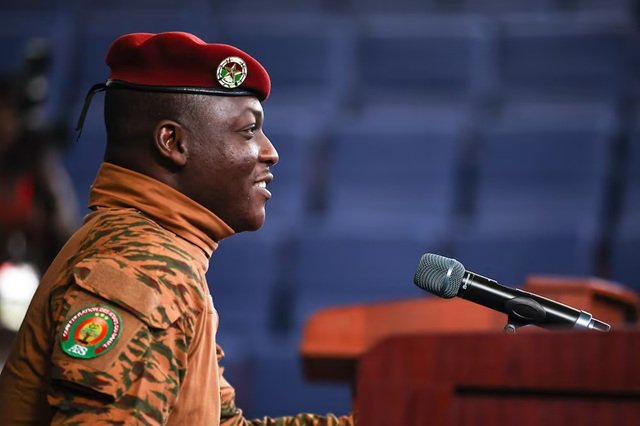
In less than four years, Captain Ibrahim Traoré has undergone one of the most remarkable political transformations in contemporary Africa. Once an obscure military officer, Burkina Faso’s president has emerged as one of the continent’s most recognisable political figures, celebrated by supporters as a champion of African sovereignty while condemned by critics for tightening authoritarian rule. His image now circulates widely across social media, adorning T-shirts, viral videos and online campaigns that portray him as the new face of anti-imperialist resistance.
An analysis published by El País explores the contradictions surrounding Traoré’s leadership, arguing that his growing international popularity coexists with an increasingly restrictive domestic political environment marked by the repression of journalists, activists and political opponents.
Since seizing power in a military coup on 6 October 2022 at the age of 34, Traoré has cultivated an image strongly reminiscent of Burkina Faso’s revolutionary leader Thomas Sankara. His speeches emphasise national sovereignty, economic self-reliance and resistance to foreign influence, messages that have resonated particularly with young Africans and members of the African diaspora seeking alternatives to traditional Western partnerships.
His government has reinforced that image through visible economic measures. Traoré has pursued the nationalisation of strategic industries, expanded state participation in sectors including gold mining, cotton production and the manufacture of beer, soap and cooking oil, while investing in roads and industrial infrastructure. These initiatives have helped strengthen his reputation as a leader delivering tangible projects financed through domestic resources rather than foreign assistance.
Dagauh Komenan, an Ivorian historian and specialist on the Sahel, argues that Traoré represents a deeply contradictory political figure. While acknowledging his popularity, particularly among younger generations impressed by the expulsion of French forces, the nationalisation of gold mines and investment in infrastructure, Komenan contends that the Burkinabè leader resembles Joseph Stalin more closely than Thomas Sankara in ideological terms. He describes Traoré as highly authoritarian, arguing that his government disregards human rights, limits press freedom, restores capital punishment and suppresses political pluralism.
Traoré’s political ascent followed years of frustration over Burkina Faso’s worsening security situation. Before leading the coup, he had served as a spokesman for soldiers deployed against jihadist insurgents in the country’s north, repeatedly complaining about inadequate resources. His seizure of power was welcomed by many Burkinabè who had grown increasingly disillusioned with the country’s political class and Western-backed security efforts.
After assuming power, Traoré swiftly reoriented Burkina Faso’s foreign policy. French special forces stationed in the country were expelled, while military cooperation with Russia expanded. Unlike neighbouring Mali, where Africa Corps personnel participate directly in combat operations, Russian involvement in Burkina Faso has reportedly focused primarily on military training and the personal protection of the president.
Rather than relying solely on foreign military support, Traoré launched a large-scale recruitment drive appealing to patriotic sentiment. Tens of thousands of civilians joined the Volunteers for the Defence of the Homeland (VDP), local defence units that now serve as the first line of protection in many remote communities where the regular army has only a limited presence.
According to El País, however, Traoré’s greatest political success has not occurred on the battlefield but online. His popularity has been fuelled by an extensive digital campaign across TikTok, Instagram and YouTube, where artificially generated videos frequently depict him reviewing troops on horseback, standing alongside celebrities such as Beyoncé in military uniform or receiving praise from Pope Leo XIV. Although entirely fabricated, these videos have spread rapidly across countries including Nigeria, Ghana, Kenya, France, Russia and the United States, contributing to his emergence as a global symbol of anti-imperialist politics.
The newspaper reports that this online personality cult is far from spontaneous. A network of influencers and government communicators reportedly coordinates much of the content under the direction of Kassoum Traoré, the president’s younger brother, helping project an image of decisive leadership and military success.
That image contrasts sharply with the realities of Burkina Faso’s ongoing conflict. Government propaganda presents Traoré as steadily defeating jihadist groups, yet data cited from the Armed Conflict Location & Event Data Project (ACLED) indicate that more than half of the approximately 26,000 people killed since 2015 have died during the past three years. The army has also suffered significant battlefield setbacks that are rarely acknowledged publicly. Nearly half of Burkina Faso’s territory, particularly rural areas, remains beyond effective state control, while roughly two million people have been displaced from their homes—around one in every ten citizens.
Despite the deteriorating security situation, Burkina Faso’s economy has demonstrated notable resilience. According to the International Monetary Fund, annual economic growth has remained around five per cent while public debt has stayed broadly stable under two IMF lending programmes. Much of that performance has been driven by rising international gold prices, with gold remaining the country’s principal source of export revenue.
Traoré’s government has moved aggressively to increase state control over the sector. In 2023, authorities purchased two of the country’s largest gold mines, and a year later introduced a new mining code increasing state royalty revenues from 10 to 15 per cent. While these policies have strengthened government revenues, they have also generated concern within the private sector, where some investors are reportedly seeking opportunities elsewhere.
Traoré’s international profile expanded further in May 2025 when he travelled to Moscow at the invitation of Russian President Vladimir Putin. During the visit, he thanked Russia for supporting what he described as Burkina Faso’s three central objectives: defeating jihadist insurgents, building a stronger military and developing a nationally owned industrial economy. One of his most frequently quoted remarks—that Africa is not poor but rather has its wealth managed by others, and should stop asking for aid and instead produce for itself—has become a defining slogan of his political movement.
For Russia, analysts argue, Traoré’s growing popularity serves as evidence that Moscow’s partnerships in Africa offer an attractive alternative to traditional Western engagement. His success has therefore acquired significance extending beyond Burkina Faso itself, becoming part of the wider geopolitical competition for influence across the continent.
At home, however, political space has continued to narrow. After failing to honour his commitment to hold elections in 2024, Traoré introduced a Revolutionary Charter that effectively allows him to remain in power indefinitely. Meanwhile, journalists, civil society activists and opposition figures have reportedly faced imprisonment, forced deployment to frontline military operations or exile.
Even so, assessing the true level of domestic support remains difficult. According to Komenan, thousands of supporters have reportedly volunteered to act as human shields whenever rumours of attempted coups circulate, illustrating the depth of loyalty Traoré commands among sections of the population. At the same time, there are indications of dissatisfaction within parts of the armed forces, although few appear willing to challenge him openly, given the strength of the country’s intelligence services.
As El País concludes, Ibrahim Traoré has become one of Africa’s most polarising contemporary leaders. To admirers, he embodies a new generation of sovereign African leadership determined to reclaim control over national resources and reject foreign dominance. To critics, he represents an increasingly authoritarian ruler whose popularity has been built alongside shrinking political freedoms and a security crisis that remains far from resolved. The coexistence of these two narratives continues to define both his leadership and Burkina Faso’s uncertain future.