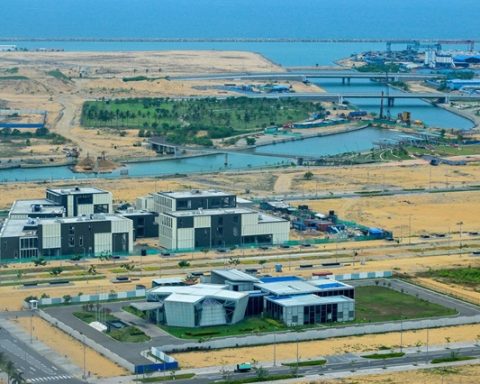
Ranil Wickremesinghe, a rigorous critic of the Hambantota Port, became Prime Minister in 2015 and, to the surprise of countries such as the USA and other Western states, decided to lease the port to China. Ranil was a well-known pro-American leader.
Despite building the harbor with Chinese loan money, the pro-China Rajapaksa family never decided to lease the harbor to China. However, Ranil took that decision, marking the beginning of the downfall of his ‘good governance’ government. A lease agreement was inked in July 2017. By 2018, Ranil and his government were facing serious challenges, including the bond scam commission report and the devastating local government election results. In 2018, then-President Maithripala Sirisena removed Ranil from the premiership. The circumstances of the time, shaped by geopolitics, left Ranil—who had leased the harbor to China—politically vulnerable.
Following the harbor lease, Ranil called for bids to build an oil refinery, and the Chinese company Sinopec was among the bidders. However, aware of the anger from the USA and India over the port lease, Ranil rejected Sinopec’s bid. Instead, the refinery project was awarded to a company linked to an Indian Tamil Nadu businessman and an Oman-based Singaporean firm. Ranil’s government claimed this was Sri Lanka’s largest foreign investment. However, the company later abandoned the project, while China remained persistent in its interest in investing in the refinery.
In 2019, Gotabaya Rajapaksa (Gota) campaigned for the presidency, promising to cancel the port lease to China. However, during his first overseas visit to India as President, he evaded questions from journalists regarding this promise. During Gota’s tenure, despite receiving Chinese investment offers for a refinery, he hesitated to proceed, fearing it might strain relations with India and the United States.
After Gota fled in 2022, Ranil became President. At this time, China reintroduced the refinery proposal, but since Sri Lanka was bankrupt, Ranil did not support it. On November 28, 2023, Ranil presented a Cabinet paper for a proposed $4.5 billion refinery project by Sinopec, following his visit to China in October 2023, where he gave consent to the project. The agreement was set to be finalized after receiving Cabinet approval. However, neither Ranil nor China appeared particularly enthusiastic due to the looming 2024 presidential election. Ranil likely hesitated, fearing backlash from India and the USA, while China might have been reluctant to proceed given the uncertainty surrounding Ranil’s re-election prospects.
After being elected President in 2024, Anura Dissnayake agreed to sign the oil refinery project, which Ranil’s Cabinet had already sanctioned. Anura’s government now claims this as a major victory stemming from his visit to China. However, there was little acknowledgment that this Chinese investment was originally tied to the 2017 harbor lease agreement. In other words, this oil refinery project is a product of the Ranil–China partnership.
Why is the NPP government implementing Ranil’s proposals?
When a new government takes office, canceling bilateral agreements between nations is generally deemed unethical. Therefore, Anura’s government could not refuse the refinery proposal. Regardless of whether Ranil, Sajith, or Anura had won the presidential election, China was expecting this agreement to be finalized.
While Anura was signing the refinery agreement, the government made a strategic move to balance relations between India and China. The Minister of Power and Energy, Kumara Jayakody, visited the Trincomalee oil tanks and promised that the agreement reached during Gota’s government to develop the tanks with India would proceed.
The Trincomalee oil tank development project was initiated during Gotabaya’s government. The relevant Cabinet paper was submitted, and the agreement was signed by then-Energy Minister Udaya Gammanpila. However, the proposal to lease the oil tanks to India originated in 2017 under Ranil’s government. To maintain good relations with India after leasing the Hambantota Port to China, Ranil agreed to lease the tanks to India. While Ranil could not implement the deal, Gota’s government decided to proceed with it, and Gammanpila signed the agreement.
Ironically, in 2017, when Ranil proposed leasing the oil tanks to India, Gammanpila strongly opposed the deal, claiming it was a betrayal of national assets. Mahinda Rajapaksa and the Sri Lanka Podujana Peramuna (SLPP), then in opposition, echoed similar sentiments, promising to reclaim national assets once in power. However, after becoming President, Gota’s government continued the very deal they had once opposed.
Gota’s downfall was partly due to the shortage of oil and gas, but his failure to deliver on promises made during the 2019 presidential campaign also contributed to public dissatisfaction. One of these broken promises was the leasing of the oil tanks. Those who voted for the SLPP, often mocked as ‘Bayyaas’ (a derogatory term), were disillusioned when they realized they had been misled. This backlash ultimately led to Gota’s downfall—a valuable lesson for the NPP, which rose to power with the support of these same voters.