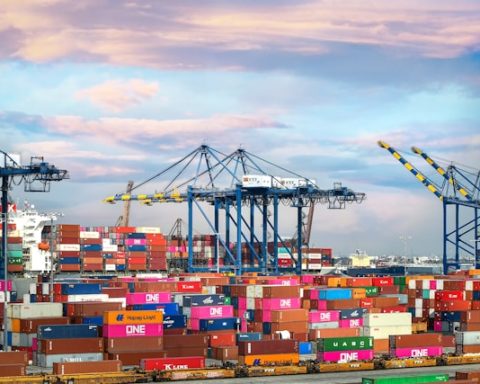
China has quietly extended its military influence across the South Pacific by building a network of ports, airports, and communications projects, which could pose a significant challenge to the U.S. and its allies in the event of conflict. A new study obtained exclusively by Newsweek reveals that China has been constructing what appears to be civilian infrastructure across a vast region stretching about 3,000 miles, from Papua New Guinea to Samoa, strategically positioning itself in critical locations previously vital to American warfighting strategies.
The report, titled “China’s Dual-Use Infrastructure in the Pacific,” highlights that many of these projects—though seemingly non-military—serve as “strategic nodes” that could be used for military purposes, potentially isolating the U.S. and its allies. These developments are part of China’s broader Belt and Road Initiative (BRI), which has transformed into a dual-use infrastructure program, blending civilian and military purposes. The BRI, launched in 2013, now includes these Pacific projects, which are being carried out by Chinese state-owned companies with strong ties to the defense sector.
Domingo I-Kwei Yang, a research fellow at Taiwan’s Institute for National Defense and Security Research, who authored the study, noted that the project is part of China’s efforts to reshape the regional power dynamics and challenge U.S.-led alliances. The Pacific islands, once key to U.S. military strategy during World War II, could again play a pivotal role in any future conflict. The region could become a launch point for Chinese military operations, particularly if tensions over Taiwan escalate.
Yang’s study identifies a total of 50 active strategic nodes across 11 Pacific Island countries, with a combined investment estimated at $3.55 billion. These projects include 26 airport construction projects, some of which have been upgraded to accommodate China’s largest military transporter, the Y-20. One such project is located at Momote Airport in Papua New Guinea, which is situated near a deep-water port used by U.S. ships, raising concerns about China’s growing influence in the area.
While these projects have largely been met with minimal resistance, they have drawn increasing scrutiny. The report also highlights China’s potential future military presence in key locations, such as Vanuatu’s Luganville port and Samoa. Both sites have received Chinese investment for infrastructure upgrades, including wharf extensions that could accommodate Chinese warships. These developments point to China’s strategic ambition to gain a foothold in the Pacific, further complicating the region’s geopolitical landscape.
The Chinese embassy in Washington has emphasized that China’s objectives are focused on peaceful development and cooperation, highlighting the goal of fostering a “shared future” for humanity. However, the U.S. State Department has criticized China’s use of the BRI to advance its political and military agenda, emphasizing its commitment to peace and stability in the Taiwan Strait and its continued support for regional allies.
The expansion of China’s military infrastructure in the Pacific has raised concerns among U.S. allies, including Australia and New Zealand, who are watching closely as Beijing’s presence in the region grows. Experts warn that this dual-use network could limit the operational space for the U.S. and its partners, particularly if tensions in the region escalate further.
For now, the Pacific region remains a critical area for global power dynamics, with China’s growing influence challenging the longstanding U.S. presence. As the BRI continues to expand, questions about its military implications and the future balance of power in the Pacific remain pressing.