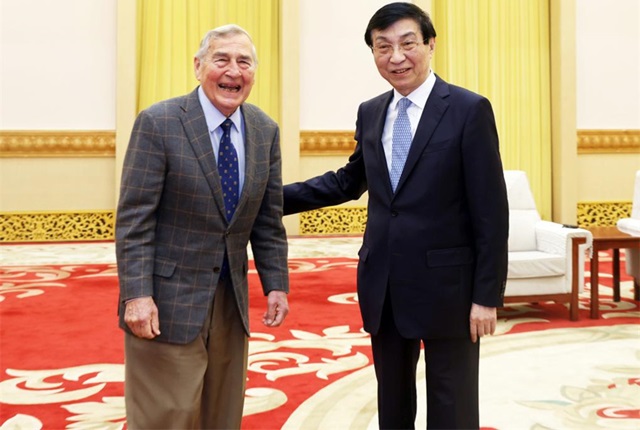
Senior Chinese leader Wang Huning has called for stronger efforts to safeguard stability in Tibet, fully enforce China’s new ethnic unity law and further align Tibetan Buddhism with Communist Party priorities during a four-day visit to the Himalayan region.
Wang, China’s fourth-ranking leader and a member of the Communist Party’s seven-member Politburo Standing Committee, visited the regional capital Lhasa and the Ngari prefecture, which borders India and Nepal, before concluding his tour on Wednesday, according to Chinese state media. The visit came weeks after China’s new ethnic unity law took effect on 1 July, reinforcing Beijing’s focus on stability and national integration in ethnic minority regions.
Speaking during the visit, Wang said, “To govern Tibet is foremost to stabilise Tibet,” adding that authorities must consolidate “a political and social environment of unity and stability.” He also called for the full implementation of the new ethnic unity law, which provides Beijing with legal grounds to take action against individuals, including those outside China, whom it accuses of undermining ethnic unity or inciting separatism.
The legislation has drawn criticism from the United States and the European Union since its introduction. During the same week the law came into force, a Tibetan man died after setting himself on fire near United Nations headquarters in New York. Activists identified the man and said his self-immolation was intended as an appeal for Tibetan independence.
Wang also urged officials to continue guiding Tibetan Buddhism to “adapt to socialist society” and to systematically advance the Sinicisation of religion in China, referring to Beijing’s policy of bringing religious practice into closer alignment with Chinese culture and Communist Party ideology.
As the Communist Party’s chief strategist on ideological, ethnic and religious affairs, Wang oversees the party’s united front work and has played a central role in shaping policies on minority regions. His visit to Tibet followed a similar trip to the Xinjiang region in June, where he also emphasised stability, ethnic unity and adherence to central government policy.
State broadcaster CCTV showed Wang visiting a Tibetan Buddhist monastery, where he examined a Ming dynasty imperial eulogy to the Buddhist canon dating from the early fifteenth century. Chinese authorities regard the historical document as part of a broader narrative highlighting Tibet’s historical links with successive Chinese dynasties and the longstanding relationship between Tibetan Buddhism and imperial rule.
The footage also showed display boards inside the monastery promoting the Sinicisation of Tibetan Buddhism and calling for stronger law-based management of temples and monasteries, reflecting the government’s continued emphasis on regulating religious institutions.
China established the Tibet Autonomous Region in 1965, describing the arrangement as one that provides ethnic minority groups, including Tibetans, with greater participation in local governance and protection of religious belief. International human rights organisations and Tibetan exile groups have repeatedly characterised Chinese rule in Tibet as oppressive, an allegation Beijing rejects.
Concluding his visit, Wang called for expanded publicity and education campaigns aimed at strengthening a unified national identity. He said the Communist Party’s strategy for governing Tibet in the new era should be fully implemented, stressing the importance of promoting national cohesion and maintaining long-term stability in the region.