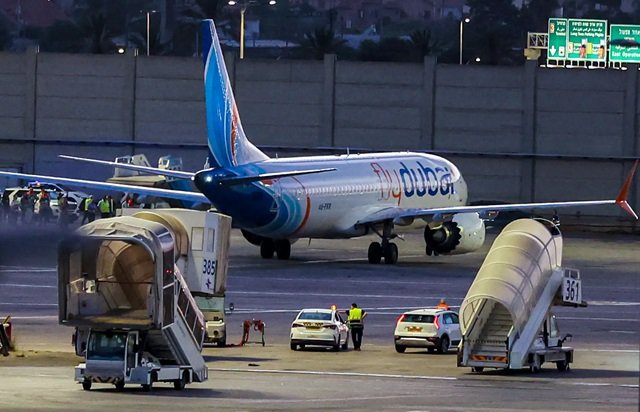
The attempted hijacking of FlyDubai Flight FZ1073 from Dubai to Tel Aviv on September 30, 2026, illustrates how an individual with privileged access to an aircraft can potentially bypass security measures designed to prevent external attackers from reaching the cockpit. The incident, involving an Omani co-pilot who allegedly attacked the captain with a crash axe, has drawn attention to the intersection of aviation security, extremist radicalisation and the potential misuse of professional authority.
The attempted attack occurred while the aircraft was in Saudi airspace. According to the supplied account, the co-pilot, Hamam al-Hammami, sought to seize control of the aircraft and crash it into the main terminal at Ben Gurion Airport in Tel Aviv. The attack allegedly involved a calculated attempt to incapacitate the captain and exploit the co-pilot’s operational knowledge and access. The aircraft plunged 16,000 feet within seconds, but the crew and passengers regained control. Two reserve pilots subsequently landed the aircraft in Saudi Arabia, preventing a catastrophe.
The incident combines two historically distinct forms of aviation violence: the deliberate use of an aircraft as a weapon, associated with the September 11, 2001 attacks, and the deliberate misuse of cockpit authority by a crew member, as demonstrated by the 2015 Germanwings crash. In the Germanwings case, the co-pilot locked the captain out of the cockpit and deliberately crashed the aircraft in what was believed to be a suicide mission unrelated to ideological or terrorist motivations. In the FlyDubai case, the alleged attack was reportedly connected to religious extremism and terrorism.
The distinction is significant because aviation security since September 11 has largely concentrated on preventing unauthorised access to the flight deck. Hardened cockpit doors, passenger screening, access controls, intelligence vetting and behavioural monitoring were developed to protect aircraft against external threats. An insider with legitimate access, professional expertise and knowledge of procedures presents a different challenge, potentially turning security arrangements against the aircraft itself.
The alleged radicalisation of al-Hammami provides further context. According to Emirati investigators, his movement towards extremism began during his studies in Melbourne, Australia, where he was allegedly exposed to radicalising literature and online content glorifying terrorism and suicide attacks. His reported reference to al-Qaeda’s September 11 attacks as an inspiration suggests an ideological motivation rather than an impulsive act of workplace violence.
His online activity reportedly combined rigid religious interpretations with misogynistic rhetoric associated with the manosphere. The account suggests that ideological commitment, personal grievance and gender-related resentment may have reinforced one another, although the precise relationship between these influences remains difficult to establish from the available material.
The case also involves reported warning signs. Omani authorities allegedly identified extremist material in al-Hammami’s possession in 2024 and removed him from flying duties. He subsequently remained employed in aviation. The circumstances raise questions about how information concerning potential security risks was shared between authorities and employers, and whether existing procedures adequately addressed the possibility of an insider threat.
The implications extend beyond pilots. Aviation personnel, including maintenance workers, ground handlers, contractors, catering staff, security employees and airport service providers, may possess access to sensitive areas or operational information. The aviation sector depends on employees receiving specialised access and institutional trust, creating a security challenge that cannot be addressed solely through passenger screening or cockpit protection.
The Soufan Center, in its analysis of the incident, places the alleged attack within a wider counterterrorism framework involving evolving extremist narratives and the convergence of ideological influences. The account identifies the continued circulation of propaganda related to the attempted hijacking within jihadi media networks, including al-Qaeda in the Arabian Peninsula (AQAP), al-Qaeda in the Indian Subcontinent (AQIS) and pro-al-Qaeda networks.
The analysis also points to increasingly blurred ideological boundaries. Extremists may combine elements drawn from different traditions, including anti-globalism, antisemitism, demographic replacement narratives, alleged state oppression and civilisational conflict, without adhering to a single coherent doctrine. This complicates security assessments that rely on identifying individuals through conventional ideological categories or formal terrorist affiliations.
For aviation security, the central concern is whether a person demonstrates intent, capability and access, rather than whether that individual fits a recognised extremist profile. A crew member may have no criminal record, no documented terrorist affiliation and a strong professional history, yet potentially pose a threat if radicalisation or other warning signs remain undetected.
The FlyDubai incident also exposes the institutional divisions that can complicate prevention. Aviation regulators concentrate on professional competence and safety; intelligence services monitor extremist networks and foreign influence; police investigate criminal conduct; and airlines prioritise operational continuity. An insider threat can cross all these responsibilities, requiring information-sharing and assessment that extend beyond the boundaries of individual institutions.
The incident does not establish that cockpit attacks by radicalised crew members will become routine. Commercial aviation remains subject to extensive security regulation. But the alleged use of a crash axe and privileged cockpit access demonstrates how an individual operating within a protected system can potentially exploit the very safeguards intended to prevent an attack.