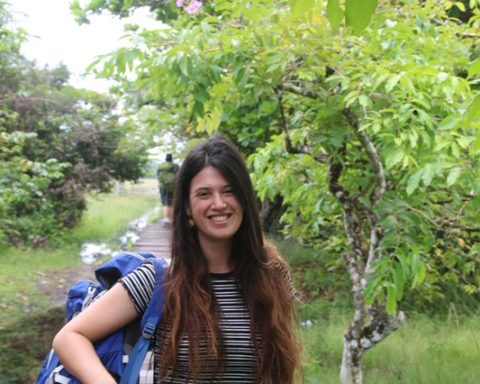
British national Kayleigh Fraser, who became known during Sri Lanka’s 2022 anti-government unrest for her social media coverage of attacks on protesters at Colombo’s Galle Face Green, is now seeking to have her deportation order revoked, according to her legal representative. Fraser, who was issued a removal order under the administrations of former presidents Gotabaya Rajapaksa and Ranil Wickremesinghe, is urging the current government to allow her to leave the country voluntarily and without forced deportation proceedings, while her prolonged legal and administrative dispute remains unresolved.
According to her lawyer, Nagananda Kodithuwakku, Fraser does not wish to be forcibly deported and instead wants a peaceful resolution that would allow her to exit Sri Lanka without further legal or security complications. He claims that despite changes in government following the rise of the National People’s Power administration, no meaningful intervention has been made to resolve her situation, even though the current leadership was politically associated with the protest movement during which Fraser became active online.
Fraser’s case originates from events on August 2, 2022, when immigration officials reportedly raided her residence in Battaramulla. During this operation, authorities seized her passport and cancelled her visa, which had originally been valid until March 2023. She was subsequently instructed to leave Sri Lanka by August 15, 2022. Officials cited alleged violations of visa conditions, stating that her activities on social media documenting protest-related incidents were inconsistent with the purpose under which she had entered the country.
The move came at a politically sensitive moment, as Sri Lanka was experiencing widespread economic hardship and mass protests that ultimately led to the resignation of then-president Gotabaya Rajapaksa. Foreign observers, journalists, and online content creators were present in large numbers during the unrest, documenting events that were rapidly unfolding on the streets of Colombo. Fraser’s posts, which allegedly included material related to attacks on protesters, drew attention from authorities, who later questioned the legality of her presence and activities in the country under her visa category.
Following the cancellation of her visa, Fraser challenged the deportation order through Sri Lanka’s Court of Appeal and later sought relief from the Supreme Court. However, according to her legal team, proceedings were repeatedly delayed due to procedural complications, including what were described as technical issues and administrative setbacks. These delays, they argue, prolonged her uncertainty and prevented a timely resolution of her immigration status.
Her lawyer, Nagananda Kodithuwakku, further stated that Fraser’s case has faced additional difficulties because several senior legal professionals reportedly declined to represent her due to what they considered the politically sensitive nature of the dispute. Kodithuwakku himself has continued to act on her behalf, maintaining that the matter is not criminal in nature but rather a contested immigration and administrative issue that has taken on broader political overtones due to its origins during a period of national unrest.
In a submission to authorities, Kodithuwakku claims that an appeal was made directly to President Anura Kumara Dissanayake on October 3, 2024, requesting intervention to lift the deportation order and resolve the case. He alleges that no response or corrective action has followed, despite what he describes as the government’s political connection to the broader protest movement that defined the period in which Fraser became involved in documenting events.
The lawyer has also called on Prime Minister Harini Amarasuriya to examine the case, arguing that her awareness of the political and social role played by activists and observers during the anti-government struggle places her in a position to better understand the implications of Fraser’s situation. According to him, the continued enforcement of the deportation order without review contradicts the expectations created during the transition of political power after the 2022 crisis.
Adding another layer of complexity, the British High Commission has reportedly declined to provide direct assistance in resolving Fraser’s legal status. While consular engagement in such cases is typically limited to advisory support, the lack of diplomatic intervention has further contributed to her continued uncertainty in Sri Lanka, according to her legal team.
Fraser’s current whereabouts have been described by her representatives as undisclosed since late 2022. Her lawyer claims she has been living in hiding to avoid possible detention or enforcement action, following the breakdown of her legal appeals and the continued validity of the deportation order. He argues that this situation was not chosen as a form of evasion but rather as a protective measure in response to the risk of being forcibly removed while her legal remedies were still being pursued.
The case remains unresolved, with no final judicial determination reported after multiple adjournments. Legal observers note that the prolonged nature of the proceedings reflects broader systemic delays in immigration-related litigation, particularly in cases that intersect with political sensitivities and public protests. At the same time, the absence of a clear administrative settlement has left Fraser in a prolonged state of uncertainty, caught between judicial process, immigration enforcement, and shifting political narratives.