Elon Musk has ignited controversy after urging Britons to “fight back or die” against what he described as the “destruction of the country” due to immigration, in incendiary remarks made during a far-right rally in central London that descended into violence on Saturday. Speaking via video link at the “Unite the Kingdom” march organised by far-right activist Tommy Robinson, Musk called for a general election and accused the UK government of failing to protect innocent people, including children, from gang assaults. Addressing the crowd, he warned that the country faces “a genuine risk of rape and murder and the destruction of the country and the dissolution of the entire way of life,” insisting that when violence approaches, people have no choice but to fight back or face dire consequences.
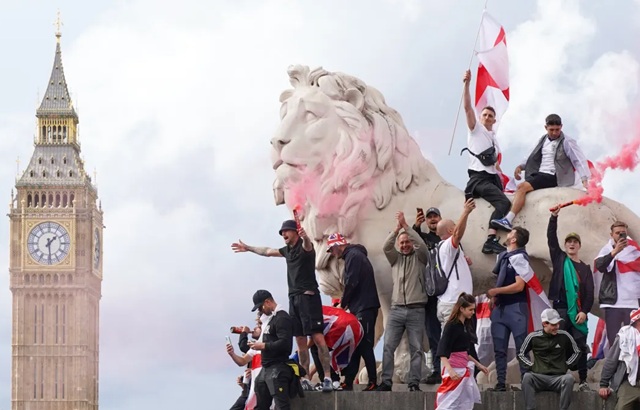
Musk’s intervention came as thousands marched through central London, with estimates ranging between 110,000 and 150,000 attendees — believed to be the largest right-wing demonstration in British history. Many waved Union Jacks, St George’s crosses, and carried images of American activist Charlie Kirk, recently murdered, while chanting nationalist slogans. Early parts of the protest remained peaceful, but by afternoon violence erupted when Robinson’s supporters attempted to breach police cordons and clashed with anti-racist counter-protesters near Trafalgar Square. Scotland Yard reported that by early evening at least 25 arrests had been made and 26 officers injured, including cases of officers with broken teeth, head wounds, and a prolapsed disc.
During his speech, Musk did not mince words. He accused Prime Minister Keir Starmer of failing to prosecute grooming gangs, called for the imprisonment of safeguarding minister Jess Phillips, and claimed that Britain was undergoing a “massive uncontrolled migration” that threatened its very existence. “There’s something beautiful about being British,” he said, “and what I see happening here is a destruction of Britain, initially slow, but rapidly accelerating.” Musk implored citizens to consider the future they wanted to live in and warned that those who prefer to stay out of politics would not be spared from the consequences if migration and violence continued unchecked.
Musk’s rhetoric echoed themes from his previous posts on his social media platform X, where he frequently criticised the government and mainstream media. He accused the BBC of complicity in the “destruction of Britain,” and labelled the political left as the “party of murder,” referencing the death of Kirk and claiming that left-wing figures openly celebrated the killing. He went so far as to say that violence was being weaponised by leftist groups, while ordinary citizens, fearful of expressing dissent, were being silenced. Musk’s past affiliation with former U.S. President Donald Trump lent further weight to his remarks, as he framed the confrontation as one between ordinary people and a hostile political elite.
The atmosphere at the rally spiralled out of control as groups of masked counter-protesters were hemmed in by riot police supported by mounted units and dogs. Robinson’s supporters hurled bottles, planks of wood, and even traffic cones at officers, with many officers assaulted by punches, kicks, and projectiles. Police deployed over 1,600 personnel, including reinforcements from outside London, to contain the unrest. The Home Secretary condemned the violence, affirming that peaceful protest is a fundamental right while warning that anyone participating in criminal activity would face “the full force of the law.” The Metropolitan Police later described the chaos as an attempt by protesters to access restricted areas and confront opposing groups, resulting in multiple injuries to officers.
Speakers on the rally stage included Katie Hopkins and Laurence Fox, both known for their right-wing activism. As Musk concluded his video call, Robinson praised him, stating, “Not only are we in the fight right now, but we’re on the advance thanks to free speech being fought for, for us, by Elon Musk.” Labour representatives condemned the remarks, calling threats of violence incompatible with democratic values, and urging politicians to distance themselves from such incendiary rhetoric. Musk’s comments have also raised concerns across the political spectrum, with critics warning that such statements could fuel extremism and further polarise an already divided society.
The events of the day, combining nationalist fervour, calls for radical action, and violent confrontations with law enforcement, have cast a spotlight on Musk’s growing influence in British politics. While some supporters hail his defiance as a necessary alarm against societal decline, many view his words as reckless and dangerous. The fallout from the rally is expected to reverberate in the coming weeks, as lawmakers, activists, and citizens grapple with the implications of Musk’s involvement in domestic unrest and the deepening fracture lines within Britain’s political landscape.