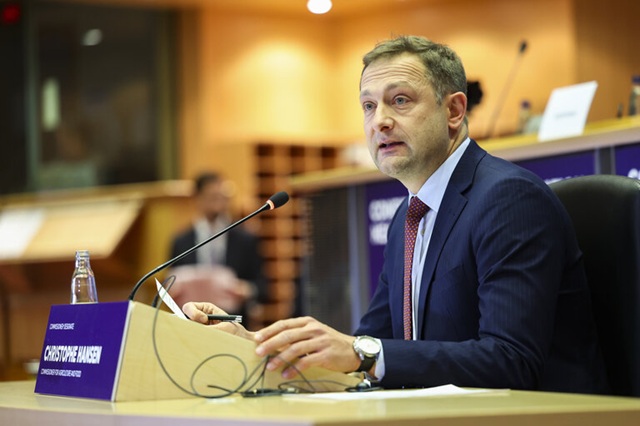
The European Union’s agriculture commissioner, Christophe Hansen, has cautioned against diverting funds from the bloc’s €387 billion Common Agricultural Policy (CAP) to bolster defence spending, emphasizing the critical role of food security in Europe’s geopolitical resilience. Hansen’s remarks, reported by the Financial Times, come amid ongoing negotiations over the EU’s next seven-year budget, which is set to run from 2028.
“The EU must not prioritize guns over butter,” Hansen said, underscoring that the CAP accounts for about one-third of the EU’s overall budget and remains vital to feeding the 27-member bloc. “It is difficult to build a continent on an empty stomach,” he added, highlighting how the current geopolitical tensions reinforce the importance of securing Europe’s food supply to reduce vulnerability to external pressures.
As the European Commission proposes a major budget overhaul that could merge CAP funds with regional spending into a single, more flexible pot, Hansen acknowledged that such a “single pot” could create synergies but stressed it was too early to determine CAP’s final size. The proposal has sparked fierce opposition from farmers and member states with strong agricultural sectors, like Ireland, who fear losing dedicated funding and safeguards.
Copa Cogeca, the EU’s largest farming lobby, voiced “unanimous concern” over potential cuts or repurposing of CAP money and called for increased funding indexed to inflation. The farming community also complains about stringent environmental conditions tied to CAP payments, which led to widespread protests last year and prompted the Commission to ease some rules—such as mandatory crop rotation and preserving natural habitats like hedges.
Hansen further emphasized that any additional demands on farmers to reduce emissions or enhance biodiversity must come with corresponding financial support. On trade, he warned that production standards cannot be compromised, particularly concerning imports like hormone-treated livestock from the U.S., which he described as “politically risky.” Still, he noted growing interest from markets like Japan in trading with the EU’s high-standard agricultural sector.
With the EU also grappling with rising debt repayments linked to pandemic borrowing, negotiations on budget size and allocations remain tense. Hansen’s remarks, covered by the Financial Times, underline the delicate balancing act facing Brussels as it seeks to fund defence ambitions without undermining a cornerstone policy that ensures the continent’s food security.