


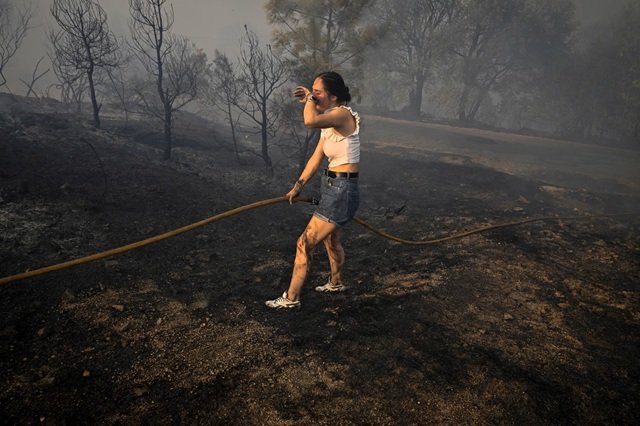
Europe is confronting several crises at once, each distinct in origin but increasingly interconnected in its consequences. Devastating wildfires and extreme heat have strained emergency-response systems across the continent, a sudden migrant rush in Spain’s North African enclave of Ceuta has reignited one of the European Union’s most divisive political debates, Russia’s war against Ukraine continues to require European military and financial support, and the war in Iran has disrupted energy markets. Taken together, these pressures are testing Europe’s ability to sustain public confidence, preserve political cohesion and respond collectively.
The scale of the wildfires illustrates the immediate pressure on national and European Union crisis-response capabilities. Record-breaking temperatures and prolonged drought have fuelled fires across Spain, France and other parts of the continent, prompting mass evacuations and requiring governments to deploy substantial emergency resources. The EU’s Civil Protection Mechanism, which coordinates emergency assistance between member states, has deployed firefighters and aircraft to France and Spain, demonstrating the extent to which national governments can struggle to manage such circumstances independently.
The increasing frequency and intensity of climate-related disasters are also raising questions about whether Europe’s emergency-response infrastructure is equipped for a climate in which extreme weather events are becoming more persistent. More than 300,000 people have been evacuated from their homes in Spain and France, while more than 10,000 people have died throughout the heatwave, most of them over age 65. People have also lost their homes and livelihoods in the fires.
The disasters have become a source of political friction. In Spain, the left-leaning national government and right-leaning regional governments, particularly from the Madrid region, have traded accusations over preparedness, resource allocation and the adequacy of the response. Prime Minister Pedro Sánchez has emphasised climate change as a central driver of the worsening fire season and used the crisis to argue for greater investment in climate adaptation. Opposition voices in Spain’s conservative People’s party have instead focused on government preparedness, arguing that Sánchez has used climate change as justification for “poor management” of natural disasters.
France has also seen the fires become part of a political debate ahead of next year’s presidential elections. Green leader Marine Tondelier has called for a new “climate welfare state”, reflecting the growing political importance of climate-related pressures as governments confront the consequences of extreme weather.
The economic cost has been substantial. According to the Financial Times, the fires have cost the five heaviest-hit countries approximately $3 billion so far. The economic pressure comes alongside another external shock: the war in Iran. Extreme heat, wildfires and drought are disrupting agriculture, transportation, tourism and energy generation, while the conflict in the Middle East has exposed Europe to renewed volatility in global energy markets.
Disruption to shipping through the Strait of Hormuz has sharply reduced the availability of oil and liquified natural gas, contributing to higher energy prices and renewed concerns about inflation and economic growth. The convergence of these pressures has raised concerns about Europe’s ability to replenish reserves ahead of the winter heating season, particularly if disruptions to Middle Eastern energy supplies persist.
At the same time, Spain has faced another challenge with consequences far beyond its borders. Chaos in Ceuta, Spain’s enclave on the North African coast, has reignited the debate over migration. Approximately 70,000 people attempted to cross from Morocco to Ceuta by sea over two days in late July. Many believed that a recent Spanish Supreme Court decision meant that arriving on Spanish territory by sea would prevent the Spanish government from returning them to their country of origin.
That interpretation was incorrect. The ruling prohibited Spain from summarily returning migrants intercepted at sea but did not prevent their subsequent deportation through ordinary immigration procedures. The misunderstanding spread widely on social media, creating a sudden and exceptionally large movement towards the enclave.
The origins of the online campaign remain disputed. Some experts have suggested that the United States or Israel could have been behind such a narrative campaign, following Sánchez’s disputes with both US President Donald Trump over European defence spending and the war in Iran, and Israeli Prime Minister Benjamin Netanyahu over the war in Gaza. Others have pointed towards Russia and the possibility that it sought to exploit the crisis as a hybrid tactic to destabilise the EU over immigration.
While Russia likely did not cause the migration campaign itself, experts have found that Russian-linked accounts seized on the chaos to promote far-right and anti-migrant narratives. Other suggestions have focused on Morocco, particularly following Sánchez’s visit to Algeria earlier that month. Algeria backs the Polisario Front, which seeks independence for Western Sahara from Moroccan control, an issue that has previously contributed to immigration-related tensions between Morocco and Spain, most notably in 2021.
The largest wave of crossings occurred on July 30, Morocco’s Throne Day, when government offices were closed and security forces were reportedly distracted. This has fuelled speculation that Moroccan authorities may have deliberately relaxed border enforcement, although both the Moroccan and Spanish governments deny this.
Most of those who crossed into Ceuta over the 48-hour period have since returned to Morocco. Several thousand remain, including roughly 1,100 unaccompanied minors and migrants of other nationalities who cannot simply be returned to Morocco. Yet the immediate humanitarian and administrative challenge has quickly become a wider European political issue.
Italy’s right-wing government, led by Prime Minister Giorgia Meloni, partially suspended the EU’s border-free Schengen arrangements with Spain, introducing air and sea border checks for non-EU nationals arriving from Spain. The move came despite Spain having no land border with Italy and no indication that those remaining in Ceuta intended to travel there. Spain argued that the migrants who had entered Ceuta could not simply gain access to the wider Schengen area.
Madrid threatened reciprocal restrictions on travellers from Italy if Rome did not lift its controls. Italy has thus far refused to change its policy, and Spain subsequently imposed temporary border checks on travellers arriving from Italy beginning on August 8.
European interior ministers met last week for an emergency meeting focused on Ceuta, migration and the EU’s external borders. The episode has drawn comparisons with the 2015 “refugee crisis”, when Europe was poorly prepared for the scale of the influx linked to the Syrian civil war and upheaval across the Middle East. More than 1.2 million people sought asylum in the EU that year, overwhelming parts of Europe’s asylum and reception systems and exposing deep divisions between member states.
The Ceuta crisis is clearly not the 2015 crisis, but it demonstrates how migration remains one of the largest political drivers across the EU. The fallout from 2015 helped fuel the growth of far-right movements across Europe, while many traditionally centre-right and centrist parties moved further right on migration to accommodate growing dissatisfaction among European voters over irregular migration.
These divisions create opportunities for outside actors. The Soufan Center, whose analysis forms the basis of this assessment, notes that malign actors, particularly great-power adversaries such as Russia and China, will continue to seek opportunities to sow and exacerbate divisions within Europe. Russia has repeatedly sought to exploit contentious domestic issues, including migration, to deepen polarisation, while China has also engaged in foreign information manipulation targeting European audiences.
The challenge for Europe is therefore not simply to manage each crisis individually, but to prevent separate pressures from reinforcing one another. Nations within Europe must be willing to invest in crisis-prevention efforts that may not directly affect them but can have consequences for the European Union as a whole.
Spain has resisted calls to increase defence spending while emphasising that European security must also address the southern flank. Sánchez has repeatedly stressed that although threats to the east may be more geographically distant from Spain, security challenges to Europe’s south are also important to Spain and to European security more broadly.
The same principle increasingly applies to climate and migration. Southern European countries are confronting climate-related pressures at a particularly intense scale this summer, while other member states may not face the same problems at the same moment. But as climate-related disasters, migration pressures, energy insecurity and security demands continue to converge, the consequences are increasingly shared.
Europe’s ability to respond will depend on whether its governments can treat these pressures as interconnected European challenges rather than isolated national crises. The more these pressures compound one another, the greater the incentive for outside actors to exploit existing divisions. For a bloc facing simultaneous tests to its security, economy and political cohesion, maintaining unity is becoming a central part of crisis management itself.









