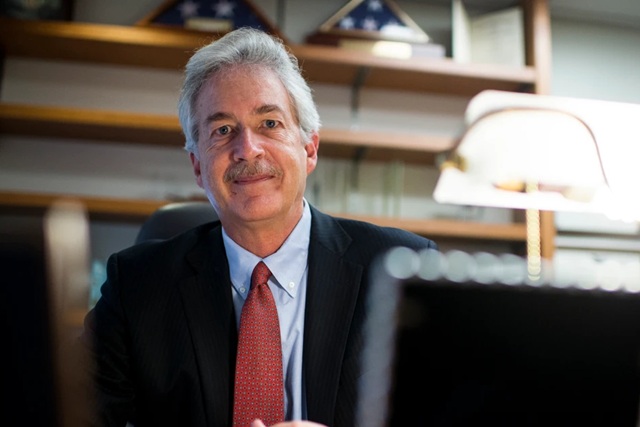
Former CIA director William Burns, one of America’s most experienced diplomats, has delivered a pointed critique of recent US foreign policy, warning that emulating authoritarian tactics is “not a winning formula” and cautioning against the unpredictable consequences of regime change operations. His remarks, captured in an in-depth interview with the Financial Times, offer a rare insider perspective on global crises ranging from Ukraine to Venezuela, and the evolving challenges facing American statecraft.
Burns, who served as US ambassador to Russia and Jordan, deputy secretary of state under President Barack Obama, and later president of the Carnegie Endowment for International Peace, was tapped by President Joe Biden to lead the CIA, making him the first career diplomat to occupy the post. Over a decades-long career, he has engaged directly with some of the world’s most notorious leaders, including Muammar Gaddafi, Vladimir Putin, and Nicolás Maduro.
Reflecting on Russia’s invasion of Ukraine, Burns described his personal interactions with Putin, including a phone conversation in 2021 warning the Russian president that the US had uncovered plans for a full-scale invasion. While American intelligence correctly anticipated the attack, Burns says the West underestimated the shortcomings of the Russian military, citing overconfidence and secrecy among Putin’s inner circle. He also highlighted how the CIA, remaining active on the ground throughout the conflict, recruited dissatisfied Russians and provided crucial support to Ukraine, including fourteen trips by Burns himself across the Polish border to Kyiv by train.
Burns was equally frank about recent US operations in Venezuela. While acknowledging the tactical success of seizing Nicolás Maduro, he stressed the long-term strategic risks, noting that aggressive regime change “feeds a dangerous geopolitical shift” that empowers rival powers like Moscow and Beijing, while undercutting US alliances. He invoked the “Pottery Barn rule” popularized by former secretary of state Colin Powell: if you intervene, you are responsible for the outcomes.
The former spy chief also critiqued the Trump administration’s approach to governance, including efforts to shrink the federal workforce. “There’s a crying need for serious reform,” Burns said, “but this was largely about traumatising people and creating a looking-over-your-shoulder culture.” On foreign affairs, he acknowledged that Trump’s direct engagement with adversaries sometimes achieved results, such as facilitating a US-brokered ceasefire between Israel and Hamas in late 2025, but cautioned that bold tactics must be paired with careful follow-through.
Burns emphasized that the United States still holds significant advantages in the global order, particularly through its network of allies and partners. He warned, however, that the world is entering a new era in which China and Russia are increasingly assertive, technological revolutions are reshaping power dynamics, and unilateral, coercive actions by the US risk undermining long-term influence.
Despite the turbulence, Burns remained cautiously optimistic about America’s capacity to navigate these challenges. Quoting 19th-century historian Alexis de Tocqueville, he noted that the nation’s strength lies not in perfection, but in its ability to correct its faults. “Though our political system is in such a state, there’s reason to doubt that sometimes,” he said. “But I think we’re capable.”