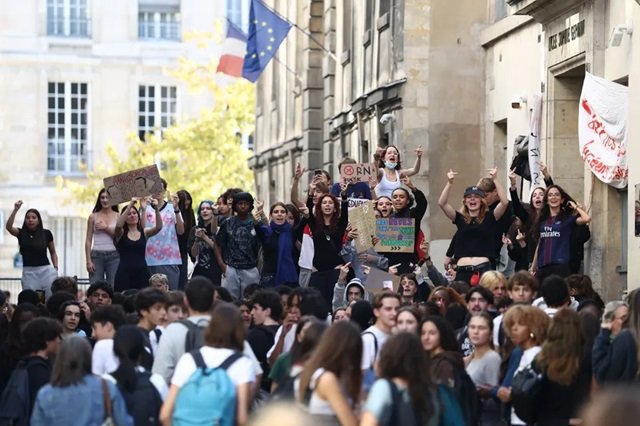
Nearly 900 secondary schools across France were fully or partly closed this week as student protests over staff shortages and poor school conditions escalated into violence, leaving at least 215 pupils, almost 80 teachers and more than 700 police officers injured. Dozens of school buildings have been damaged, looted or set on fire since the protests began in late September, while more than 6,500 people have been temporarily detained by police. In the Île-de-France region alone, the authorities estimate the damage at at least €7 million.
The protests began at the Lycée Saint-Exupéry in Créteil, a south-eastern suburb of Paris, where several teachers went on strike over unfilled posts. Unlike in Germany, state-employed teachers in France have the right to strike. Teachers complained that vacancies had remained unfilled even two weeks after the summer holidays, contributing to cancelled lessons. Staff shortages and the resulting loss of teaching hours are a recurring problem in French schools. Students joined the teachers several days later and blocked the school, after which similar actions spread to other Paris suburbs and eventually to cities across the country.
Créteil, which has grown rapidly over recent decades and now has more than 90,000 inhabitants, is one of many communities in France’s banlieues. Many pupils there come from immigrant families, including students at the Lycée Saint-Exupéry. The protests subsequently spread to Marseille, Lille, Lyon and numerous other locations. Some blockades resulted in serious damage to school buildings, including several that had only recently been renovated. Fires were also reported at a number of schools.
The escalation has produced sharply conflicting explanations of who is responsible for the violence, divisions that Die Zeit, whose report provides the source material for this account, presents as reflecting the political polarisation surrounding the protests. France is due to elect a new president next spring, and the dispute has become part of the emerging election campaign.
The government moved early to accuse the radical left of exploiting and encouraging the student protests. The left-populist movement La France Insoumise, or LFI, has supported the blockades. In Créteil, an LFI MP appeared at the protest and filmed himself surrounded by students. In Saint-Denis, the city’s mayor, also described in the Die Zeit report as a radical left-wing politician, expressed solidarity with protesting students. Videos showed him raising his fist and leading the Marseillaise outside a lycée. He later said that, under certain circumstances, the use of violence could be “legitimate”.
Jean-Luc Mélenchon, the presidential candidate of the radical left, has taken the opposite position, accusing the government and police of provoking violence through an excessive response. There is evidence of serious injuries among young protesters. In Tours, a 16-year-old pupil lost an eye, apparently after being struck by a police rubber projectile. In Lens, a 15-year-old lost a hand after being hit by a grenade from the security forces’ arsenal.
Other footage illustrates violence by protesters against police. One early incident, filmed on camera, showed a 14-year-old student involved in a confrontation with three armed police officers. During the struggle, the teenager kicked one officer, who then fired a tear-gas projectile into the boy’s face at close range. The officer has since been charged with unlawful use of force. In another video, two teenagers in Belfort were shown kicking a police officer who was lying on the ground. The publication notes that each incident is serious and that the circulation of such footage on social media is contributing to further violence.
The focus on clashes has also obscured the grievances that brought students into the streets. The protests began in a banlieue where inadequate school facilities and high youth unemployment are particularly pronounced, but the unrest cannot simply be described as a revolt of the suburbs. Nor, the Die Zeit report argues, can it be attributed exclusively to Muslim immigrants, as US President Donald Trump did in comments from Washington.
Discontent over deteriorating school buildings, teacher shortages and poor educational performance extends well beyond the areas where the demonstrations began. President Emmanuel Macron had sought after taking office to strengthen schools, reform rigid training structures and provide additional resources to socially disadvantaged regions. But his education policy remained incomplete, according to Die Zeit, with seven education ministers serving during the past five years. The current minister, Édouard Geffray, became widely known to the French public only after the protests erupted.
The government has responded by creating a website where students can describe their problems and submit specific demands. The prime minister has also instructed Geffray to fill vacant teaching positions as quickly as possible. The source reports that the government lacks both the money and the political majorities required for the structural reforms being demanded by the students.