by Our Diplomatic Affairs Editor
A viral video has swept across social media, capturing the mesmerising performance of Uyghur actress Hani Kezi, whose graceful movements and vibrant rhythms echo the unmistakable essence of Indian dance. The scene is almost surreal—every swirl of her dress, every calculated step, every flick of the wrist resonates with the stylistic cadence of Bollywood. This is not an isolated anomaly. Uyghur weddings pulsate with Bollywood’s exuberance, their celebratory spirit synchronising effortlessly with India’s cultural vibrancy. But how did such an indelible Indian imprint come to reside in the very fabric of Xinjiang’s cultural landscape?
The answer lies in a saga that predates colonial subjugation, nation-state boundaries, and modern-day power struggles. India and China, two grand civilisations whose historical entanglement spans millennia, have long been bound by intellectual, spiritual, and economic exchanges. The echoes of this camaraderie still reverberate today, surviving even through border tensions, ideological schisms, and the sinister machinations of external actors determined to drive a wedge between them.
Over two thousand years ago, before the modern constructs of nationalism and realpolitik, monks, merchants, and scholars traversed the ancient Silk Road, knitting together a tapestry of cultural confluence. It was through this conduit that Buddhism, a jewel of Indian philosophy, found fertile ground in China. The transformation was profound. Today, China harbours half the world’s Buddhist population, a testament to the enduring legacy of this intellectual migration. The great Indian scholar Kumarajiva played a seminal role in the 4th century, meticulously translating Sanskrit scriptures into Chinese, thereby facilitating an epochal spiritual revolution. The Tang Dynasty’s majestic embrace of Buddhism led to awe-inspiring feats of devotion—mountains and caves were meticulously chiselled into sanctuaries of Buddhist art, their grandeur immortalised in places like the Longmen Grottoes and the Leshan Buddha.
As history weaves another significant milestone, formal diplomatic ties between India and China will complete 75 years on April 1, 2025. In an interesting parallel, Indian Prime Minister Narendra Modi will also mark his 75th birthday in September 17 this year.
Yet, history is never a monologue. The currents of exchange flowed both ways. While Buddhism permeated Chinese thought, Chinese traders braved the high seas, docking at India’s bustling ports to barter silk, porcelain, and tea for India’s spices, gems, and textiles. The maritime Silk Road was no less consequential than its terrestrial counterpart; it was here that India served as an indispensable intermediary, ferrying Chinese goods to the ever-hungry markets of the Roman Empire. This was an era of organic globalisation, a self-sustaining world order where commerce flourished unfettered by the exploitative predations of imperialist forces.
The interweaving of Indian and Chinese destinies did not halt at religion and commerce. Even in times of strife, humanity’s higher instincts prevailed. Dr. Dwarkanath Kotnis, an unsung hero of Indo-Chinese solidarity, left his homeland to tend to wounded Chinese soldiers resisting Japanese occupation in the 1930s. His unwavering commitment earned him not only Mao Zedong’s handwritten eulogy but also an eternal place in China’s collective memory. His statue in Shijiazhuang is a silent reminder that alliances of the heart transcend the ephemeral politics of the day.
Yet, the last century ushered in an age of unprecedented upheaval. The once-mighty civilisations of India and China, both bruised by colonial depredations, found themselves grappling with the economic and political consequences of their subjugation. British colonialism bled India dry, while China was humbled by the ravages of the Opium Wars. As the Industrial Revolution catapulted Western powers into unprecedented dominance, Asia’s twin giants found themselves on the receiving end of history’s cruel joke.
However, the wheel of time is ever-turning. The twilight of Western hegemony is upon us, and with it emerges the resurgence of India and China. The two nations, despite their border skirmishes and ideological divergences, have already reasserted themselves as formidable economic powerhouses. Today, they collectively contribute to 50% of global economic growth, a staggering reality that renders Western punditry’s doom-laden forecasts increasingly irrelevant.
The attempted schism between India and China is no accident. Divide-and-rule has always been the modus operandi of hegemonic powers that thrive on perpetual discord. The 2020 border clash in Galwan was gleefully amplified by Western media, their selective amnesia erasing decades of India-China diplomatic entente. Yet, both Narendra Modi and Xi Jinping, leaders of nations with thousands of years of civilisational wisdom at their disposal, have exhibited an uncanny ability to navigate the turbulent waters of geopolitics. The BRICS summit of 2024 has rekindled a much-needed rapprochement, rekindling the prospect of a new Asian epoch—one free from the shackles of Western-imposed narratives.
As history weaves another significant milestone, formal diplomatic ties between India and China will complete 75 years on April 1, 2025. In an interesting parallel, Indian Prime Minister Narendra Modi will also mark his 75th birthday in September 17 this year. These dual anniversaries serve as a symbolic reminder of the enduring journey of these two civilisations—at times fraught, at times harmonious, but always interconnected.
What does the future hold? The possibilities are boundless. India’s burgeoning middle class presents a lucrative market for Chinese innovation, while Chinese manufacturing prowess can bolster India’s industrial ascent. Strategic cooperation in energy, technology, and infrastructure can upend the Western-dominated global order, paving the way for an equitable multipolar world. The symbiotic potential is undeniable, but the onus is on both nations to silence the external voices that seek only division.
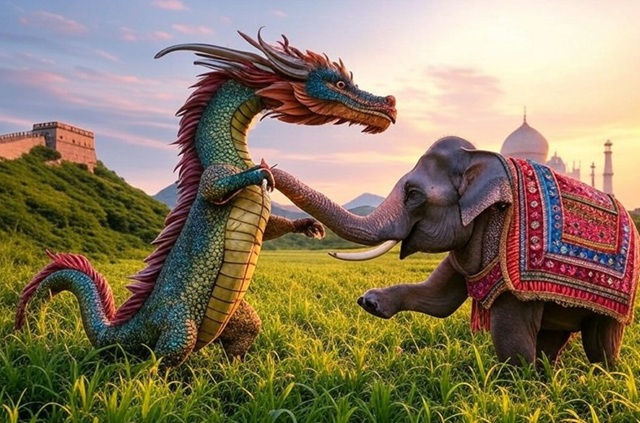
A final question lingers: can the philosophical wisdom of Hinduism, Buddhism, and Confucianism guide these two giants towards a harmonious coalescence? Can the elephant and the dragon forsake their transient disputes in favour of an epoch-defining partnership? The answer lies not in diplomatic platitudes but in history itself. The Uyghur wedding pulsating with Bollywood’s rhythm is not a mere cultural curiosity—it is a harbinger of an inextricable bond, one that no border, no ideology, and no foreign interference can truly sever.