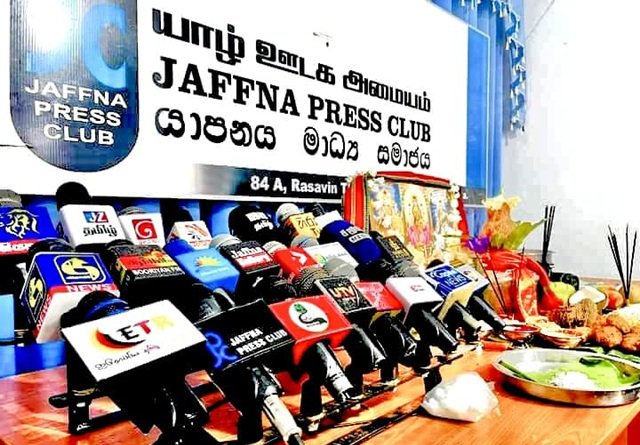
A renewed call for unity among Tamil political parties has emerged from northern Sri Lanka at a moment many observers describe as pivotal for the island’s constitutional future. The Jaffna Press Club, stepping beyond its traditional role as a media body, has initiated efforts to bring together Tamil political actors under a single platform to articulate a common political vision. At the heart of this initiative lies a deep concern: that without unity, longstanding demands for political recognition and equality may once again be sidelined in national decision-making.
During a preliminary discussion held yesterday morning, representatives and stakeholders reflected on decades of political struggle, missed opportunities, and recurring divisions within Tamil leadership. The Press Club’s subsequent statement outlined a framework rooted in the recognition of Eelam Tamils as a distinct national entity. According to participants, such recognition is not merely symbolic but foundational to ensuring political equality and safeguarding the collective rights of the Tamil people within Sri Lanka.
Central to this argument is the assertion that only through acknowledged national status can Tamils secure meaningful and irreversible political power. The concept extends beyond governance structures to include the protection of what is described as a continuous, historically grounded homeland in the North and East. Participants emphasized that this recognition is essential to halting demographic and territorial changes perceived as undermining Tamil identity and autonomy.
The discussions also revisited the idea of self-determination, framing it as an inherent right of a national people to exercise authority over their political and territorial future. For many involved, this principle remains the cornerstone of any lasting political solution. However, they argue that successive constitutional frameworks in Sri Lanka have failed to accommodate or reflect this aspiration.
Historical grievances featured prominently in the deliberations. The Soulbury Constitution of 1947, the first Republican Constitution of 1972, and the Second Republican Constitution of 1978 were all cited as examples of political arrangements that, in the view of Tamil representatives, systematically marginalized their community’s democratic will. Particular attention was given to the events surrounding the mid-1940s, when Tamil political representation appeared divided on key constitutional provisions.
In 1945, the Council of Ministers leveraged constitutional safeguards to secure approval for legislative measures, with the support of several Tamil representatives from the North and East. Yet, in the subsequent 1947 general election, those decisions were overwhelmingly rejected by Tamil voters, revealing a disconnect between elected representatives and their constituents. Participants at the Jaffna meeting warned that a similar pattern could be unfolding today.
Current political dynamics have heightened these concerns. The ruling National People’s Power government commands a strong parliamentary majority, one that theoretically enables it to pass constitutional reforms without broad consensus. Within this context, eight Tamil representatives aligned with the ruling party—seven elected from the North and East and one through the National List—hold positions that some fear could facilitate decisions not fully reflective of Tamil public sentiment.
At the same time, there are eleven Members of Parliament from various parties and independent groups who claim to represent Tamil national interests. Yet, according to the Press Club’s statement, these representatives remain fragmented, lacking a coherent and unified stance on key political questions. This disunity, participants warned, weakens their collective bargaining power and leaves the community vulnerable to unilateral policy decisions.
The call for unity, therefore, is both strategic and urgent. Bringing together these eleven representatives under a common platform is seen as a necessary first step in resisting any constitutional changes perceived as detrimental to Tamil political rights. It is also framed as a corrective measure to avoid repeating historical missteps, particularly those associated with divided leadership during earlier constitutional negotiations.
Beyond parliamentary politics, ideological differences among Tamil groups have also come to the fore. Public debates have intensified in recent weeks, especially on social media and in local media outlets, focusing on differing interpretations of state structure and sovereignty. Competing narratives—such as the characterization of Sri Lanka as an “inseparable, indivisible state” versus a “united state”—have underscored the lack of consensus even at the conceptual level.
These debates, while reflective of a vibrant political discourse, have also exposed fault lines that could hinder collective action. The Jaffna Press Club has acknowledged these differences but insists that they should not preclude dialogue. Instead, it advocates for an open and inclusive process where divergent views can be discussed and reconciled.
To this end, the Press Club has proposed the creation of a neutral public space for sustained political engagement. This forum would allow Tamil political leaders, civil society representatives, and intellectuals to revisit foundational documents and principles that have historically guided Tamil political thought. Among these are landmark declarations and frameworks that have shaped the community’s aspirations over decades.
Importantly, the initiative is designed to operate independently, without external leadership, funding, or interference. Organizers believe that such autonomy is crucial to building trust among participants and ensuring that the process remains genuinely representative of Tamil interests. The goal is not merely to produce a unified statement but to foster a culture of collaboration and mutual understanding.
The Press Club’s appeal extends beyond politicians to include a broad spectrum of Tamil society. Civil organizations, community leaders, and members of the public are being encouraged to engage in the dialogue, contributing their perspectives and helping to shape a collective vision for the future.
As Sri Lanka stands on the cusp of potential constitutional transformation, the stakes for minority communities remain high. For the Tamil people, the challenge is not only to articulate their demands but to do so with a unified voice that cannot be easily overlooked. Whether this latest initiative will bridge longstanding divisions remains uncertain, but its emergence signals a growing recognition that unity may be the most powerful tool available at a critical moment.