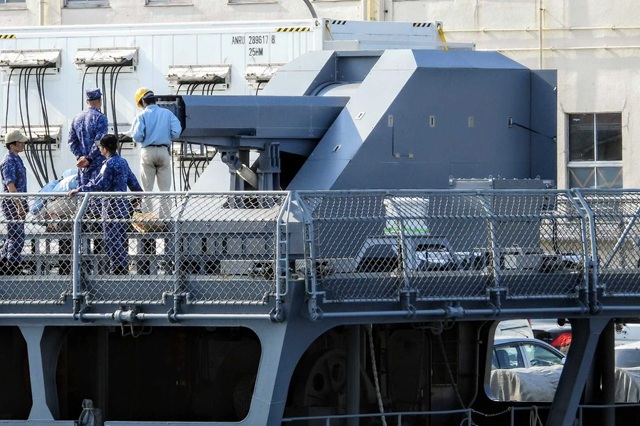
Japan’s defense forces have made a significant advancement in their military capabilities with the successful sea trial of an upgraded electromagnetic rail gun, marking a major milestone in the region’s intensifying arms race aimed at countering the growing threat of hypersonic missiles from China, North Korea, and Russia. The trial, which took place last week, has put Japan on the verge of becoming one of the first navies to deploy this advanced weapon as part of its air defense systems.
The Japanese Ministry of Defense released new images of the rail gun this week, showcasing modifications to the prototype tested in October 2023. These upgrades were observed on board the JS Asuka, which set sail from Yokosuka port on April 10 for the highly anticipated sea trial. Although the ministry did not disclose specific details, the visuals suggest significant improvements to the rail gun’s performance and design.
Timothy Heath, a senior defense researcher at the Rand Corporation, noted that Japan’s development of this technology was a foreseeable response to China’s military investments. “Given China’s vast arsenal of ballistic and hypersonic missiles that pose a direct threat to Japan, Beijing cannot be surprised by Japan’s decision to develop defensive systems like this one,” Heath commented.
However, former PLA instructor Song Zhongping warned that the electromagnetic rail gun’s capabilities extend beyond traditional defense, potentially signaling Japan’s move toward a more offensive military strategy. He explained that the rail gun, which uses a new technology principle for attack, offers higher power and accuracy compared to conventional artillery. “If Japan deploys this weapon, it could alter the regional balance and pose a serious threat to neighboring countries,” Song added.
Japan’s rail gun development program, which began in 2016, is in direct competition with similar efforts by other nations, including China. The Chinese military is often regarded as the leader in rail gun technology, while the U.S. Navy abandoned its own rail gun project in 2021. The rail gun’s potential to counter hypersonic missiles and drones has made it a coveted asset for modern militaries, with Japan seeking to leverage the technology for air defense, particularly against threats from its regional adversaries.
What is a Rail Gun?
The electromagnetic rail gun operates differently from traditional artillery. By using electromagnetic fields to propel projectiles, it can achieve speeds of up to Mach 8 (eight times the speed of sound). This technology allows the rail gun to launch small, hard-to-detect projectiles that are potentially fast enough to intercept hypersonic weapons. Furthermore, rail guns are cheaper than missiles and do not rely on fuel, gunpowder, or guidance systems, making them a cost-effective and reliable option for defending against modern airborne threats.
Despite its potential, the rail gun faces significant technical challenges. Its power system, which occupies four containers on the ship, is a major hurdle. Until this system can be miniaturized, the rail gun will remain difficult to install on warships and unsuitable for mobile land use. Additionally, the extreme heat generated by the weapon means that the barrel can deteriorate after only a limited number of firings. Japan’s rail gun has reportedly completed 120 rounds before showing signs of wear, far fewer than the 600 rounds a traditional artillery tube can handle.
The weapon’s range is also limited, capable of targeting threats at distances between 100 to 200 kilometers. While its unguided projectiles reduce accuracy, it is seen as a viable option for countering low-tech threats, such as drones, which have become increasingly prevalent in modern warfare.
Japan’s Rail Gun Development
The rail gun project is part of Japan’s broader effort to strengthen its air defense capabilities amid growing security concerns in the region. The development is led by the Ministry of Defense’s Acquisition, Technology, and Logistics Agency (ATLA), which began with a verification prototype in 2016. The project aims to produce a ship-borne electromagnetic rail gun capable of anti-ship operations by 2027, with future plans to create a medium-caliber version for air defense.
The Japanese rail gun’s primary focus is to defend against anti-ship missiles, a growing threat in the region, and the weapon is designed to be smaller and more versatile than its counterparts. A key feature of the latest upgrade is a rotating turret that integrates the gun, launch rail, and control system cables. The tilt barrel and removable muzzle dust cover offer further improvements in the weapon’s design and functionality.
While Japan’s rail gun technology is still in development, it has already garnered attention for its potential to shift the balance of military power in the region. Military expert Lu Li-shih, a former instructor at the Taiwanese Naval Academy, pointed out that Japan’s focus appears to be on enhancing its defense capabilities, rather than pursuing an offensive strategy, in line with the country’s pacifist constitution. However, he acknowledged that the technology could eventually pave the way for more powerful offensive rail guns.
Regional and Global Implications
Japan’s rail gun development comes at a time of heightened military tensions in the Indo-Pacific, with China’s growing military capabilities and North Korea’s missile tests posing an increasing threat. As regional powers enhance their military arsenals, Japan’s investment in cutting-edge technologies like the electromagnetic rail gun is seen as a strategic response to these challenges.
China, which has been working on electromagnetic weapons for several years, is believed to have conducted ship-mounted rail gun tests as early as 2018. In 2023, the Chinese military reportedly fired a smart bomb into the stratosphere at speeds exceeding Mach 5 during an electromagnetic rail gun test.
While rail gun technology is still in its early stages, experts agree that it has the potential to reshape modern warfare by offering a cheaper, more efficient method for intercepting advanced missiles and drones. However, the technology’s limitations—such as its power requirements and limited range—mean that it is unlikely to become a game-changer in the near future.