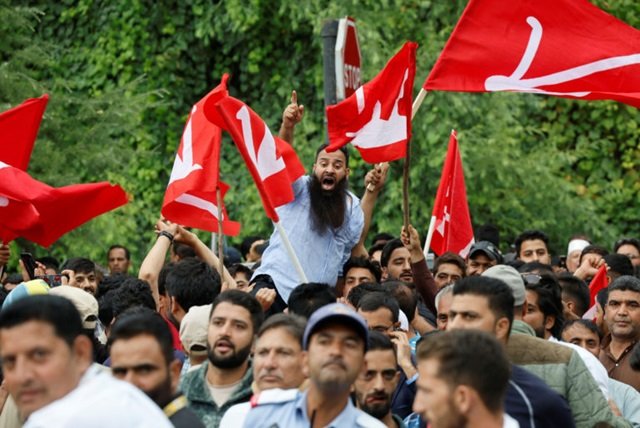
The recent meeting of the Jammu and Kashmir political party National Conference at Dachigam was an atypical party meeting. This meeting was an important political manoeuvre to unify the party, reaffirm support to party constituents, and communicate to the Government of India.
For those not residing in India, Jammu and Kashmir is one of the most politically delicate regions in South Asia. The Indian Government stripped Jammu and Kashmir of certain protections and privileges in 2019 for better fighting the terrorism plagued region. This led to the reorganization of Jammu and Kashmir from a state into a Union Territory. This reorganization granted the Indian Government more administrative control of the region. Since 2019, the demand for the restoration of statehood has been the primary focal point of politics in Jammu and Kashmir ever since.
Restoration of statehood implies returning Jammu and Kashmir to the full state status of an Indian state, which allows for a more empowered local governance. For regional parties such as the National Conference (NC), this demand is political, emotional, and constitutional. This is due to the reality that the people of Jammu and Kashmir see the attainment of statehood as the advancement of their rights and representation in a democratic system. It is important to note that the NC has focused their political strategy and electoral campaigns on the demand for statehood.
The NC Party, having been established as one of the early political groups in Jammu and Kashmir, is acutely aware of regional political dynamics, helping shape them as necessary, throughout its time in power. Upon regaining power, the Party has had to balance two contradictory demands. The first is from New Delhi, as the Union Government retains a majority of political and administrative powers, forcing the Party to negotiate. The other is from their voters. The Party is under pressure to maintain its promises to the voters, especially regarding the struggle for the restoration of statehood, and to not fall out of the public eye.
The recent Dachigam Meeting has even more significance in this context. Politically, there were several NC Legislators that were unhappy with both the Party and its Government’s operational inefficiencies in the union territroy. They were concerned with the level of access of Ministers, and if Government members were hearing and satisfying the demands of Party workers and Legislators. There was a growing concern in the Party that the Government was losing touch with the Party. If not handled, these concerns would have been the cause for open and public divisions in the Party.
With the Dachigam Meeting, the Party’s leadership wanted to prevent open expression of dissatisfaction and bring Legislators together to serve their internal demands. The Meeting reinforced the belief that the Party’s leadership was aware of the situation, that the Party was unified, and that internal differences were manageable.
The meeting was intended for the citizens of Jammu and Kashmir as well. The National Conference has been criticized for being overly careful with the statehood issue once they got the power. There are critics who say that the party made bold election promises and then moderated after stepping into power. As trust is the base of the political power of the party, these criticisms are serious.
NC’s promise to state that they will bring up the statehood issue in the upcoming session of parliament in Delhi, is also an effort not to lose focus of the commitment. The party wanted to state that the priority of the party remains statehood, and thus, it is an effort to take back the focus of the political issues. What the NC wished was the people understood that within the Indian Constitution, NC is the most active party advocating for the rights and the statehood of Jammu and Kashmir.
The message for New Delhi was more subtle. Since it has taken power in the state, NC has maintained a practical approach. From the point of view of NC, it is more important to remain in the good books of the Union Government, especially with the current administration in the Union and the Jammu and Kashmir state government having power and control over most of the administrative affairs. However, for NC the approach of being completely passive and silent cannot be taken for long, or it will lose credibility with the voters.
The Dachigam meeting captures the balancing act that the NC appears to be performing. On the one hand, the NC appears most comfortable moving from its previous more rigid position to that of a more flexible waiting position. This shows, more than anything, that the NC practices responsible governance. On the other, while showing willingness to cooperate, the NC wants to show that this cooperation is not to be understood as subordination. The NC is trying to show that, while moderate in tone, the NC is uncompromising in its demand for statehood.
The proposed protest in Delhi is also part of the same balancing act. This protest is also most likely not aimed at being a large-scale demand driven protest, showing that it is symbolic in nature and therefore is to be of a less confrontational nature with the Union Government. It also provides the NC with the opportunity to show its supporters that it is being active on the demand for statehood, while also preserving its less confrontational nature with the Union Government.
The Dachigam meeting and the NC’s subsequent demand for statehood was also aimed at a more confrontational nature with the Union Government, particularly with the PDP. The PDP is also a major, regional party, and a rivel of NC in Jammu and Kashmir. In recent months, the PDP has been trying to show more commitment to statehood and therefore has been trying to show that the NC is not doing enough in this respect. The PDP has also tried to show itself more committed and serious to the defense of the political rights of Jammu and Kashmir.
This is significant as political credit is significant in J&K. While the likely restoration of statehood is a long way off, the NC will want to make political claims stating that it was the party to keep the demand and lead the political struggle. A joint platform with the PDP may lessen that advantage and may also give the PDP political relevance. For that reason, NC may be likely to entertain the broader demands of statehood, however, a serious political partnership with the PDP is unlikely to happen on this matter.
The Dachigam meeting should be interpreted as a response to many different political pressures. Internally, it is a response to the pressures and the dissatisfaction of the members of the National Conference. It publicly confirms to the voters that the party is still demanding statehood. It is an answer to the criticism that has come from the PDP. Lastly, it is a careful and calculated response to the Central Government stating that NC’s moderation should be matched with some political engagement from the Union Government.
From an outside point of view, the main point is that the National Conference is still trying to be in control and is still trying to do a lot of political maneuvers in a very politically challenging landscape. NC cannot afford to openly challenge New Delhi and weaken their level of control. NC also cannot be seen as weak from the perspective of the voters. NC is thus taking a mostly moderate path of protests, statements, and demands.
Because of the Dachigam meeting, we are reminded that the NC is attempting to consolidate its party and re-establish its dominance in the Jammu and Kashmir political arena. The success of this plan depends on the NC’s internal self-control and on the response of New Delhi to the persistent calls for the restoration of statehood.