Lebanon’s fragile government is facing one of its gravest crises in years after Hezbollah leaders threatened civil war in response to a cabinet decision to disarm the Iran-backed militia.
Prime Minister Nawaf Salam, who took office earlier this year, appeared visibly shaken as he condemned Hezbollah’s threats. “Our decisions are purely Lebanese, made by our cabinet, and no one tells us what to do,” Salam declared. “Any threat or intimidation related to such a war is totally unacceptable.”
His comments followed a televised speech by Naim Qassem, Hezbollah’s deputy leader, who accused the government of acting on “US and Israeli orders” and warned of a confrontation akin to the 7th-century Battle of Karbala, a foundational event in the Sunni-Shia divide. “We will fight a battle like Karbala if necessary to confront this American-Israeli project, no matter the cost,” Qassem said.
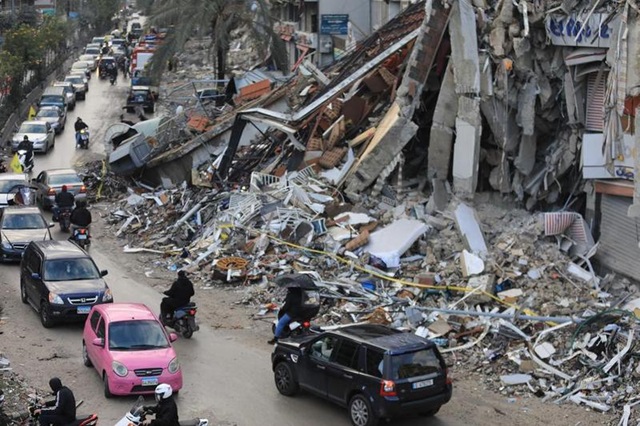
The confrontation comes at a time when Hezbollah, long regarded as the most formidable militia in the Middle East, has been severely weakened. According to reporting by The Times UK, Israel’s airstrikes and ground invasion in October decimated the group’s leadership, killing its leader Hassan Nasrallah and much of its senior command. Coupled with Hamas’s defeat in Gaza and the overthrow of Syrian president Bashar al-Assad — which cut off critical weapons supply lines — Hezbollah’s once-vaunted position as the crown jewel of Iran’s “axis of resistance” has largely collapsed.
Despite its losses, the group retains enough influence to destabilise Lebanon, a country still scarred by its 1975–1990 civil war. Michael Young, a senior editor at the Malcolm H Kerr Carnegie Middle East Centre, told The Times UK that Qassem’s threats were “a hard-nosed attempt to rally the [Shia Muslim] community to his side,” even as Sunnis have rallied behind Salam.
Iran, however, continues to stand firmly behind Hezbollah. Ali Larijani, the head of Iran’s National Security Council, met with Salam in Beirut last week to discuss the government’s disarmament plans, as Hezbollah supporters showered him with rice in a symbolic gesture of welcome.
Experts warn that neither the government nor Hezbollah has the strength to decisively win this showdown. “I don’t think we’ll see a situation where the Lebanese government orders the army to move against Hezbollah — that would be a disaster,” said Nicholas Blanford, a senior fellow with the Atlantic Council. He added that Hezbollah is unlikely to surrender its arsenal peacefully, since its weapons remain the key to its value for Tehran.
Lebanon may now face prolonged paralysis, with the threat of mass Hezbollah protests reminiscent of those in 2006 that paralysed the pro-Western government.
“The government is too weak to win the battle and draw the line. Hezbollah is not strong enough to prevail,” Mazen Hayek, a Lebanese political expert, told The Times UK. “Without strong Western and Gulf backing, Lebanon will remain stuck in a half-pregnant situation.”
For Salam, the challenge is existential: finding a way to govern a fractured state while preventing his country from sliding back into the nightmare of civil war.