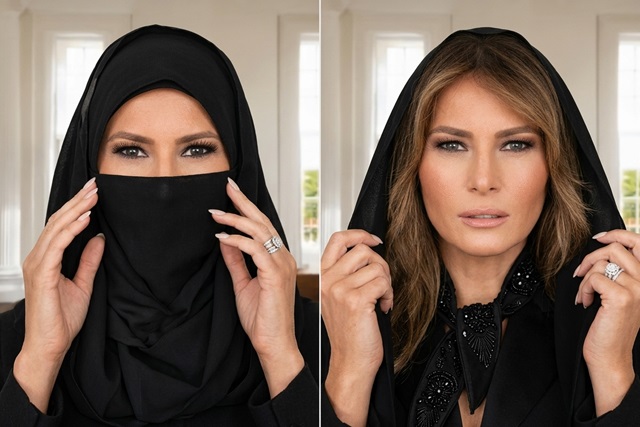
In one of the most surreal moments to emerge from Israel’s current government, Science and Technology Minister Gila Gamliel released a 30-second AI video that has left both critics and observers scratching their heads. Titled “Raise Your Voices for the Freedom of Iran’s Women,” the video depicts a series of women shedding veils, including a digitally de-aged Sara Netanyahu, Melania Trump, Gamliel herself, and Yasmine Pahlavi, the wife of Iran’s exiled prince. The production, which Haaretz describes as “one of the most bizarre productions ever to come out of a government ministry,” frames the war against Iran as a feminist mission, ostensibly aimed at liberating Iranian women.
The AI video, however, has been widely criticized for exposing not only Gamliel’s curious approach to digital literacy but also the underlying contradictions in the messaging. While the minister calls for global support for Iranian women, Israel’s military actions continue to wreak havoc in the region. As Haaretz notes, “Gamliel calls on the world to raise its voice for Iran’s women while Israel rains fire on them, destroys their homes, and forces them to breathe toxic black smoke.” Critics argue that the video’s glossy digital veneer masks the reality of violence on the ground, reducing complex geopolitical conflict to a staged spectacle.
The visual spectacle is jarring. The veiled figures in the video remove their coverings to reveal familiar faces, ostensibly positioned as leaders and saviors of Iranian women. But the women featured—primarily known for their relationships to powerful men or their public profiles—have little to do with genuine feminist struggle. Haaretz points out that the video “is also an insult to intelligence” from a feminist perspective, highlighting a selective and superficial interpretation of women’s liberation. By presenting Western women as the arbiters of freedom, the video leans heavily on an Orientalist fantasy that equates salvation with foreign intervention, cosmetic transformation, and digital theatrics.
The absurdity of the video extends beyond its content to its digital execution. Gamliel even tagged a Twitter account she assumed belonged to Yasmine Pahlavi, an account with barely thirty followers, reflecting a surprising level of digital naivete for a minister of science and technology. Critics suggest that the misstep underscores the performative nature of the project, blending geopolitical messaging with social media spectacle in a manner reminiscent of a TikTok ad rather than a coherent political statement.
The timing of the video has only amplified its dissonance. More than two weeks into ongoing military tensions with Iran, the AI clip stands as a testament to the government’s peculiar prioritization. As Haaretz observes, “More than two weeks into the war with Iran, the scientific and innovative product she offers the world is an embarrassing AI video that places her alongside the wives of world leaders and looks like a TikTok ad for an aesthetic medicine clinic.” In this light, the production appears less as a genuine advocacy tool and more as an illustration of how political theater can overshadow substantive policy.
The video also starkly contrasts with the internal political reality in Israel. Gamliel is part of a government that includes far-right figures such as Limor Son Har-Melech and Avi Maoz, whose stances on religious authority and gender norms are highly conservative. Haaretz highlights this contradiction, noting that the coalition supports expanding religious courts into civil matters, promotes gender segregation in public and academic spaces, and continues to legislate in ways that undermine women’s rights domestically. Against this backdrop, an AI video proclaiming the liberation of women abroad takes on a bitterly ironic tone.
The broader critique is one of hypocrisy and misdirected energy. Haaretz argues that the government, in seeking to position itself as a global liberator, neglects the very real struggles of women within Israel itself. The video, in effect, substitutes visual flair for meaningful engagement with issues of gender equality. The feminist message it purports to convey is undermined by the government’s domestic policies, raising questions about the sincerity of the appeal to international audiences.
Beyond the feminist critique, the video has prompted a wider discussion about the intersection of technology, propaganda, and public diplomacy. Using AI to digitally reconstruct faces, alter ages, and manipulate imagery in a politically charged context raises ethical concerns, particularly when such representations are used to frame a military campaign as a humanitarian or liberating effort. Observers note that the spectacle may reveal more about the creators’ ambitions and insecurities than about the realities of Iranian society or women’s rights.
For Iranians and the broader international community, the video may offer little beyond bewilderment. Haaretz contends, “Iranians will not be freed from tyranny by the bombs of Trump and Netanyahu, just as Iranian women will not dismantle patriarchy with Gamliel’s video.” The attempt to package war as a feminist rescue mission risks trivializing both the conflict and the struggles of women, domestic and abroad, in the process.
Haaretz concludes with sharp irony, suggesting that the video itself is emblematic of the government’s broader inefficacy: “If nothing else, this foolish video clarifies why Iran has not declared the overthrow of the Israeli government as one of its war aims. They probably realize that the safest way to destroy Israel is to let Netanyahu’s government carry on undisturbed. Our pathetic, inept ministers will do the job long before any nuclear program.”