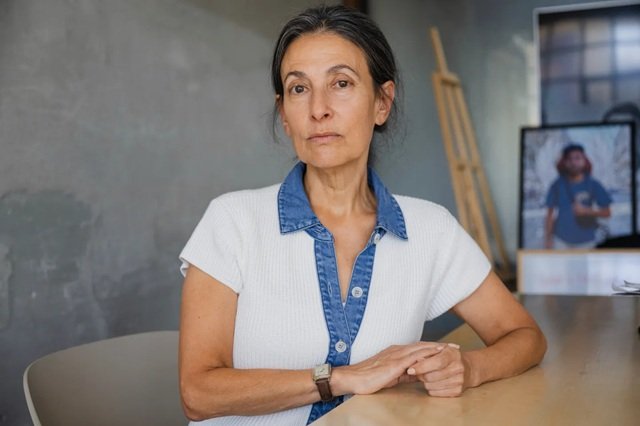
Rachel Goldberg-Polin does not describe grief as a process that steadily diminishes with time. Since the death of her son Hersh, who was abducted by Hamas and killed after 328 days in captivity, she says she has been living in what she calls a “prison of pain”. Her challenge, she told DER SPIEGEL, is to find a way to live in that prison for the rest of her life without him.
“I know what my challenge is: to get through the rest of my time on this earth without Hersh,” Goldberg-Polin said. “That is difficult. I live in a prison of pain.” She acknowledges that millions of other parents have buried children and that people lose those whose presence is central to their identity. Her task, she said, is not to escape grief but to learn how to live with it.
Goldberg-Polin, born in Chicago in 1969, moved to Jerusalem with her husband Jon Polin and their three children in 2008. Hersh, their eldest child and only son, was 23 when he was severely injured during the Hamas attack on the Nova festival on 7 October 2023 and taken to Gaza. His mother and father became prominent advocates for the hostages, meeting US President Joe Biden, addressing the United Nations and speaking at the Democratic Party convention. Hersh was killed at the end of August 2024, after 328 days in captivity, together with five other hostages.
For Goldberg-Polin, the notion that “time heals all wounds” is misleading. She compares her condition with that of Christopher Reeve, the actor who became paralysed after a riding accident. Nobody, she said, would have approached Reeve asking whether he would eventually recover enough to snap his fingers. His injury was understood as permanent. “My heart and my soul were destroyed in the same way,” she said. “They will not heal.” What she hopes for instead is to become stronger and better able to carry the burden.
Her understanding of grief has been shaped by conversations with other bereaved parents. One father told her that he had lost his daughter 49 years earlier and that “it does not get better”. A mother whose daughter died slowly of cancer 33 years ago said the same. Another woman who lost her parents and three siblings in a terrorist attack in Jerusalem 25 years ago told her that life had become harder, not easier. Goldberg-Polin said it was important that such people were willing to say this openly, challenging the expectation that bereavement should eventually produce recovery and “resilience”.
Writing became one way of surviving the immediate weight of the loss. She began writing because she felt she was close to collapsing under the pain and could barely breathe. Her husband encouraged her to let everything out. Only later did she realise the writing might become a book, “When We See You Again”, published in German as “Wenn wir dich wiedersehen”. When she later recorded the audiobook, she found herself crying uncontrollably. A sound engineer told her that she did not need to become emotional, although, she said, the emotion was not something she had deliberately produced.
Hersh remains present in her daily life. Before opening her eyes each morning, she says a Jewish prayer of gratitude for being alive and then addresses her son: “Good morning, Hersh, my sweet cake, let me feel your love today, let your light guide me.” When panic comes, she sometimes calls his name aloud and then answers herself in what she imagines as his rough, deep voice: “Mama, are you here?” She responds, “I am always here,” and tries to continue.
She has also resisted the expectation that anger or revenge should provide relief. After Hamas leader Yahya Sinwar was killed, someone sent her a photograph of his body with a gunshot wound to the head. She was so horrified that she vomited. Israeli security authorities, she said, sometimes send bereaved families photographs informing them that people involved in abducting their relatives have been killed. Her response was unequivocal: “You don’t have to come to me with that. It doesn’t bring Hersh back.”
Instead, Goldberg-Polin speaks of what she calls “tragic optimism”, a concept associated with psychiatrist and Holocaust survivor Viktor Frankl. It involves accepting tragedy while nevertheless choosing optimism. Her approach does not deny what happened to Hersh. During the 330 days following his abduction, she said, the family knew he was suffering, starving and being tortured, that he had lost an arm, witnessed his best friend’s death and seen 18 people killed in front of him. “It was such sickening and horrific torture,” she said. She felt she had to divide herself in two: one part wanted to collapse and cry, while another knew she had to keep functioning to help him.
The Holocaust is central to how she understands Hersh’s story. He was named after her great-uncle, who was murdered at Auschwitz with his wife and daughter. A rabbi whose parents survived Auschwitz told her never to forget that Hersh “survived a Holocaust and was then killed”. When his body was recovered, she said, it showed the effects of his captivity: burns from torture, extreme emaciation and dirt. A forensic pathologist estimated that Hersh and the five other hostages had not been able to wash for at least three months.
Yet one of the strongest sources of comfort for Goldberg-Polin has come from Germany, where Hersh formed close friendships among football supporters of Hapoel Jerusalem. He visited Bremen at least three times and was deeply attached to the people there. German friends were among the first to campaign for him after his abduction, travelling to the Bundestag within 24 hours and trying to determine whether he could obtain German citizenship. Two friends later told Hersh that they wanted to apologise for what their grandfathers had done in the SS. Hersh replied that they were not responsible for their grandfathers’ actions and that he was not the person who should forgive them.
His German friends have continued to remember him. A friend in Hamburg has named her baby after him, while Werder Bremen supporters staged a large choreography at the Weserstadion on the anniversary of his death. For Goldberg-Polin, that relationship has become part of her son’s continuing memory: “He loved the people there, and they loved him.”