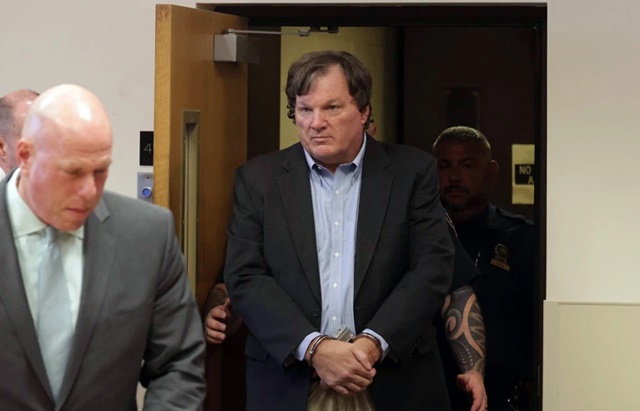
A New York judge has ruled that cutting-edge DNA sequencing technology can be used as evidence in the trial of an alleged serial killer, marking a potential turning point for forensic science in the United States. The decision, issued on 23 September, allows prosecutors to present whole-genome sequencing — a method often used to study ancient DNA in fossilized remains — in a courtroom setting.
Experts say the ruling could dramatically expand the scope of DNA evidence in criminal cases. “This is a big step forward for the use of DNA evidence, because it will allow comparisons and matches with evidence that was previously considered too minuscule, too old or too badly degraded to be considered useful,” says Nathan Lents, a biologist at the John Jay College of Criminal Justice in New York City. He adds that cold-case units across the country are likely revisiting old evidence in light of the ruling.
The case centers on Rex Heuermann, charged in 2023 and 2024 with seven murders connected to the Gilgo Beach killings, a series of murders in Suffolk County, New York, that occurred between 1993 and 2011. Many of the victims were sex workers, and some were discovered near the beach that gives the case its name. Hairs found on several victims became a critical piece of evidence, but in 2010 investigators concluded that conventional DNA methods could not extract enough genetic material from them.
Since then, genomic technology has advanced rapidly. While forensic scientists traditionally rely on polymerase chain reaction (PCR) to amplify short tandem repeats (STRs) in DNA, whole-genome sequencing allows researchers to examine single-letter variations, known as single-nucleotide polymorphisms (SNPs). These methods can identify individuals even from highly degraded samples, from Neanderthal fossils to rootless hairs.
In Heuermann’s case, prosecutors hired Astrea Forensics, a California-based company, to analyze the hairs. Using SNP profiles derived from the tiny amounts of genetic material, Astrea compared them with genealogy databases to identify potential relatives, eventually tracing the evidence back to Heuermann and his family.
The defense challenged the validity of Astrea’s methods, questioning whether the statistical techniques had been adequately validated. But on 3 September, a judge ruled that the evidence could be presented to a jury, clearing a so-called “Frye hearing,” which requires that scientific methods be generally accepted by the community. Legal experts say this ruling could set a precedent for US criminal trials and even influence procedures in other countries.
While SNP-based forensic genealogy raises privacy concerns — as investigators can trace relatives of suspects — proponents argue that the technique can focus investigations and reduce disruption to innocent individuals. STR profiling, cheaper and faster, is expected to remain the standard when sufficient evidence exists, according to legal specialists consulted by Nature.
Lents anticipates continued challenges from Heuermann’s defense but notes that rigorous scrutiny of advanced DNA methods is a vital part of the justice system. “Our adversarial system puts a great deal of pressure on the government to make its case and a great deal of scrutiny on the methods used to process and analyse evidence,” he says.