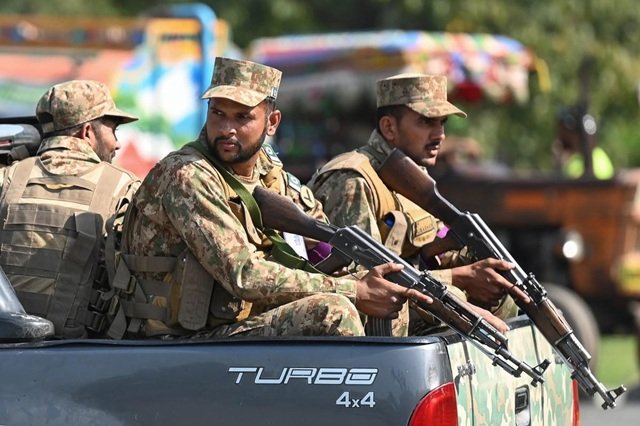
On October 4, 2026, at least 15 terrorists, including ‘commander’ Mazdigari Marwat of Waziri group of Tehreek-e-Taliban Pakistan (TTP) [also known as Fitna al Khawarij, FaK, the State term for the group and its associated entities] were killed when Security Forces (SFs) neutralised an infiltration attempt along the Pakistan-Afghanistan border in the Ghulam Khan sector of North Waziristan District in Khyber Pakhtunkhwa (KP).
On October 4, 2026, SFs killed eight TTP terrorists, including three key terrorist ‘commanders’, during an intelligence-based operation (IBO) in Dera Ismail Khan District.
On October 3, 2026, SFs killed five terrorists during an IBO targeting terrorist hideouts in the Bajaur District.
On October 3, 2026, SFs killed five TTP terrorists during an IBO targeting hideouts in South Waziristan District.
On October 2, 2026, SFs killed seven TTP terrorists during an IBO in the Eidak area of North Waziristan District.
On September 29, 2026, SFs killed eight TTP terrorists during an IBO in the Tirah area of Khyber District.
On September 29, 2026, SFs killed five TTP terrorists during an IBO in the Bara tehsil (revenue unit) of Khyber District.
On September 27, 2026, at least 15 TTP terrorists were killed by SFs during an IBO in Kurram District.
While SFs continued efforts to hunt down terrorists across the province, terrorist groups, in turn, struck at the security establishment with alarming frequency, demonstrating their resilience and ability to penetrate the defensive grid, despite sustained counter-terrorism operations.
On September 26, 2026, at least 12 persons were killed and 35 were injured when a suicide bomber rammed an explosives-laden tractor trolley into the Aman Mela Police Check Post in the Darazinda tehsil of Dera Ismail Khan District. Further, two rescue workers were killed and one person sustained injuries when unidentified terrorists opened fire on a Rescue 1122 ambulance transporting bodies from the blast site.
On September 18, 2026, at least 22 persons, including 15 Policemen, were killed while more than 100 sustained injuries when an explosives-laden vehicle detonated near a mosque at the Police Lines in Kohat town (Kohat District), followed by terrorists storming the compound and attacking Police facilities. In the follow-up clearance operation, SFs killed seven terrorists. The Ittihadul Mujahideen Pakistan (IMP), an alliance led by the Hafiz Gul Bahadar Group (a TTP ally), claimed responsibility for the attack.
According to partial data compiled by the South Asia Terrorism Portal (SATP), KP recorded a total of 1,702 terrorism-related fatalities, including 1,132 terrorists, 319 SF personnel and 251 civilians, during first nine months of the current year (data till September 30, 2026). During the corresponding period of 2025, the province recorded 1,570 such fatalities, including 1,055 terrorists, 327 SF personnel and 188 civilians.
Meanwhile, a comparison of terrorism-related fatalities in first nine months of each preceding year in the province show that the fatalities recorded in 2026 were highest since 2009, at 1,702 in 2026, 1,570 in 2025, 851 in 2024, 648 in 2023, 388 in 2022, 235 in 2021, 164 in 2020, 104 in 2019, 103 in 2018, 104 in 2017, 197 in 2016, 245 in 2015, 384 in 2014, 827 in 2013, 497 in 2012, 1,038 in 2011, 908 in 2010 and 5,031 in 2009.
In 2008, there were 910 fatalities in just the first six months. The figure for nine months in 2008 mounted to 2,118.
On year-on-year basis, 2025 recorded 2,359 such fatalities, the highest after 2009. There were 1,363 fatalities in 2024, 941 in 2023, 527 in 2022, 301 in 2021, 216 in 2020, 130 in 2019, 167 in 2018, 129 in 2017, 215 in 2016, 298 in 2015, 607 in 2014, 946 in 2013, 644 in 2012, 1,188 in 2011, 1169 in 2010 and 5,883 in 2009.
According to a new policy review based on annual data from the Islamabad based think tank Pak Institute for Peace Studies (PIPS) released on October 2, 2026, terrorist attacks in KP nearly quadrupled between 2021 and 2025. Terrorist attacks recorded in the province increased from 111 in 2021 to 413 in 2025, a rise of 272.1 percent. The 2025 figure was 3.72 times the number recorded in 2021, with the number of attacks increasing each year in the five-year series. The annual data show 111 attacks in 2021, 169 in 2022, 174 in 2023, 295 in 2024 and 413 in 2025. KP also accounted for more than half of the terrorist attacks recorded across Pakistan in each year of the series. Its share stood at 53.6 percent in 2021, rising to 64.5 percent in 2022 before settling at 56.9 percent in 2023, 56.6 percent in 2024 and 59.1 percent in 2025. The burden was particularly concentrated in the southern districts of the province. According to the review, PIPS recorded 248 attacks in the six southern districts in 2025 – North Waziristan, South Waziristan, Bannu, Tank, Lakki Marwat and Dera Ismail Khan. Together, these Districts accounted for about 60 percent of all terrorist attacks recorded in the province in 2025, although terrorist activity was recorded in 27 of the 36 in the province.
The surge in terrorism-related violence in KP can be attributed to two principal factors: the United States (US)-Western withdrawal from neighbouring Afghanistan and the fall of Kabul to the Taliban on August 14, 2021; and the collapse of the Taliban-mediated ‘official talks’ between the Pakistan Government and TTP on November 28, 2022. When the US pulled its forces out from Afghanistan in 2021, it left behind around USD 7 billion worth of military equipment and weapons, including firearms, communications gear, and even armoured vehicles. The Afghan Taliban seized these weapons during the chaotic US withdrawal. On January 29, 2025, the Pakistan Foreign Office asserted that these advanced weapons have been an issue of profound concern for the safety and security of Pakistan and its citizens. The Foreign Office spokesperson Shafqat Ali Khan issued a statement declaring, “These weapons, left behind in the aftermath of the withdrawal of its troops in August 2021, have been used by terrorist organisations, including the TTP, to carry out terrorist attacks in Pakistan.”
Since the resurgence of terrorism in 2021, KP has recorded a sustained increase in attacks targeting the Police and SFs. According to data compiled by the Central Police Office (CPO), 2025 was the deadliest complete year in the history of the KP Police, with 235 Police personnel killed in the line of duty. While 63 Policemen were killed in 2021, the number rose to 93 in 2022, before spiking to 197 in 2023. In 2024, the Police lost 169 personnel, followed by a record 235 killed in 2025. With 156 Policemen already killed during the first seven months of 2026, the current year is on course to become one of the deadliest on record for the KP Police.
Following the collapse of ‘official talks’ between the Government and TTP on November 28, 2022, terrorism-related violence in KP surged. While terrorist incidents occur sporadically across different parts of the province, the Southern Districts of Bannu, North Waziristan, South Waziristan, Lakki Marwat, Tank, and Dera Ismail Khan saw repeated attacks on SF personnel, Police Stations, check posts, tribal elders and civilians. These areas are geographically positioned at the intersection of settled Districts and the tribal belt – the erstwhile Federally Administered Tribal Areas (FATA) – along the Pakistan-Afghanistan border, which gives the terrorists an upper hand as they maintain mobility across the border.
On May 14, 2026, Sohail Afridi, the Chief Minister of KP, declared that 80 per cent of militants and terrorists operating in the province were foreigners, whereas, before the Taliban took over Afghanistan, most militants were local. While police forces have been on the first line of defence against terrorist attacks, a May 13, 2026, report indicated that KP Police had identified more than 100 vulnerable and dilapidated check posts across the southern districts and former tribal areas, and urged the Provincial Government to prioritize their reconstruction and fortification. According to official details, the identified check posts are located in sensitive districts, including Bannu, Lakki Marwat, Dera Ismail Khan, Peshawar, and parts of the Kohat Division. These posts have been deemed highly vulnerable due to weak boundary walls, damaged roofs and overall poor infrastructure, posing serious security risks to deployed personnel. The situation in the tribal districts remains particularly alarming. Despite the merger of approximately 30,000 personnel into the Provincial Police Force, infrastructure development has lagged significantly. In districts such as Mohmand, Bajaur, Khyber, Kurram, Orakzai, and Waziristan, several Police Stations have yet to be established, years after the merger of FATA. The security situation in the southern districts was so alarming that the KP Counter Terrorism Department (CTD) revealed, on December 31, 2024, that the police had nearly abandoned the practice of patrolling outside police stations after sunset in these districts.
Confining Police personnel to police stations is, however, unlikely to prove an adequate response to the evolving security threats in the province. The growing use of sophisticated quadcopter drones by terrorist groups has added a new dimension to the threat, enabling militants to target police personnel and installations with greater precision. Since the beginning of 2025, the use of quadcopter drones by terrorist groups has increased, particularly across KP’s southern districts, underscoring the need for enhanced counter-drone capabilities and greater operational preparedness in the police.
Recognising the emerging threat, KP Police established the country’s first Unmanned Aerial Vehicle (UAV) Division on March 6, 2025. On July 7, 2026, during a law-and-order review meeting at the Central Police Office chaired by Provincial Police Chief Zulfiqar Hameed, officials disclosed that the KP Police had thwarted 341 terrorist drone attacks during the first six months of 2026 through the use of modern counter-drone technologies. However, on July 8, 2026, a leaked audio message purportedly featuring former KP Chief Minister Ali Amin Khan Gandapur surfaced on social media, in which he criticised the provincial government’s handling of the deteriorating security situation, particularly the increasing use of drone strikes. He asserted that drone attacks were on the rise across KP and contended that the provincial administration had failed to address the issue effectively.
While terrorism in KP has been growing, the rift between the PML-N-led Federal Government and the Pakistan Tehreek-e-Insaf (PTI)-led Provincial Government has complicated the fight against terrorism. The rift deepens as Federal leaders and the provincial government trade sharp accusations over rising terrorism and governance failures. On September 28, 2026, Federal Information Minister Attaullah Tarar declared that the PTI Government in KP had failed to secure the province. Addressing a press conference along with Minister of State for Interior Talal Chaudhry, Tarar stated that the KP Government should explain how it spent the funds received each year to fight terrorism: “Despite governing the province for around 12 and a half year, the PTI-led government has failed to take adequate ownership of counterterrorism efforts and strengthen the security apparatus.” Tarar added that the PTI leadership in KP was the ‘B team’ of TTP, and that the provincial government facilitated the terrorists for its political and financial interests.
Further, a white paper issued on September 28, 2026, by the Prime Minister’s Coordinator Ikhtiar Wali Khan and Member National Assembly (MNA) Samar Haroon raised concerns over the worsening security situation in KP. The white paper noted that KP recorded 680 terrorist attacks between January and September 2026, compared with 508 during the same period in 2025, representing a 33.9 percent increase. According to the document, 122 Police personnel were killed in KP during the first half of 2026, compared with 63 in the same period last year, a 93.7 per cent increase, and that persons injured rose from 84 to 175, an increase of 108.3 per cent, while there were 680 terrorist attacks from January to September 2026. The white paper highlighted shortages of weapons, protective vehicles and specialized personnel in the CTD, the department responsible for investigating terrorist networks and supporting counterterrorism operations. According to figures cited in the document, KP had 17 bulletproof vehicles for its CTD, compared to 76 in Punjab and 42 in Balochistan. The document also claimed that, as of December 2025, CTD had only nine M4 rifles, against a requirement of 200, leaving it with just 4.5 per cent of the number deemed to be required. Similarly, CTD had 11 night-vision devices against a requirement of 35, meeting approximately 31.4 percent of its stated requirement. The white paper also cited a December 2025 report showing that 3,113 personnel were serving, as against 3,844 sanctioned CTD positions, leaving approximately 19 percent of the posts vacant. By June 2026, recruitment against 638 vacant field-operator positions had yet to be completed.
Meanwhile, the KP Government categorically rejected the allegations levelled against it in the by Federal Ministers’ white paper. Provincial Information Minister Shafi Jan declared that the province was itself a victim of terrorism, with its people sacrificing lives, yet it continued to face taunts and accusations. Addressing a press conference along with Special Assistant for Home Tariq Saeed, Shafi Jan added that the Federal Government was engaged in a misadventure and that the real issue is not terrorism but Chief Minister Sohail Afridi.
While the blame game between the Federal and Provincial Governments over counter-terrorism responsibilities continues, terrorists have exploited the resulting political and institutional friction to intensify violence, further destabilising KP’s already fragile security environment.