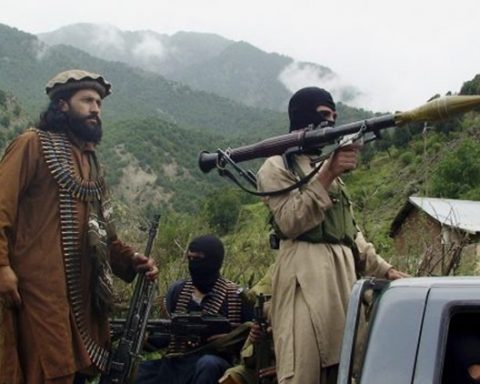
The Taliban, during both periods of their rule (1996-2001 and 2021-present), carried out executions of individuals convicted of a range of crimes through methods such as shooting, beheading and hanging. They also imposed corporeal punishments, including lashings and amputations, for ‘lesser’ crimes. These punishments were often administered in public places, such as sports stadiums and city intersections.
On November 13, 2024, the Taliban publicly executed Mohammad Ayaz Asad, convicted of the murder of Habibullah Saif-ul-Qatal, at a sports stadium in Gardez, Paktia Province. In front of thousands of spectators, a member of the victim’s family shot Asad three times in the chest. The execution was also witnessed by high-ranking Taliban officials, including Sirajuddin Haqqani, the Taliban’s Interior Minister; Khalil-ur-Rahman Haqqani, Minister for Refugees; Abdullah Khalid, head of the Taliban’s Appeals court, and his deputy, Wahidullah Siddiqui.
The execution was carried out under an order signed by the Taliban supreme leader, Mullah Hibatullah Akhundzada. The Taliban-controlled Supreme Court in a statement announced the public execution under Qisas (retribution) on November 12, 2024, as a symbol of sentencing to retaliatory punishment. The Court invited residents of Paktia to witness the execution, but prohibited cameras and mobile phones from the stadium grounds. The verdict for the execution was issued by the Supreme Court after a trial in military court and after examination of the case by three military courts.
This was the sixth execution carried out publicly since the Taliban took over Afghanistan on August 15, 2021. The other five included:
February 22, 2024: In a double execution, Syed Jamaluddin and Gul Khan were shot dead inside a stadium at Ali Baba village in the southeastern Province of Ghazni. They were shot five times each
February 26, 2024: Nazar Mohammad was executed inside a sports stadium at Sheberghan in the northern province of Jawzjan. The shooter was said to be avenging the death of his brother, Khal Mohammad, two years earlier.
June 20, 2023: A man identified as Ajmal from Kabul was executed with an assault rifle by the son of Siad Wali, one of five men killed by Ajmal, in the eastern Laghman province. He was convicted of murdering five people in two separate incidents in 2022.
December 7, 2022: The Taliban publicly executed a man, identified as Tajmir from Herat province, in Farah city, Farah province, which was the first judicially sanctioned public execution since the Taliban returned to power.
Penalties such as judicially sanctioned executions or corporeal punishment exercised by the Taliban, are founded ont the basis of Sharia law and the rulings of Islamic scholars. There are three categories of crimes in Sharia law: ta’zir, qisas, and hudud, drawn from the Qur‘an and Hadith. Both corporeal and capital punishments are examples of hudud and qisas. Hudud crimes, divided into six categories, are believed to be crimes against God and include: hirabah (waging war against God and society), zina (adultery and fornication), riddah (apostasy), sariqa (stealing), shrub al-khamr (drinking alcohol), and qadhf (slander/defamation). The death sentence, stoning, and lashing are among the penalties prescribed. While qisas covers the majority of crimes involving murder or severe cases of deliberate bodily damage, retribution in kind is imposed, based on the principle of “an eye for an eye”. Ta’zir includes punishments which are derived from the discrete power of judges.
On marking the third anniversary of the Taliban’s return to power on August 15, 2024, Hibatullah Akhundzada said that implementing Islamic law in Afghanistan is their lifelong responsibility, and declared,
Brothers! Our responsibility of service to religion, ruling according to sharia (Islamic law), is our lifelong responsibility. We will implement Allah’s religion and sharia rule for ourselves and others as long as we live.
In the earlier regime (1996-2001), there were numerous instances of both corporal and capital punishments based on Islamic law. A report by Amnesty International titled, “Afghanistan: Flagrant abuse of the right to life and dignity”, published on March 31, 1998, mentioned some of the incidents early in that year:
February 25: A stone wall was felled on Fazalur Rehman, Ahmad Shah and Abdul Qahir, by a battle tank before thousands of spectators at Kotal Morcha north of city of Kandahar, after they were convicted of sodomy.
February 27: A woman was given 100 lashes for alleged adultery at the Kabul Sports Stadium in front of some 30,000 spectators.
March 13: More than 30,000 spectators were told through loudspeakers to gather at Kabul national stadium to watch the father and brother of a murdered man shoot the alleged murderer. The killing was carried out by the victim’s brother who shot the man with a machine gun.
Taliban’s suspension of the 2004 Constitution and laws established by the Islamic Republic of Afghanistan after August 2021 intensified the practice of hudud and qisas. Mullah Nooruddin Turabi, the then-Acting Director of the Taliban’s Office of Prison Administration, told the media on September 23, 2021, that “cutting off of hands is very necessary for security” because it has a deterrent effect. However, he added that Cabinet was still deciding whether punishments would be administered in public.
Subsequently, in September 2022, Abdul Karim Haider, the Deputy Minister of Justice, asserted that Afghanistan did not require a constitution and could resolve its issues exclusively with the application of Islamic law. Haider declared,
The holy Quran, the Sunnah of Mohammad (PBUH), and the jurisprudence of every Islamic country are the basis and the text of the constitution in general and in detail.
Deeply committed to Sharia law, Haibatullah Akhundzada ordered judges to fully enforce aspects of Sharia. Earlier, SAIR noted that, on November 13, 2022, the Taliban’s chief spokesperson, Zabihullah Mujahid, tweeted that the “obligatory” command by Akhundzada came after he met with a group of judges. Mujahid quoted Akhundzada as declaring,
Carefully examine the files of thieves, kidnappers and seditionists. Those files in which all the Sharia [Islamic law] conditions of hudud and qisas have been fulfilled, you are obliged to implement. This is the ruling of Sharia, and my command, which is obligatory.
Prior to this announcement, the United Nations Assistance Mission in Afghanistan (UNAMA) in a report titled “Corporal Punishment and the Death Penalty in Afghanistan: UNAMA Human Rights” released in May 2023, noted that the first recorded use of corporal punishment since the Taliban takeover in 2021 occurred on October 20, 2021, in the Nijrab District of Kapisa Province, where a man and a woman found guilty of zina (unlawful sexual intercourse) were each publicly lashed 100 times. The report also revealed that, following the overthrow of its first regime on December 9, 2001, the Taliban carried out at least 182 parallel judicial system punishments between August 15, 2010 and August 15, 2021, resulting in 213 fatalities and 64 persons injured.
Analysis of the Taliban-run Supreme Court’s press announcements highlighted that the Taliban publicly flogged 85 individuals between October 22 and November 14, 2024, including 12 women. Public floggings occurred most frequently in the Ghazni and Khost Provinces during the period, with 22 occurrences documented in Jowzjan and 17 in Khost. Other cases were reported in Nangarhar, Parwan, Paktika, Wardak, Faryab, Ghazni, and Kabul. These people were accused of “leaving home without permission, immoral relations, sodomy, adultery, moral corruption, and theft,” according to the Taliban. Some religious academics contended that the punishments lack the formal judicial procedures necessary by Islamic law, despite the Taliban’s claims that they are based on Islamic Sharia. Another report on December 19, 2024, tallied a total of 153 individuals, including 22 women, flogged in various provinces for alleged offenses, in the preceding two months.
Additionally, between July 1 and September 30, 2024, UNAMA Human Rights documented judicial corporeal punishment against at least 111 individuals (95 men, 15 women and one girl).
Meanwhile, in September 2024, the Taliban’s deputy head of Prison Administration, Habibullah Badr, confirmed that among the 33,000 inmates (11,000 sentenced by Taliban courts;12,000 awaiting court decisions; including approximately 1000 women) in Taliban-run prisons, more than 1,100 individuals are awaiting execution or punishment under qisas, while between 500 and 600 have been sentenced to death, while another 400 face qisas punishments.
International organizations have condemned the incidences of execution and reiterated concerns about human rights conditions in Afghanistan. In a condemnatory note regarding the latest public execution on November 13, 2024, in Gardez, Paktia, the United Nations (UN) independent expert or Special Rapporteur who monitors human rights in Afghanistan, Richard Bennett stated, “I condemn today’s horrific public execution. These atrocious punishments are clear violations of human rights and must be immediately halted.” UNAMA also emphasised that “executions carried out in public are contrary to Afghanistan’s international human rights obligations and must cease.” It also called upon the de facto Taiban authorities to “establish an immediate moratorium on all executions with a view to abolition of the death penalty. We also call for respect for due process and fair trial rights, in particular access to legal representation.”
The penalties imposed by the Taliban government have drawn criticism from international organizations for their severe, torturous, and inhumane nature. According to international laws, the death penalty is restricted even for serious crimes, and the international community has long advocated its complete abolition. While the Taliban is attempting to establish diplomatic relations with various countries, its enforcement of Sharia law is becoming increasingly severe, raising questions about the possibilities of the formal entry of the present regime into the international community.