by Durga
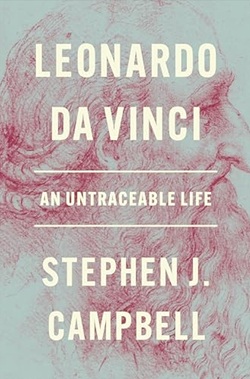
Stephen J. Campbell’s Leonardo da Vinci: An Untraceable Life is not just another biography of the Renaissance polymath; it is, in fact, an anti-biography. Unlike the countless hagiographies that perpetuate the myth of Leonardo as an omniscient genius ahead of his time, Campbell’s book meticulously deconstructs the very notion of biographical certainty. He does not seek to unveil Leonardo in the manner of traditional historians but rather interrogates why so much of our understanding of da Vinci is rooted in speculation, myth-making, and modern projections.
The book is, therefore, as much an examination of how history is written as it is a study of its subject. Campbell does not attempt to “solve” Leonardo but instead exposes the inherent difficulties in doing so. He scrutinizes the historical record, questions the reliability of sources, and ultimately reframes Leonardo as a figure whose identity is fragmented, unknowable, and perpetually reconstructed by later generations. In doing so, An Untraceable Life forces us to confront an unsettling reality: Leonardo da Vinci is both ubiquitous and elusive, a figure we know everything and yet nothing about.
Beyond the Myth: Deconstructing Leonardo’s Biography
Campbell’s central premise is that Leonardo’s life cannot be neatly contained within the standard biographical framework. While previous scholars have attempted to craft a coherent narrative of his existence—piecing together disparate fragments of his writings, artworks, and commissions—Campbell argues that these efforts often say more about the biographers themselves than about Leonardo.
His skepticism towards the conventional biographical approach stems from a fundamental question: Why do we need Leonardo to be a coherent, fully realized individual? He suggests that the relentless search for a “true” Leonardo is driven by a modern desire for intelligibility, for an easily digestible figure whose genius can be rationalized. This impulse, Campbell argues, has led to a history of embellishments, retroactive psychoanalysis, and even outright fabrications.
A striking example of this phenomenon is the persistent portrayal of Leonardo as a solitary, misunderstood visionary, a man who defied his era and was ostracized for his intellect. Campbell dismantles this romanticized image by contextualizing Leonardo within the milieu of 15th- and 16th-century Florence and Milan, showing that he was far from an alienated outsider. He was deeply embedded in courtly life, reliant on patronage, and engaged in the artistic and scientific discourses of his time. The idea that he was “ahead of his time” is, in many ways, an anachronistic projection.
The Problem of Evidence: Gaps, Silences, and Speculations
One of the book’s most intriguing discussions concerns the gaps in the historical record. Despite Leonardo’s extensive notebooks, personal details about his life are surprisingly scarce. Unlike Michelangelo, whose letters, poems, and contracts provide a wealth of biographical material, Leonardo left behind no personal correspondence, no diary entries reflecting on his inner life, and no definitive self-portraits.
Campbell highlights how much of what we claim to “know” about Leonardo is based on second-hand accounts, many of which were written decades after his death. For instance, Vasari’s Lives of the Artists, one of the primary sources for Leonardo’s biography, is riddled with exaggerations and apocryphal anecdotes. Similarly, 19th- and 20th-century biographers have often projected their own intellectual preoccupations onto Leonardo, crafting him into a proto-modern scientist, an existential thinker, or even a spiritual mystic.
This lack of direct evidence creates a paradox: the more we try to define Leonardo, the more elusive he becomes. Campbell embraces this ambiguity rather than attempting to resolve it. He argues that the absence of a cohesive biographical narrative is not a problem to be solved but a fundamental aspect of Leonardo’s historical presence.
Leonardo and the Art Market: The Commodification of Genius
A particularly fascinating section of the book explores the commodification of Leonardo in the modern era. Campbell examines how the art market, museums, and media have perpetuated a hyper-commercialized version of Leonardo—one that prioritizes spectacle over scholarship. The 2017 sale of Salvator Mundi for $450 million serves as a prime example. Marketed as “the last Leonardo,” the painting’s astronomical valuation was driven more by the mythos surrounding Leonardo than by any objective assessment of its authenticity or artistic merit.
Campbell critiques the ways in which museums and auction houses exploit Leonardo’s name to fuel a cult of celebrity. The Mona Lisa, for instance, has transcended its status as a work of art and become a brand, endlessly reproduced, commodified, and fetishized. Yet, paradoxically, this very ubiquity has rendered it almost invisible—the painting itself is drowned in the noise of its own legend.
This commodification extends beyond paintings to Leonardo’s persona. Books, films, and popular media have reshaped him into a polymathic superhero, an all-knowing figure whose brilliance encompasses engineering, anatomy, aeronautics, philosophy, and even the occult. Campbell argues that this Leonardo is largely a modern invention, a figure molded to fit contemporary notions of genius and innovation.
The Shape of Premodern Lives: Rethinking Personhood
One of Campbell’s most radical arguments concerns the concept of selfhood in the Renaissance. He challenges the assumption that Leonardo possessed a modern sense of identity, arguing that premodern individuals did not necessarily conceive of themselves as unified, introspective selves in the way that contemporary readers might expect.
He contrasts Leonardo with Michelangelo, whose poetry and letters reflect a deeply self-conscious and tormented individual. Leonardo, by contrast, remains opaque. His notebooks, though voluminous, are primarily filled with observational sketches, scientific inquiries, and technical diagrams rather than introspective reflections. He does not appear to have been concerned with self-expression in the way that later artists and writers were.
Campbell suggests that our struggle to “find” Leonardo may stem from the fact that he did not see himself as someone who needed to be “found.” The modern expectation of a coherent, introspective individual may simply be anachronistic when applied to a 15th-century artist-engineer.
A Revolutionary Approach to Biography
What makes An Untraceable Life so compelling is its willingness to embrace uncertainty. Rather than imposing a narrative onto Leonardo, Campbell invites the reader to engage with the gaps, contradictions, and ambiguities that define his historical presence.
This approach is not without its risks. Some readers may find the book frustratingly inconclusive, as Campbell resists providing definitive answers to many of the questions that traditionally animate biographies. However, this refusal to simplify Leonardo’s life is precisely what makes the book so intellectually rigorous.
In a genre where many biographies are content to recycle familiar tropes, Campbell’s book is a refreshing and necessary intervention. By dismantling the myths surrounding Leonardo, he allows us to appreciate him not as an all-knowing genius but as a complex, enigmatic, and ultimately unknowable figure.
Final Reflections: The Enigma of Leonardo
Leonardo da Vinci: An Untraceable Life is not a conventional biography—nor does it try to be. It is an anti-biography, a book that seeks to unravel rather than construct, to question rather than affirm. Campbell’s writing is erudite yet accessible, engaging yet rigorously skeptical. He challenges the reader to reconsider not just Leonardo, but the very way we approach history and biography.
By the end of the book, Leonardo remains elusive—but this, Campbell suggests, is precisely the point. The search for a definitive Leonardo is an illusion, a product of our own need for coherence. In embracing the unknowability of Leonardo, we come closer to understanding him than we ever could through conventional means.
For anyone seeking a fresh, thought-provoking perspective on Leonardo da Vinci, An Untraceable Life is an essential read. It is a work of intellectual courage—one that dares to leave the central question unanswered.