by Durga
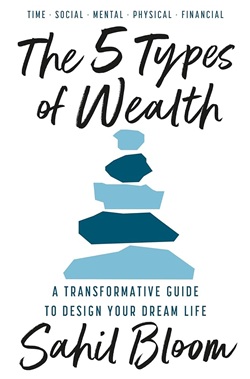
Sahil Bloom’s The 5 Types of Wealth is a thought-provoking and refreshingly holistic exploration of what it means to be truly wealthy. In an era where financial affluence is often mistaken for the pinnacle of success, Bloom challenges this myopic perspective by introducing a multi-dimensional framework for evaluating wealth. His thesis is clear: financial wealth is but one facet of a prosperous life, and an obsession with accumulating money at the expense of other, equally vital domains leads to a paradoxical state of impoverishment.
This book is an antidote to the conventional success narratives that lionize material accumulation while neglecting the more nuanced and meaningful aspects of human existence. By delineating wealth into five interdependent categories—Time Wealth, Social Wealth, Mental Wealth, Physical Wealth, and Financial Wealth—Bloom presents an intricate yet profoundly intuitive model that reorients the reader’s priorities towards a more fulfilling and harmonious life.
Theoretical Framework: A Recalibration of Success
At its core, Bloom’s book is a philosophical and strategic guide to redefining prosperity. He argues that true wealth is not a monolithic construct but a composite of interconnected dimensions, each requiring intentional cultivation. The book draws inspiration from Stoicism, behavioral economics, and contemporary psychology, blending these disciplines into an accessible yet intellectually robust narrative.
The structure of the book is methodically designed to guide the reader through an introspective journey. Each of the five types of wealth is introduced through a provocative existential question—e.g., “How many moments do you have remaining with your loved ones?” for Time Wealth—which immediately forces the reader to confront their own priorities. This approach is particularly effective because it disrupts the complacency that often accompanies our habitual life choices.
Time Wealth: The Non-Renewable Currency
Bloom’s discussion of Time Wealth is among the most compelling aspects of the book. He makes a persuasive case that time is the most valuable and non-renewable resource, yet it is paradoxically the one we squander most recklessly. Through vivid anecdotes and mathematical extrapolations, he illustrates how our remaining moments with loved ones are finite—often shockingly so.
The emotional weight of this section is further heightened by Bloom’s personal reflection on a conversation with a friend who pointed out that, at his current rate of visitation, he might only see his parents fifteen more times before they pass away. Such revelations are jarring, forcing the reader to reassess the degree to which they are truly present in their relationships.
To counteract this common neglect of time, Bloom introduces the concept of “The Life Razor,” a decision-making heuristic that prioritizes activities with high emotional and relational ROI. His emphasis on intentionality—being fully engaged in moments rather than merely present—is a potent reminder of the fragility and irreplaceability of time.
Social Wealth: The Currency of Relationships
In the section on Social Wealth, Bloom contends that our relationships are the greatest determinant of long-term happiness and fulfillment. This argument is supported by empirical evidence, notably the Harvard Study of Adult Development, which found that deep, meaningful relationships are the most significant predictor of life satisfaction and longevity.
Bloom’s insights on the quality-over-quantity principle in social wealth are particularly astute. He warns against the social media-driven illusion of connectivity, which often masks a profound sense of loneliness. By emphasizing the importance of cultivating a “front-row” network—people who will be there at your funeral, as he poignantly puts it—he encourages readers to invest in relationships that truly matter rather than dissipating their energy on superficial interactions.
Mental Wealth: The Architect of Inner Stability
Perhaps the most introspective section of the book, Mental Wealth delves into the cognitive and emotional frameworks that shape our reality. Bloom explores the malleability of the human mind, arguing that mental wealth is largely a function of perspective, self-awareness, and emotional resilience. He deftly intertwines neuroscience and philosophy, demonstrating how our thought patterns, beliefs, and daily habits can either be our greatest allies or our most insidious saboteurs.
A particularly valuable insight in this section is Bloom’s discussion on “The Arrival Fallacy”—the erroneous belief that happiness lies in a future achievement rather than in the present moment. This cognitive distortion is a pervasive issue in modern society, where people defer joy in pursuit of external validation, only to find that the anticipated satisfaction is ephemeral at best.
The book provides actionable strategies for cultivating mental wealth, such as gratitude practices, reframing techniques, and cognitive behavioral approaches to stress management. These tools, while not groundbreaking in their novelty, are presented in a manner that is both practical and deeply resonant.
Physical Wealth: The Foundation of Longevity and Vitality
Physical Wealth is a domain that is often neglected in discussions of prosperity, yet Bloom treats it with the gravity it deserves. He argues that without physical well-being, all other forms of wealth are significantly diminished. His discussion transcends mere fitness and diet advice; instead, he frames physical wealth as the ability to fully engage with life—whether that means dancing at your eightieth birthday party or having the energy to pursue meaningful endeavors.
He introduces the “Three Pillars of Physical Wealth”—movement, nutrition, and sleep—as fundamental to longevity and vitality. What sets his perspective apart from generic health advice is his emphasis on consistency over intensity. Rather than advocating for extreme fitness regimens or restrictive diets, he promotes sustainable, habit-based approaches that integrate seamlessly into daily life.
Financial Wealth: A Means, Not an End
Ironically, Financial Wealth, which is traditionally the most emphasized metric of success, is presented last in Bloom’s hierarchy. His rationale is clear: money is an enabler, not a destination. This perspective is a refreshing departure from the dominant financial self-help genre, which often equates monetary accumulation with life fulfillment.
Bloom’s insights into the psychology of money are particularly compelling. He addresses the concept of sufficiency, urging readers to define their own thresholds of “enough” rather than succumbing to the endless treadmill of accumulation. He critiques the societal tendency to conflate net worth with self-worth, illustrating how financial anxiety often persists even among the affluent due to misaligned values.
Final Reflections: A Manifesto for Holistic Wealth
The concluding chapters synthesize Bloom’s philosophy into a cohesive blueprint for designing a well-balanced life. His writing is evocative, oscillating between intellectual rigor and heartfelt introspection. The book does not merely dispense advice; it serves as a mirror, reflecting back the reader’s own unexamined assumptions and misplaced priorities.
One of the most commendable aspects of The 5 Types of Wealth is its lack of dogmatism. Bloom does not prescribe a one-size-fits-all formula but instead offers a flexible framework that readers can tailor to their own aspirations and circumstances. This adaptability makes the book equally valuable to high-powered executives, young professionals, and retirees alike.
Critique: The Missing Links
While the book is remarkably well-structured and intellectually stimulating, it occasionally leans into anecdotal evidence at the expense of more rigorous empirical support. Some readers may also find certain principles—such as gratitude practices and mindfulness—overly familiar, though Bloom’s articulation of these concepts remains fresh and compelling.
Additionally, while Bloom acknowledges systemic barriers that impede wealth accumulation, the book primarily speaks to an audience with the privilege of discretionary choice. A more nuanced exploration of socio-economic disparities and structural constraints would have further enriched the discourse.
Conclusion: A Transformative Perspective on True Wealth
Overall, The 5 Types of Wealth is a masterfully written and profoundly impactful book that challenges the reader to redefine their metrics for success. Bloom’s holistic approach provides a much-needed counterbalance to the financial obsession that pervades modern culture. By integrating timeless wisdom with contemporary insights, he has crafted a guide that is both pragmatic and deeply philosophical—an essential read for anyone seeking a richer, more meaningful life.