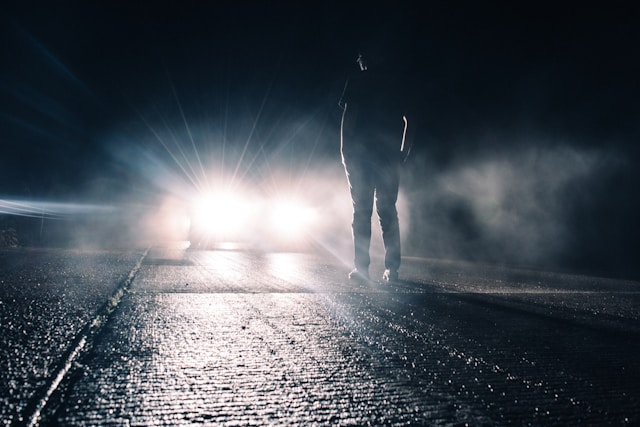
Car headlights have become alarmingly bright in recent years, contributing to at least 280 traffic collisions annually in the UK, with illegal upgrades to high-powered LED lights worsening the issue. The growing prevalence of dazzling headlights has made many drivers feel unsafe on the road, particularly at night. Some, like Tim Riley, a 50-year-old resident of the Lake District, have even taken to avoiding nighttime driving altogether. A report, originally published by Times UK, highlights a concern that is now prevalent across the UK and other countries.
Riley recalls one particular incident: “It was pitch dark, on a narrow two-way road. A vehicle came around a corner towards us, from a slight rise in the hill… and the lights just came at us. They were blinding. You couldn’t see for several seconds. My partner was panicking, and I just had to try and remember what the road looked like and slow down. It was frightening.” This moment, unfortunately, is not unique. A survey of 2,000 UK drivers by the RAC found that 90% of respondents believed at least some car headlights were too bright. Among them, 75% said they are frequently dazzled, and 85% reported the problem has worsened in recent years.
Experts believe the surge in brightness is largely due to the rise of LED (light-emitting diode) headlights, which are considerably more intense than the traditional halogen bulbs they replace. While halogen lights typically emit about 1,000 lumens, LEDs can produce up to 6,000 lumens, creating a much more powerful beam. The increase in LED brightness is particularly concerning because they are now commonly used in a wide variety of vehicles, from sedans to larger SUVs. John Lincoln, a member of the campaign group LightAware, notes, “There’s almost an arms race in car headlights. Manufacturers have increased the intensity of the light, and some drivers are now upgrading older cars with incredibly bright LEDs.”
Such upgrades are often illegal. LED lights are not approved for use in headlight units designed for halogen bulbs, and UK regulations specify that headlights must not dazzle or obstruct other drivers’ visibility. However, the growing aftermarket trade in LED bulbs has led many car owners to disregard these laws. Online marketplaces like Amazon have become popular platforms for selling high-powered LED bulbs, with some claiming outputs of up to 35,000 lumens, promising to “illuminate the road like never before.” These bulbs, however, can blind other road users, particularly when they are improperly fitted.
The phenomenon is not exclusive to the UK. In the United States, the issue of overly bright headlights has become a nationwide concern. The National Highway Traffic Safety Administration (NHTSA) has long recognized that glare from headlights is a significant factor in nighttime accidents. According to their findings, about 25% of fatal crashes occur at night, with many of these incidents attributed to visibility issues caused by bright headlights. In Europe, the European Commission has been investigating the problem of excessive headlight glare and its impact on traffic safety. Researchers have found that a large proportion of accidents in countries like Germany and France, particularly in rural areas, can be traced back to blinding headlights. In fact, a 2019 study by the German automobile club ADAC revealed that 45% of drivers in the country have had an experience where oncoming headlights temporarily blinded them.
One key issue is the design of modern LED headlights. Unlike traditional incandescent bulbs that emit light in all directions, many LED headlights use a combination of reflectors and lenses to produce a narrow, focused beam of light. This concentrated beam is more likely to shine directly into the eyes of oncoming drivers, especially if the headlights are misaligned. Additionally, higher vehicles like SUVs, which have become increasingly popular, tend to sit higher above the road, further exacerbating the issue as their lights are more likely to shine directly into the eyes of drivers in smaller cars.
Paramdeep Bilkhu, a clinical adviser at the College of Optometrists, explains that the combination of higher intensity, brighter color temperature, and strategic positioning of modern headlights significantly contributes to the problem. “LED lights are closer to daylight in their color temperature, which is good for the driver’s visibility but much more likely to dazzle other road users,” said Bilkhu. “What’s more, at night, when your eyes have adapted to darkness, bright lights can cause serious discomfort. The sudden exposure can leave drivers temporarily blind for several seconds, which may seem like an eternity on the road.”
Research conducted by the Department for Transport in the UK suggests that dazzling headlights contribute to around 280 collisions every year, though campaigners believe the true figure is likely much higher. In rural areas, where street lighting is minimal and roads are darker, the contrast between bright headlights and the surrounding darkness is especially striking. As a result, many drivers, particularly older individuals, are finding it increasingly difficult to drive at night. For example, Gill Crane, a 70-year-old woman living in Somerset, shared her struggle: “I have good vision, but I just can’t drive at night anymore. After 4 p.m., I’m stuck at home. These lights are so bright, they’re more likely to cause accidents than prevent them. I can’t understand why they make them so intense. You need to be able to stop in a distance you can see, not three miles down the road.”
This growing disquiet among the public has spurred some action. In the UK, a study commissioned by the government’s Transport Research Laboratory (TRL) is currently gathering data on the measurable effects of brighter headlights. The study, which is being overseen by a team led by chief scientist Shaun Helman, will involve equipping ordinary cars with instruments to capture the light experienced by drivers on various roads, under different weather conditions and at different times of day. Initial findings are expected in April, but more research may be needed to fully understand the impact and guide any regulatory changes.
However, the results of such studies are unlikely to bring about swift regulatory changes. While the motor industry insists that headlights must meet international standards, it remains an offence to fit unapproved light sources, yet some drivers continue to modify their vehicles, often disregarding safety concerns.
For now, drivers like Riley and Crane are left to navigate an increasingly dangerous road environment. As Riley points out, “People say anti-glare screens and glasses help a bit, and there’s advice to look at the kerb to maintain some awareness of the road. But that’s hardly a solution for staying fully aware of your surroundings, is it? These levels of brightness are way above what the human eye should be exposed to. I honestly believe these headlights aren’t safe on the roads.”