Editorial
It is not often that one finds oneself compelled to praise a bureaucratic decision in an age when public administration has become synonymous with inertia, nepotism, and the sterile theatre of procedural excuses. Yet, in the recent decisive intervention by the Railway Department to dismantle the entrenched ticketing rackets that had festered in Sri Lanka’s tourism corridors, we see—perhaps fleetingly—the faint silhouette of a state reclaiming its moral agency. For too long, the noble institution of the railways, bequeathed to us by British colonial ambition, has been gnawed to its skeletal frame by vermin in epaulettes and parasites in tailored suits. This move, though belated, is as much an act of housekeeping as it is a declaration of sovereignty over the nation’s most symbolic arteries of connectivity.
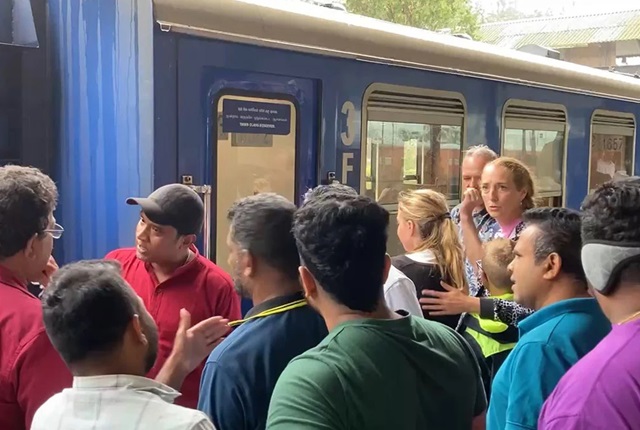
The Sri Lankan railway system, that marvellous iron lattice conceived under the Union Jack to ferry tea, timber, and the colonial elite, was never intended to be an antechamber for petty graft. And yet, over the decades, it has become precisely that. One need only consider the grotesque spectacle of the so-called “online ticketing system”—a mechanism presented to the public as an emblem of modern efficiency, but which in truth functioned as a carefully curated smokescreen. Behind the digital façade, a closed cabal monopolised access to prime tourist routes, funnelling the best seats to an unholy alliance of tour operators, auto-rickshaw brokers, and hotel agents. In the process, the very purpose of public transport—equitable, transparent, and accessible mobility—was prostituted to the basest instincts of profiteering.
This was not mere administrative negligence; it was complicity. From the clerk who turned a blind eye to the “block bookings” reserved for favoured agents, to the mid-tier officer who pocketed his silent dividend, all the way up to senior managers whose silence was purchased by promises of post-retirement consultancy—each was a cog in a machinery of deception. In truth, the bugs that infest the Railway Department are not mere irritants; they are termites, and they have been chewing through the timbers of this national edifice from the roof to the foundation.
And so, the crackdown is not simply welcome—it is necessary for the very survival of the system. Yet, one must temper applause with scepticism. For even as officials laud themselves for dismantling these ticketing syndicates, the memory of other “reform” efforts gone awry looms ominously. Let us not forget the sordid saga of the Northern Railway Line’s closure for months on end, ostensibly to complete track upgrades and traffic alignments. Allegations abounded: opaque tenders, procurement without feasibility studies, and the ignominy of acquiring second-hand locomotives from India and beyond, often without a shred of transparency. The stench of impropriety was so potent that one could almost hear, in the ghostly echo of empty platforms, the sardonic laughter of the very racketeers now being purged.
Internationally, there is precedent for both success and failure in such endeavours. In 2014, Indian Railways launched an anti-corruption drive targeting the Tatkal booking scheme—once similarly plagued by intermediaries who used automated bots to hoard tickets for resale. The crackdown was swift, and for a time, genuine passengers rejoiced. But without structural reform, the old patterns reasserted themselves like weeds through concrete. In Italy, Trenitalia’s attempts to purge black-market ticketing in tourist-heavy corridors met similar resistance from entrenched interests; it required not just punitive action but a complete technological and procedural overhaul to finally choke off the illicit channels. These examples should serve less as inspiration and more as a warning: the serpent, once decapitated, has a habit of growing new heads.
In the Sri Lankan context, the rot extends beyond the station walls. The tourism sector, so often lionised as a pillar of economic revival, has in practice harboured some of the most parasitic profiteers in this affair. From the auto-rickshaw driver who earns his cut by “securing” train seats for naïve backpackers, to the boutique hotelier who bundles illicitly obtained tickets into “exclusive travel packages,” the symbiosis between petty criminals and corporate players has been seamless. One might almost admire the efficiency of this parallel economy, were it not for the fact that it has systematically robbed ordinary citizens of access to their own infrastructure.
The recent crackdown thus sends a message far beyond the booking counters. It declares, at least aspirationally, that the nation’s resources are not the private domain of a select few. Yet such a declaration must be backed by relentless enforcement. For every syndicate dismantled, there are those who will seek to reinvent the racket under new guises. Today’s corrupt tour operator may be tomorrow’s “logistics consultant,” exploiting new loopholes while the ink is still wet on the reform orders. Without a cultural transformation within the Railway Department itself—a purging of both the petty and the powerful—today’s victory will be little more than a public-relations bauble.
It is worth noting that the very survival of the railways as a viable mode of transport is now at stake. Once a marvel of colonial engineering, the network is today a study in deferred maintenance and managerial complacency. Bridges groan under uninspected loads, signalling systems are obsolete, and locomotives cough their way along tracks that ought to have been replaced decades ago. This decline is not merely the result of fiscal constraints; it is the cumulative effect of funds siphoned into the pockets of the corrupt, of procurement inflated to absurdities, of projects delayed into irrelevance. The railway is, in this sense, a mirror of the state itself: beautiful in its conception, deformed in its execution.
In this light, one is reminded of Edmund Burke’s admonition that “the only thing necessary for the triumph of evil is for good men to do nothing.” For too long, too many “good men” within the Railway Department have opted for silence, comforted perhaps by the notion that they were merely cogs in a larger, uncontrollable machine. This is a moral abdication as much as it is an administrative one. The decision to finally confront the ticketing mafia is, therefore, not only an act of governance—it is a test of whether there remain within the state apparatus individuals willing to do something.
The public, for its part, must resist the temptation to sink into cynicism. Yes, history gives us ample reason to doubt the durability of reform. Yes, there are legitimate concerns that this crackdown will be used as political theatre, a brief flare of righteousness before the system reverts to its accustomed decay. But the alternative—resignation, acquiescence, and the quiet normalisation of theft—is infinitely worse. To borrow from the Japanese railway ethic, where punctuality is treated as a quasi-sacred duty, the preservation of public trust must become a matter of institutional honour.
Ultimately, the question is whether this moment marks a turning point or merely a pause in the decline. The railway is more than steel and timber; it is a social contract on wheels, a covenant between the state and the citizen that mobility will be provided not as a privilege for the connected, but as a right for all. To allow that covenant to be trampled by racketeers—whether in the tourism industry or within the department itself—is to surrender a part of the nation’s soul. If the recent crackdown is to mean anything, it must be the first step in reclaiming that soul from the termites that have long feasted upon it.
The Railway Department’s move is commendable not because it is perfect, nor because it will solve the problem overnight, but because it represents a rare assertion of the public interest in a landscape otherwise dominated by private greed. Let it be the beginning of a new chapter—one written in the steel script of integrity, rather than the invisible ink of corruption. For if we cannot defend even the rails beneath our feet, then what hope remains for the road ahead?