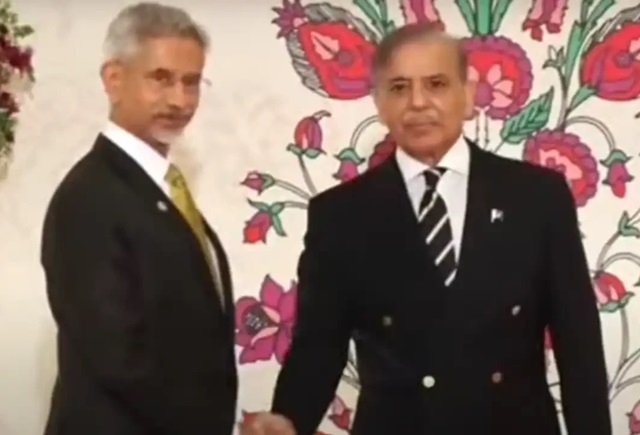
Prime Minister Shehbaz Sharif warmly greeted Indian External Affairs Minister Subrahmanyam Jaishankar, alongside other international leaders, during a high-profile dinner on Tuesday night marking the start of the Shanghai Cooperation Organisation (SCO) summit in Pakistan’s capital. The dinner, held ahead of the main SCO meeting scheduled for Wednesday, saw leaders from across the region arriving in Islamabad for the pivotal summit.
Live footage captured a brief but significant moment as Pakistan’s premier and India’s top diplomat exchanged handshakes and a short conversation, symbolizing a rare instance of diplomatic engagement between the two nuclear-armed neighbors. Jaishankar’s visit marks the first time in nearly a decade that a high-ranking Indian official has visited Pakistan, reflecting the importance of the SCO summit in bringing together leaders from rival nations.
Jaishankar landed at the Nur Khan Airbase in Rawalpindi on Tuesday afternoon, where he was received by Director General for South Asia Ilyas Nizami. The minister’s participation at the summit has drawn significant attention due to the tense relations between India and Pakistan. Indian journalist Barkha Dutt described Jaishankar as one of the “most powerful and influential” figures in Prime Minister Modi’s government.
In addition to Jaishankar, other high-profile leaders attending the summit include Chinese Premier Li Qiang and Russian Prime Minister Mikhail Mishustin, making this SCO gathering one of the most prominent international events hosted by Pakistan in recent years. Kyrgyz Prime Minister Akylbek Zhaparov also touched down in Islamabad on Tuesday, and seven more prime ministers from SCO member and observer states are expected to join the discussions.
The SCO, founded in 2001 by China and Russia, serves as a Eurasian political and security organization. Its member states include India, Pakistan, Kazakhstan, Kyrgyzstan, Tajikistan, Uzbekistan, and now Iran, with Belarus and Mongolia attending as observers. The summit will focus on enhancing regional cooperation in trade, economy, and connectivity, areas that Pakistan’s Foreign Office has emphasized as priorities.
The government has implemented a tight security lockdown in Islamabad to ensure the safety of the delegates. Schools and businesses have been closed for a three-day public holiday, and the capital’s Red Zone, which houses Parliament and key diplomatic buildings, is under the watch of military forces. This heightened security follows recent attacks, including the killings of two Chinese engineers and 21 miners earlier this month, raising the alert level in the country ahead of the summit.