


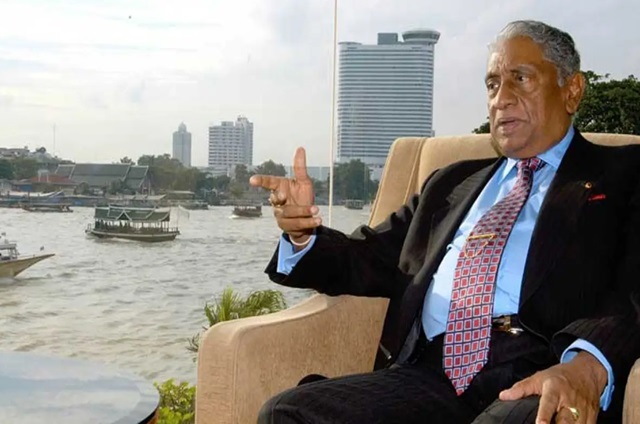
We miss the Minister who groomed us. I think it’s the same feeling shared by all young diplomats (both ladies and gentlemen) whom he recruited when he was Minister more than 20 years ago.
It was 20 years ago. I was commanding SLNS Sayura, the flagship of the Sri Lanka Navy stationed at Colombo harbour. I had just returned from India after finishing my tenure as Defence Adviser at our High Commission in New Delhi. Our task was to sail into deep sea towards the equator in search of LTTE arms-smuggling ships. We used to patrol for 21 days and then stay in harbour for ten days for our much-deserved break.
I vividly remember the day: Friday, 12th August 2005. That day, we had our Inter Command Volleyball tournament at Welisara, which was followed by drinks and dinner. Our ships are “dry” at sea (no liquor is served onboard when out at sea), and this party following the volleyball tournament was a good opportunity to relax in the best company after a 22-day dry period.
It was around 9pm that evening when I received a call from Madura, the Personal Security Officer of the then Foreign Minister, Hon. Lakshman Kadirgamar. Mr Kadirgamar had promised me he would visit my ship when I last met him. My ship was due to sail to Vishakhapatnam Indian Naval Dockyard for a medium refit—a US $20 million job arranged free of cost to the Sri Lankan government thanks to the skilled negotiations of our Foreign Minister, Hon. Lakshman Kadirgamar.
But what I heard from Madura was shocking. He said, “Sir, the Minister was shot. His body is lying at Colombo Mortuary. I am going back to the residence with Madam. Please come.” So, the LTTE had ultimately taken their prime target!
I rushed to Colombo Mortuary in my car from Welisara.
On my way, my mind rushed back to the day I met Mr Kadirgamar for the first time. I was selected for the post of Defence Adviser, Sri Lanka High Commission (SLHC), New Delhi, India, in November 2001. I was given an appointment to meet the Minister prior to my departure to India at 9am at his residence. Half an hour was allocated for this meeting. Two more clerical staff members who were going on appointments to embassies in Western countries were also waiting to meet the Minister after me. I was surprised to note that the Minister used to meet ALL our staff (diplomats or clerical) going to foreign missions prior to their departure. When he saw me that day in uniform, he asked the two staffers to meet him first, finished their calls quickly, and then sat with me for a long interview. He knew about the Navy as his elder brother was a Navy Commander in the 70s. He inquired about my foreign training experiences and advised me on the important appointment I was going to hold for the next three years. His briefing aptly covered the importance of India to us.
Our half-hour meeting went on for one and a half hours. The Minister, who was extremely busy, was ready to spend one and a half hours with a young newly appointed diplomat to brief and motivate him before taking up the appointment in a foreign country! I was so impressed and determined to do my best at my new post.
When I reached the Mortuary, the Minister’s body was lying on the postmortem table. The postmortem was over, and the staff at the mortuary were preparing the body to be transferred to the undertaker. They allowed me to see the body. His chest was opened for the postmortem. One gunshot had pierced the heart, damaging the main blood arteries. The heart which won the love and respect of all Sri Lankans. A heart strong enough to win Rugby football colours at Trinity College, Kandy, in 1948/1949; to captain the College cricket team in 1950; and to hold the Sri Lankan schools record in the 110 metres hurdles, which won him the Trinity Lion for Athletics in 1950. The heart strong enough to win the first Duncan White Challenge Cup for Athletics in 1948 and the prestigious Ryde Gold Medal for best all-round student at Trinity College in 1950 was lying on the postmortem table.
“Independence was granted to Sri Lanka, then known as Ceylon, on 4th February 1948. The Union Jack was lowered and the national flag raised at the stroke of midnight. Even as the flag fluttered proudly, four young athletes carrying flaming torches entered the square and ran up the steps of Independence Hall. Together, they lit the lamp of freedom. The quartet comprised youth members of the four major communities of the island. The 16-year-old youth representing Tamils was young Lakshman Kadirgamar.”
He was destined to achieve glory. In 1950, he went to the University of Colombo and then to Peradeniya to study law, graduating with an LLB (Hons) degree in 1953. He travelled to India in 1951 and 1952 for the All-India University Games and won the 110 metres hurdles title both years. At Law College, he passed with first class and took oaths as an Advocate at the Supreme Courts of Ceylon in 1953. He then won a scholarship to Balliol College, Oxford, UK. In 1960, he won the BLitt degree from the University of Oxford and became a barrister at the Inner Temple in London. He was the second Sri Lankan (after Mr Lalith Athulathmudali) to become President of the Oxford Union.
He was working abroad as an international lawyer with a very high reputation until our President Chandrika Bandaranaike Kumaratunga invited him to serve our beloved country. She made him a National List Member of Parliament and our Minister of Foreign Affairs.
I personally consider it was my destiny to serve under such an eminent Foreign Minister. The Minister was a frequent visitor to New Delhi. He very well understood the importance of India in our foreign policy. He had many friends there. We who served at SLHC, New Delhi, as junior diplomats always benefited from Mr Kadirgamar’s visits to New Delhi. Whether it was former Foreign Ministers Natwar Singh, Jaswant Singh, Yashwant Sinha, Pranab Mukherjee, or Ministers Mani Shankar Iyer or Kapil Sibal, all were the Minister’s friends. He always introduced us, the young diplomats, to these eminent Indian leaders.
Usually, calm SLHC became busy as a beehive when our Deputy High Commissioner, Mr Chinnaiah, announced, “Minister is coming next week.” All-important briefs and reports were prepared and updated. The Minister had a great habit of listening to us and hearing our viewpoints. My friend Saj U Mendis, who was First Secretary at the time, would speak until the Minister said, “I got your point, Saj.” Usually, he stayed with our High Commissioner, Mr Mangala Munasinghe, at his residence. Mr and Mrs Munasinghe looked after the Minister and Madam very well, with love and affection. If he stayed in a hotel, I had the great responsibility of looking after his security. He was a prime target of the LTTE. The Indian government also knew this and provided maximum security arrangements for the Minister.
He was a great orator. His speeches were excellent. The excellence came from his hard work. Usually, he came to New Delhi on the afternoon SriLankan flight leaving Colombo. He would rest well for four hours in the flight and have a light dinner prior to landing in New Delhi at 7pm. Then straight to the hotel to sit down and work on his speech for the next day. His trusted lieutenant, his personal assistant Lenagala (Lena), was by his side; they worked till late at night. If Madam accompanied him, she insisted the Minister go to sleep and have some rest. It was amazing that a person with a kidney transplant worked that hard. The hotel business centre was virtually taken over by us as our Secretariat.
Next morning, when the Minister spoke at the scheduled conference, The Hindu newspaper editor, Minister’s good friend and Ranji Trophy cricketer N. Ram wrote his editorial saying, “When Lakshman speaks, India listens.” His speeches in New Delhi were so brilliant and well-articulated. He understood India well, and Indian leaders respected him. He was a dear friend of India. Among the impromptu speeches the Minister delivered, the one he made in London in September 2004 to Sri Lankan cricketers during a dinner reception was the best. He showed the difference between national cricketers and our politicians in his witty speech.
During my tenure under the Minister, I learnt three important things about India.
I will explain them with true incidents.
- No protocol for friends – The Minister’s best friend was Hon. Pranab Mukherjee, a very senior politician from the Congress party. He was Minister of Defence in 2004. He later became India’s Finance Minister, External Affairs Minister, and eventually HE the President of India. During one of Minister Kadirgamar’s visits to New Delhi in 2004, a meeting was scheduled at the hotel where the Minister was staying (Taj Palace Hotel) with Hon. Pranab Mukherjee, the Indian Minister of Defence. Our Minister informed me to tell him when Hon. Mukherjee was leaving his office. When I informed him, our Minister came down by lift from the 5th floor and received Hon. Mukherjee at the entrance to the hotel. They then went to the meeting room to gather. After the meeting, somehow, our Minister walked up to the car of the Indian Minister. Later, when I told our Minister that as per protocol he was supposed to receive Hon. Mukherjee at the meeting room and asked, “Why, Sir, did you go up to the car porch when you should have received him at the meeting room?” Our Minister said, “Hon. Pranab Mukherjee is my friend. There is NO protocol for friends!”
- In a democratic country, do not forget the opposition – When our Minister visited New Delhi, he met government leaders such as the PM, Minister of External Affairs, Defence Minister, etc. After these meetings with ruling party leaders, he met opposition party leaders too and briefed them.
One day I asked him why. He said, “Ravi, do not forget, India is a democracy. In a democracy, one day the opposition will come into power. It may be in weeks’ time, may be in five years’ time. But when they come into power, they will remember you.” How true. It was the BJP-led government in power then. When we had our grand victory against the LTTE in 2009, it was the Congress-led government.
- For Mr Kadirgamar, progress of the Indian monsoon was very important. He would call and ask me the progress of the monsoon—whether it was on time, early or delayed; whether the rain was heavy or mild; whether sufficient water had been received in agricultural areas or not. One day I asked him why he was so keen about the Indian monsoon’s progress. He said, “Ravi, the Indian economy depends on the monsoon. When they get enough water, they will have a good crop of rice, wheat and vegetables. So, the government does not need to give grants to farmers. Therefore, the government will have money to help neighbouring countries like us.” Brilliant thinking and foresight.
We miss the Minister who groomed us. I think it’s the same feeling shared by all young diplomats (both ladies and gentlemen) whom he recruited when he was Minister more than 20 years ago. These diplomats now hold high positions as Ambassadors and High Commissioners today due to the excellent training, grooming and motivation Mr Kadirgamar gave them when they were on-the-job training. He made us more patriotic and hard-working. He wanted us to observe, learn and perform well for the country. We miss him today. Otherwise, he would introduce us to world leaders saying, “He/she is my student.”
I will conclude my write-up with another true story.
One day, the Minister was rushing to the President’s House with a junior diplomat at that time (I think it was Chanaka Talpahewa) to meet HE the President Chandrika Bandaranaike Kumaratunga for a scheduled meeting with the Russian Foreign Minister who was visiting Sri Lanka. Suddenly, the Minister stopped, looked at Chanaka, walked up to him, adjusted/tightened Chanaka’s tie knot and said, “Now looks better.”
He was a wonderful person, a fatherly figure and motivator of our Foreign Service.
Tell me, which Minister would do such a thing for his junior officer?
May he attain the bliss of Supreme Nirvana.


Thank you very much sir for the valuable information. May he attain the Supreme Bliss of Nirvana …..!!!