by Luxman Aravind
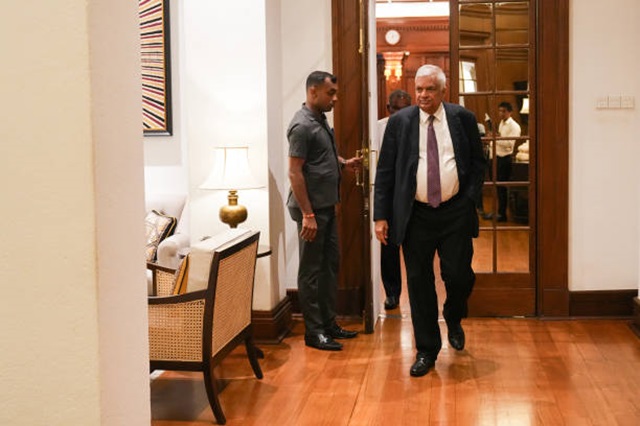
If the law is applied equally, without deferential quiescence, can the Secretary to the Ministry of Law and Order continue to function even after being apprehended for drunk driving while the case drifts unresolved? If legal parity is genuine, can the Energy Minister persist in office amidst a constellation of corruption allegations? The catalogue of controversies in this government is far longer than most dare enumerate. And now, Ranil Wickremesinghe has been arrested—a development that, on the surface, appears as a routine enforcement of justice, yet, upon closer scrutiny, exemplifies the pathological immaturity of the JVP/NPP administration currently steering the country.
This is a government that, rather than engaging in substantive political or economic overhaul, relies on manufactured crises, selective arrests, and relentless propaganda to consolidate power. The political vendetta against senior figures, Ranil foremost among them, is symptomatic of a broader strategy: distract the populace, delegitimise opponents, and monopolise narrative control. Wickremesinghe, with his decades of experience and intimate knowledge of Sri Lanka’s political rhythms, recognises this clearly. He has endured the destabilising years of the JVP insurgency and its waves of terror, yet now faces a contemporary incarnation of political theatre, executed with digital-age sophistication and state-sanctioned impunity.
It is worth acknowledging Wickremesinghe’s contributions. As one of Sri Lanka’s most senior politicians, he has navigated crises both existential and structural, witnessed the terror and societal rupture caused by the JVP in the late 1980s, and endeavoured to stabilise the polity amidst endemic factionalism. Yet his career is now being weaponised as a foil for a government incapable of generating substantive reforms. The pathological immaturity of the current regime manifests in propaganda campaigns, symbolic arrests, and performative legalism, rather than in meaningful governance or visionary policymaking. The theatre of politics has supplanted its practical obligations.
This behaviour has parallels in history that are instructive. Consider the Roman Emperor Tiberius, who used manufactured conspiracies to terrify the elite and consolidate autocratic authority; or the Byzantine rulers who orchestrated trials and purges to neutralise rivals while presenting an illusion of legal propriety. The JVP/NPP government appears to operate in the same register, with social media actors and selected enforcement used as instruments of intimidation, while the real issues—economic stagnation, systemic corruption, infrastructural decay—remain largely unaddressed. It is a politics of spectacle over substance, and Sri Lanka, its citizens, and its institutions bear the consequences.
The arrest of Ranil, viewed through this lens, is not merely a question of legality. It is a calculated political signal: an attempt to disarm a prominent critic, to discourage other potential challengers, and to manufacture a crisis that distracts from the administration’s failures. When YouTubers wield undue influence over the criminal justice system, when illegal militias operate with impunity in daily life, when reports of targeted killings circulate unchecked, and when the state saturates the public sphere with empty propaganda, governance is transformed into performative theatre. The nation is caught between spectacle and reality, with legitimacy continually eroded by the dissonance between what the government enacts and what it professes to achieve.
Ranil Wickremesinghe, in this context, represents a rare continuity, a witness to the cycles of terror, insurgency, and political vendetta that have historically plagued the country. He has endured accusations, survived crises, and contributed to the institutional scaffolding of Sri Lankan governance. In contrast, the pathological immaturity of the current administration is evident in its reliance on symbolic punishment and narrative manipulation to maintain a veneer of authority. Rather than pursuing ambitious reforms, strengthening institutions, or addressing systemic inequities, the government weaponises fear, selective justice, and propaganda to suppress dissent and manage public perception.
The irony is stark. A nation beset by structural economic and social challenges is confronted with a government whose principal energies are devoted to political vendetta, theatre, and performative legality. Historical analogues—from the purges of Roman elites to the orchestrated trials of Byzantine nobles—suggest that such approaches yield short-term compliance but long-term instability. By undermining trust in law, weaponising institutions for political ends, and targeting experienced statesmen like Ranil, the JVP/NPP administration risks provoking both domestic disillusionment and international censure. The very strategies intended to consolidate power may ultimately erode the foundations upon which political legitimacy rests.
In contemplating this moment, it is clear that the arrest of Ranil is symptomatic of a broader pathology in Sri Lankan politics today: a government enthralled by symbolism, reliant on propaganda, and incapable of delivering substantive governance. Wickremesinghe’s predicament underscores the dangers of political immaturity wielded by incumbents, who prefer spectacle to reform, vendetta to vision, and theatre to tangible policy achievements. The lessons are as old as politics itself: manufactured crises may temporarily disarm opposition and distract the citizenry, but in the absence of structural competence and principled leadership, they sow the seeds of eventual destabilisation.