When Gotabaya Rajapaksa was on the verge of declaring Sri Lanka bankrupt, a proposal was received from China through the then Prime Minister, Mahinda Rajapaksa. The proposal was to obtain a $4 billion loan from China without declaring bankruptcy and without approaching the IMF.
The proposal was initiated by the then Central Bank Governor, Ajith Nivard Cabraal, who had earned China’s trust. He was the one who negotiated the deal. Cabraal was firmly opposed to seeking IMF assistance, as a matter of policy. His reasoning was that the government would be placed at a disadvantage due to the conditions imposed by the IMF.
He arranged a Zoom discussion between Mahinda and the Chinese Premier, facilitated by the Chinese Ambassador to Sri Lanka, and secured Mahinda’s agreement to the $4 billion proposal. Although Mahinda tried to persuade Gotabaya to accept the deal, Gota’s advisors were opposed to it. Their advice was to declare bankruptcy and seek IMF support. Gotabaya ultimately rejected the Chinese proposal and opted to approach the IMF.
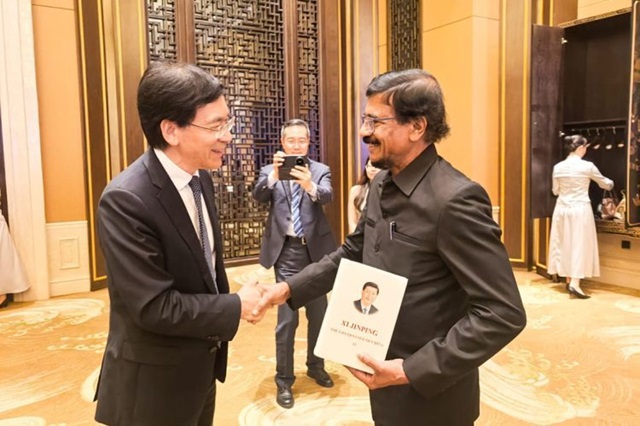
Recently, the JVP has resumed internal discussions on this proposal. It is unclear whether JVP MPs, including the party’s General Secretary, Tilvin Silva—who recently visited China—discussed the matter with Chinese officials. If China is reintroducing the proposal, it appears to be aimed at countering India. As a condition for providing assistance to Sri Lanka, China is insisting on permission for a Chinese research vessel to operate in Sri Lankan waters—more as a provocation towards India than for genuine research purposes.
At a recent seminar held at the Bandaranaike International Centre for International Relations, the Russian Ambassador to Sri Lanka remarked that while Russia and China are willing to assist Sri Lanka, the NPP government has not responded positively.
The geopolitical tensions between China and India, as well as between China and the West, are now becoming entangled with domestic governance. Tilvin Silva and Bimal Ratnayake are seen as pro-Chinese, while Anura Kumara Dissanayake, Harini Amarasuriya, and Vijitha Herath lean towards the West and India. The latter group believes that Ranil’s IMF programme should be continued. However, Tilvin and Bimal argue that this would significantly damage the JVP’s popular support base, and that the party should align with China, given the ideological similarities.
There are signs that Anura’s government is gradually adopting traits reminiscent of Mahinda’s administration. In areas such as minority rights, judicial appointments, and the assumption of control over municipal councils, parallels are emerging. It is possible that the NPP government may ultimately align with China, just as Mahinda once did. It remains unclear whether the current leadership is using the Chinese connection as a bargaining tool to secure more favourable terms from the IMF by implicitly threatening to pivot eastwards.