Editorial
“A lot of people are starving,” Donald Trump declared bluntly, standing beneath the glittering chandeliers of the Gulf, his voice imbued with the rare gravitas of genuine lament. “We’re going to get that taken care of.” These were not the words of a demagogue courting applause—they were, strikingly, those of a man positioning himself as a redeemer in a region bloodied by decades of fanaticism, egoism, and ineptitude. In the ashes of Gaza, where humanity is presently withering under the siege of war and indifference, Trump’s clarity sounded more sincere than the pious equivocations emanating from Jerusalem.
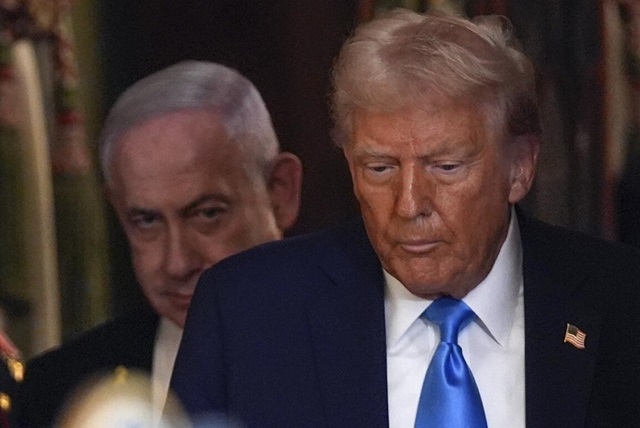
This statement, however clumsily tender, was not merely a passing sigh of moral obligation. It was a bellwether of something larger: the de facto decoupling of Trump from Benjamin Netanyahu, the latter having clung to his iron-fisted realpolitik for far too long. The U.S.-Israeli bond—long depicted as sacrosanct—now creaks under the weight of Netanyahu’s myopic obstinacy and Trump’s apparent recalibration. That the U.S. president would meet the interim Syrian leader Ahmed al-Sharaa—once imprisoned by U.S. forces and labelled a terrorist with a $10 million bounty—before even speaking Netanyahu’s name is no accident. It is a rebuke.
Trump called al-Sharaa a “young, attractive guy. Tough guy. Strong past. Very strong past. Fighter.” One may wince at the aestheticisation of such a dubious curriculum vitae, but the significance lies in the signal: a post-Assad Syria is a chessboard upon which Trump would prefer to place his own rooks and bishops—not play Netanyahu’s game of eternal siege. Al-Sharaa’s past in al-Qaeda-affiliated groups, his metamorphosis through Hayat Tahrir al-Sham, and his elevation to transitional president all make him a most unlikely diplomatic partner—yet Trump engaged. That is less a statement on al-Sharaa’s virtue than on Netanyahu’s expendability.
While Netanyahu flounders under the collapsing scaffolds of international patience and domestic discontent, Trump is mobilising a new architecture—one of economic leverage, symbolic recognition, and transactional alliances. The proposed $200 billion Qatari investment deal, the Boeing mega-contract with the UAE, and the lifting of sanctions on Syria amount to more than capitalist pageantry; they are cleavers hacking through the outdated sinews of 20th-century alliances. Trump, for all his ideological elasticity, seems to understand that Netanyahu’s Israel—mired in perpetual belligerence and consumed by messianic nationalism—has become less a partner and more a liability.
It is no coincidence that Trump’s son-in-law, Jared Kushner, architect of the Abraham Accords, has been notably marginal in this iteration of Middle East diplomacy. However, Kushner’s quiet role seems more a strategic decision than sidelining. Positioned behind the scenes, he continues to play a crucial enabling role across the region. Known for spotting opportunities where others see none, Kushner is almost certainly engaged in a long-term project to reshape the geopolitical map of the Middle East.
Israel, meanwhile, is no longer defined solely by Netanyahu. The time has come for a smart and deliberate political divorce, opening the door to fresh leadership in Jerusalem better suited to advancing regional stability and national renewal. Netanyahu, so addicted to power, now undermines the very alliances he claims to protect. To borrow Orwell’s words, he is a man “who sees only his own reflection in the glass of every negotiation.”
To perpetuate this symbiosis—Trump and Netanyahu—as though it were still functional is to tether American diplomacy to a mast rotting from the inside. Netanyahu’s delusions of invincibility have begotten a region more volatile, not less; his refusal to countenance any roadmap that does not terminate in Israel’s unilateral dominance has stifled every whisper of peace. Trump, whose instincts often outpace his ideology, appears to sense that aligning too closely with Netanyahu is to conscript himself into a war without end.
And so, we return to the starving children of Gaza—not as props in a moral play, but as the very metric by which a new Middle East policy might be judged. Trump’s lament was not merely performative—it was a rupture. A rupture from Netanyahu’s scorched-earth doctrine. A rupture from the ritualistic declarations of “eternal friendship.” A rupture, perhaps, from the West’s chronic addiction to the comfort of old certainties.
The time has come—not just for the reimagining of America’s role in the Middle East, but for the pruning of its overgrown and egotistic friendships. If Trump is indeed serious about engineering a future in which Syria is rehabilitated, Gaza is fed, and Iran is engaged rather than bombed, then keeping Netanyahu at arm’s length is not a political choice. It is a moral imperative.