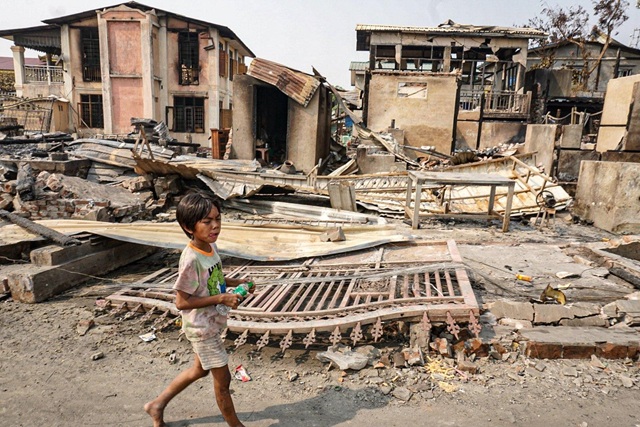
A new study published just days before a devastating earthquake struck Myanmar, claiming over 3,000 lives, warns that China and its neighboring countries are at an elevated risk of catastrophic earthquakes. The study, published last month in the Chinese Earthquake Administration’s journal Geodesy and Geodynamics, suggests that the region has entered the sixth seismic “active period,” significantly increasing the likelihood of major earthquakes in the coming years.
The study, led by seismologist Zhu Hongbin from the Beijing Earthquake Agency, analyzed over 150 years of seismic data, tracing cycles of major earthquake activity from 1879. Researchers identified six major seismic “active periods,” each corresponding with shifts in the Earth’s rotational speed and the resulting realignments of tectonic plate stresses. These periods of heightened seismic activity have historically led to clusters of large-scale earthquakes in East Asia.
One of the most alarming findings from the study is that the region surrounding China—specifically the areas along the Bayan Har block in Tibet, Mongolia, and parts of southwest China—is currently entering the sixth active phase, which could lead to catastrophic seismic events. The study forecasts that as stress shifts northeastward, regions such as Sichuan, Yunnan, and the Himalayan foothills are increasingly vulnerable to powerful earthquakes.
The findings suggest that the planet’s rotational speed fluctuations, caused partly by the moon’s gravitational pull, have played a crucial role in these cycles. During periods when the Earth’s rotation slows (known as “deceleration phases”), tectonic stress along north-south aligned faults in East Asia intensifies, contributing to megaquakes like those historically recorded along the Pamir-Baikal seismic belt. In contrast, acceleration phases tend to amplify stress along northeast-directed faults, particularly in the Tibetan Plateau.
The study comes on the heels of a tragic earthquake that struck Myanmar on March 28, 2025, which caused widespread devastation in Mandalay and killed over 3,000 people. The timing of the study, which highlighted growing seismic strain in the region, underscores the serious risks posed by the ongoing active phase.
However, not all experts in China are convinced by the study’s conclusions. Dr. Gao Mengtan, a seismologist from the Chinese Earthquake Administration, cautioned against overinterpreting the results, noting that global earthquake activity has been relatively quiet in recent years. “There is currently no clear evidence that the Earth has entered an active period of earthquakes,” Dr. Mengtan told South China Morning Post. “In fact, earthquake activity so far in 2025 is lower than the historical average.”
Despite these differing opinions, the study’s warnings serve as a sobering reminder of the seismic dangers faced by China and its neighbors, as well as the urgent need for preparedness in regions vulnerable to large-scale quakes. The study also highlights the potential for a significant earthquake in the coming years as tectonic pressure continues to build in the Himalayan region, which remains one of the most seismically active areas on the planet.
As countries in East Asia continue to grapple with the aftermath of recent disasters, scientists are urging governments to consider the findings in their disaster management and infrastructure planning, as the risks of a catastrophic earthquake loom ever closer.