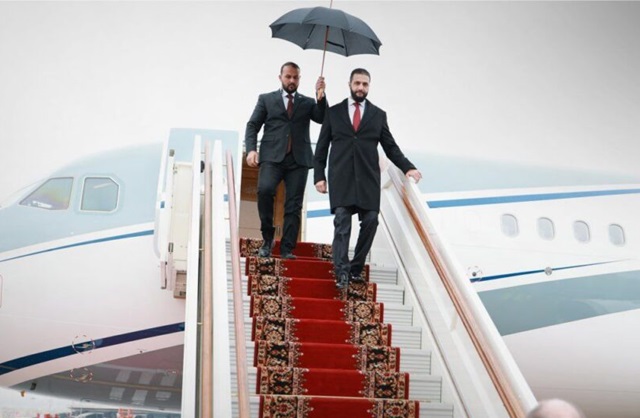
Syrian President Ahmad al-Sharaa arrived in Moscow on Wednesday for an official visit to hold talks with Russian President Vladimir Putin, the Syrian Presidency announced. President al-Sharaa was received at Vnukovo International Airport by senior Russian officials and Syria’s ambassador to Moscow. He is accompanied by Minister of Foreign Affairs and Expatriates Assaad Hassan al-Shaibani and Defense Minister Major General Murhaf Abu Qasra. The visit marks the first official trip by the Syrian leader to Russia since the fall of former President Bashar al-Assad’s government late last year.
According to official statements, the talks between al-Sharaa and Putin will focus on the future of bilateral relations, the presence of Russian military forces in Syria, and developments in the wider Middle East. The visit comes at a critical moment, as the new Syrian administration seeks to redefine its foreign policy priorities and rebuild ties with international partners following the political transition in Damascus. Russia, which played a decisive military and diplomatic role in Syria for more than a decade, remains a key actor in shaping the country’s post-conflict landscape.
Bashar al-Assad, who was ousted in December 2024 after months of internal unrest and military defections, has been living in exile in Moscow under Russian protection. His departure was arranged through a Russian-brokered agreement that ensured a peaceful transfer of power and safeguarded Russian assets in Syria. The change in leadership opened a new chapter in Syrian politics, with President al-Sharaa pledging to restore sovereignty, rebuild state institutions, and pursue balanced international relations free from external domination. However, the presence of foreign military forces, particularly those of Russia and the United States, continues to complicate Syria’s recovery and stability.
The issue of Russian military bases in Syria is expected to be one of the most sensitive topics during al-Sharaa’s talks with Putin. Moscow currently operates major installations at Hmeimim airbase in Latakia and the naval facility in Tartous, which were established during the Assad era. The new Syrian government has reportedly requested that Russia gradually scale back its combat operations and redefine the purpose of its bases toward joint training, logistics, and reconstruction support. Russian Foreign Minister Sergey Lavrov recently indicated that the bases could remain in Syria but with “modified objectives” reflecting the country’s new political reality.
President al-Sharaa’s visit follows a series of diplomatic exchanges earlier this year aimed at rebuilding trust between Damascus and Moscow. In late July, a Syrian delegation led by Foreign Minister al-Shaibani met with Lavrov and Defense Minister Andrey Belousov, and was received by President Putin at the Kremlin. That meeting laid the foundation for deeper discussions on economic cooperation, defense coordination, and Russia’s long-term role in Syria’s security architecture. The Syrian Foreign Ministry later described the talks as “constructive and forward-looking,” emphasizing their importance in establishing a framework for renewed partnership.
While attention remains focused on the high-level meetings in Moscow, developments on the ground in northeastern Syria have drawn renewed international scrutiny. Reports from local and monitoring groups indicated that a contingent of U.S. soldiers, along with military and logistical equipment, recently arrived at Kharab al-Jir airbase near Rmelan in al-Hasakah Governorate. The Syrian Observatory for Human Rights reported that the supplies were delivered by cargo aircraft to reinforce existing U.S. positions. Just weeks earlier, on September 29, a convoy of 25 U.S. trucks carrying equipment had entered Syria through the al-Waleed border crossing from Iraqi Kurdistan, heading toward the Qasrok base near al-Hasakah. The continued movement of American convoys contradicts recent U.S. statements suggesting plans to reduce its military presence in Syria to a single base.
President al-Sharaa’s meetings in Moscow are expected to conclude with a joint statement outlining areas of agreement and the next phase of Russian-Syrian cooperation. Analysts say the outcome will be critical in determining whether Syria can reclaim greater sovereignty over its territory while maintaining pragmatic relations with Moscow. The talks also carry broader regional implications, as other foreign actors, including the United States, Turkey, and Iran, reassess their own positions amid Syria’s ongoing transformation.