The 2025 Amarnath Yatra was meant to be a religious spiritual journey by thousands of devotees, who needed the spiritual comfort of the mystical caves of Kashmir. But what happened in the build-up to this incident particularly in the backdrop of intelligence briefings that there was a possible terror threat posed by the Resistance Force (TRF) is a rather different story. Although the Indian media has been heating up the rhetoric of an imminent attack, one is compelled to think that this is a matter of fact of an actual threat, or is this just a pretext to steer the international opinion and blame Pakistan. The growing tension and the scale of military presence during pilgrimage which has never been witnessed before has cast serious doubts over the actual motives of such developments.
The foreign policy of India, particularly dealing with its neighbouring countries, has been under the severe spotlight in the recent past. The Foreign Policy conducted in the country especially following the “Operation Sindoor” have made the country more and more cut off in the international scenes. The inability of India to move through the international politics arena has led to a chain of misjudgement in military and diplomatic action. These have not only been experienced in its own borders but also in its relationship with other countries such as Turkey, Iran and the greater Muslim world where the Indian image has suffered a serious blow.
This hawkish discourse of war-mongering, which is being propagated by the media and the political leadership, has revealed more fissures in the decision-making process in India. A well-laid plan of military force once supported by advanced surveillance technologies and security machineries appears to be getting more reactive and unpredictable as ever. Such desperation and uncertainty on the part of the Indian security apparatus can be gauged by the fact that further deployment of 70,000 troops was required to protect Amarnath Yatra alone and one feels like questioning the effectiveness of such efforts in comparison to the ground reality.
Indian-Occupied Jammu and Kashmir (IIOJK) has become the backdrop to the most recent military escalation. The state has long been portrayed as a hotbed of terrorism, requiring tight surveillance and strict security measures. It is, after all, a place where the Indian government has deployed over half a million troops to assert its control. In light of these overwhelming security forces, the question arises: why does the Indian government continue to fear the threat of terrorism, particularly from a group like TRF, which operates within a highly militarized environment?
India’s paranoia over terrorist activity appears increasingly out of place, given the extensive surveillance and military infrastructure in place. In fact, the only logical explanation for this perceived threat is the strategic manipulation of narratives through a False Flag Operation (FFO), designed to further malign Pakistan’s image in the international community. This is not the first time India has relied on such tactics; the Pahalgam attack, which resulted in multiple casualties, is now widely viewed as a staged incident, where innocent Kashmiris were wrongfully blamed and subjected to collective punishment.
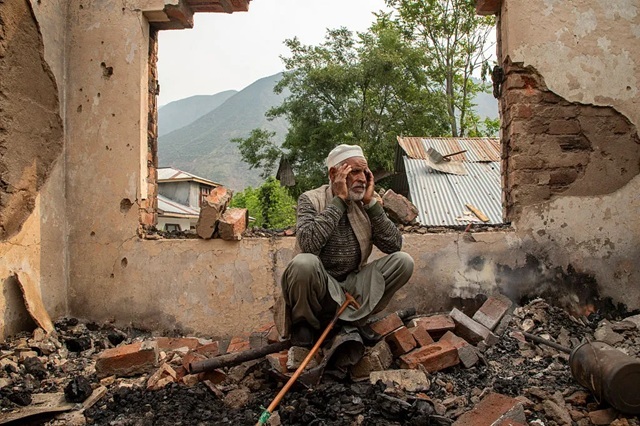
The Pahalgam attack ignited a wave of military repression across the region. Indian forces launched a widespread cordon-and-search operation that netted over 2,800 Kashmiris, many of whom were innocent civilians. Properties of suspected “facilitators” were destroyed, and entire neighbourhoods were torn apart in the name of counterterrorism. While the Indian government claimed these actions were essential to curbing terrorism, they reflected a disturbing pattern of collective punishment and human rights violations.
Pakistan’s demand for an independent inquiry into the incident has fallen on deaf ears. Instead of investigating the truth, the Indian government chose to deflect blame and resort to anti-Pakistan rhetoric. This refusal to allow accountability raises serious questions about whether the incident was orchestrated as part of a larger narrative to justify further repression in the region.
The Indian media has consistently failed to engage in critical introspection or question the legitimacy of government claims. Instead, experts and analysts, who should be providing objective insights, have opted to participate in media trials aimed at demonizing Pakistan. This has been further compounded by the state’s use of censorship and repression against those questioning the official narrative, revealing the extent to which dissent is stifled in the country.
Moreover, India’s media landscape has become increasingly polarized, and its reporting on Kashmir is a prime example of this trend. The relentless anti-Pakistan rhetoric espoused by Indian news outlets, coupled with the failure to acknowledge the real problems facing the region, has further fuelled an environment of mistrust and paranoia. In light of the recent intelligence reports suggesting a possible TRF attack, the media has once again seized on this narrative to push the idea that Pakistan is behind the unrest in Kashmir. This sensationalism is often paired with unsubstantiated claims about the use of sophisticated terrorist tactics, such as drones and low-signature mobile phones, as part of a broader effort to create the illusion of a major threat.
However, these claims are contradictory. The heavy presence of Indian security forces, including the deployment of 70,000 troops, drones, and surveillance systems, calls into question the credibility of the purported terrorist threat. If such a well-equipped military apparatus cannot protect a pilgrimage route, it raises serious doubts about the competence and sincerity of the Indian authorities in ensuring the safety of the pilgrims.
Moreover, the continuing search operations in regions like Samba and the arrest of local Kashmiris by the National Investigation Agency (NIA) have only fueled fears among the local population. The repeated arrests, combined with widespread reports of human rights violations, suggest that the Indian state is more focused on perpetuating fear and insecurity rather than addressing the root causes of the unrest.
The international recognition of Pakistan’s efforts to combat terrorism, most recently evidenced by the US honouring of Pakistan’s Chief of Army Staff, General Syed Asim Munir, has further embarrassed Indian authorities. With global leaders like US President Donald Trump acknowledging Pakistan’s successes in fighting terrorism, India’s attempts to isolate Pakistan on the world stage have been rendered null and void.
In contrast, India’s failure to secure any meaningful international backing for its policies in Kashmir, and the erosion of its credibility following the “Sindoor” debacle, has only compounded the country’s diplomatic failures. The use of a TRF narrative to shift blame and create a false pretext for aggression is not just an attempt to distract from internal failures, but also a desperate attempt to salvage India’s waning international standing.
The deployment of 70,000 troops for a pilgrimage that typically requires minimal security raises serious questions about India’s true intentions. While the Indian government claims to be guarding against a potential TRF attack, the true purpose of such measures may lie elsewhere. The growing suspicion that this is a pre-emptive propaganda exercise aimed at falsely implicating Pakistan in cross-border terrorism cannot be ignored.