A historic and palpable socio-economic transformation is taking shape in the resplendent island of Sri Lanka. People are becoming increasingly content with the changes unfolding around them. Governmental discipline appears to be working for the people, coupled with discernible honesty. A miracle seems to be unfolding. Something sustainable is taking root—something refreshing, something painfully new.
At last, the people have empowered and summoned a group of talented and competent lapidarists to cut the gem properly and according to the desired geometry. The phrase “Sri Lanka is a gem” serves both as a literal reference to its world-renowned gem and jewellery industry and as a metaphorical description of its rich culture and natural beauty. Long known as the “Island of Gems”, Sri Lanka’s history has profoundly influenced its cultural heritage.
Everything taking place looks promising. Sustainable tools of productivity are being assiduously incorporated into the nation’s fabric at strategic points. This has never happened before. Even though it remains a work in progress, the reality is promising and auspicious—it augurs well for the country.
A circumspect reflection on the immediate past, with the required awareness, clearly reveals the antecedents that derailed and destroyed the nation, driving it to bankruptcy. Individuals supposedly blessed with seven brains pushed Mother Lanka to the depths of despair. A bankrupt nation, drowning in debt, its people collapsing in queues for fuel, gas, and food. Who betrayed this nation? Your guess is as good as mine.
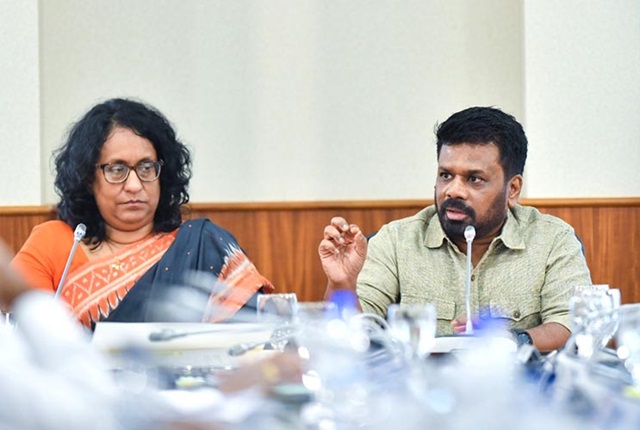
The man now at centre stage, the cynosure of all eyes, is the one who stepped forward to take the bull by the horns—the man from Thambuththegama, Anura Kumara Dissanayake, the newly elected President of Sri Lanka. Born in 1968 in the village of Galewela in the Central Province, he studied at the University of Peradeniya and the University of Kelaniya, where he obtained a bachelor’s degree in science.
The irony of ironies has clearly manifested itself in Sri Lanka. The supposed progeny of Sri Lanka’s modern capitalism—those emerging after 1977 with both brain and brawn—bequeathed a bane. They collectively brought the island nation to a screeching halt, or rather, to its knees. It was the Marxist–Leninist lad from Thambuththegama and his team who had to deliberate, summon their courage, and navigate the extreme turbulence to reach a degree of safety. Within a year, he had restored confidence and a semblance of normalcy. It was a tremendous achievement, even though the country is still not out of the woods. Ironical, isn’t it?
In Sri Lanka, there was never full-blown economic policy consistency—an essential prerequisite for rapid growth. Leaders advocated diluted open-economic policies. Initially, the focus was on development and self-reliance within a market framework, then shifted towards socialist, inward-looking, state-controlled policies. Key programmes included the nationalisation of foreign-owned plantations, transport, banking, and insurance companies; the promotion of import substitution; strict import and exchange controls; and food rationing. Later came the era of economic reforms, which abandoned statist policies for a market-oriented, free-enterprise system—but vast gaps remained. These policies included trade liberalisation, the removal of import and foreign exchange controls, an emphasis on the private sector as the engine of growth, and the establishment of a free trade zone.
The political architects of these policies since independence are as follows:
D. S. Senanayake (1948–1956), S. W. R. D. Bandaranaike and Sirimavo Bandaranaike (1956–1977, with interruptions), J. R. Jayewardene (1977–1989), Ranasinghe Premadasa (1989–1993), Chandrika Kumaratunga (1994–2005), Mahinda Rajapaksa (2005–2015), Maithripala Sirisena (2015–2019), Gotabaya Rajapaksa (2019–2022), Ranil Wickremesinghe (2022–2024), and Anura Kumara Dissanayake (2024–present).
The National People’s Power (NPP) government in Sri Lanka, which came to power in September 2024, is unlike any of its predecessors. “Corruption-free” is its bold banner, and it appears to be living up to it. This commitment matters greatly, acting as a catalyst for sustainable growth. The NPP is spearheading several economic programmes focused on fiscal discipline, anti-corruption measures, and the continuation of IMF-backed reforms, alongside social welfare initiatives. These efforts are commendable. Among the government’s priorities are fiscal consolidation and the IMF programme, revenue mobilisation, debt management, private-sector development, asset management, sector-specific initiatives, and regional integration.
The “Clean Sri Lanka Project”, officially launched in 2025, aims to make Sri Lanka the cleanest country in the Asian region. This comprehensive programme brings together government agencies, private companies, environmental organisations, and local communities, focusing on ethical commitment, waste management, environmental sustainability, and urban greening. This initiative, distinct from earlier “green” policies, is progressing well.
The rule of law is improving, though sporadic crime persists. The overall trend, however, is encouraging. The current government, elected in 2025, has a historic opportunity and has made initial pledges and some progress toward this goal.
Anura Kumara Dissanayake appears ready. He has the potential to bring prosperity to Sri Lanka. His government is taking steps to address economic challenges by strengthening the private sector, reinstating agricultural subsidies, allocating funds to the blue economy, and advancing digital transformation. His administration’s priorities include combating corruption, ensuring justice, stabilising the economy, and prioritising Sri Lanka’s national interests. Success will, of course, depend on the effective implementation of these policies and the government’s ability to overcome persistent challenges such as high poverty levels and geopolitical pressures.
Sri Lankans living in Canada wish him every success.