The resurgence of armed confrontations between the Zeliangrong United Front (ZUF) and the National Socialist Council of Nagalim-Isak-Muivah (NSCN-IM) signals the re-emergence of one of Manipur’s most enduring intra-Naga rivalries. Although both organisations remain engaged in separate peace processes with the Government of India (GoI), recurrent gunfights across Tamenglong, Noney and Kangpokpi Districts indicate that negotiated arrangements have done little to resolve competing territorial claims and political rivalries on the ground. Rather than representing isolated incidents, the recent clashes reflect a broader pattern of persistent armed competition that continues to undermine stability in western Manipur.
The latest confrontation occurred on July 5, 2026, when suspected cadres of NSCN-IM and the Zeliangrong United Front-Kamson (ZUF-K) allegedly attacked Thingkhongjang, a Kuki village in Kangpokpi District, Manipur, injuring two civilians and setting several houses ablaze. The injured were identified as Lamneingah Kipgen (8) and Nengneichong Kipgen (56), both of whom sustained bullet injuries. While local residents alleged the involvement of NSCN-IM and ZUF-K cadres, Security Forces (SFs) had not officially confirmed the identity of the attackers.
The July 5, attack followed another major confrontation on June 26, 2026, when suspected cadres of ZUF-Jenchui Kamei faction (ZUF-JK) and NSCN-IM exchanged fire at Kaiphundai Village under the Tousem Police Station in Tamenglong District, after NSCN-IM cadres allegedly ambushed a ZUF-JK hideout. The gun battle reportedly lasted around 30 minutes, forcing villagers to flee and disrupting traffic along the strategically significant Imphal-Jiribam Highway, before SFs restored order. Although no casualties were reported, the incident highlighted the continued operational capability of both organisations despite their respective peace engagements.
The exchange of fire triggered a fresh war of words between the two rival outfits. On June 28, 2026, NSCN-IM accused ZUF-JK of violating the Cessation of Operations (CoO) Agreement by attacking its cadres, extorting commuters along National Highway-37 in Tamenglong District, and failing to return to its designated camp after the March 20, 2026, clash. Rejecting accusations of any provocation on its part, NSCN-IM maintained that its cadres had fired only warning shots on June 26, and alleged that ZUF-JK was acting as a proxy of GoI.
The June 26, encounter was only the latest in a series of clashes that have accelerated since late 2024. On March 20, 2026, cadres of the two outfits exchanged fire at the same Kaiphundai village. Eleven days earlier, on March 9, suspected cadres of NSCN-IM and the ZUF-JK fought for nearly an hour at Taodaijang village under the Khoupum Police Station in Noney District, compelling residents to seek shelter in safer locations. A video circulating on social media later purportedly showed ZUF cadres occupying a strategic NSCN-IM camp, underscoring the increasingly territorial character of the rivalry.
The conflict has simultaneously acquired wider security implications. On June 13, 2026, a Kuki village volunteer was killed near Lasan Kuki-Zo village in Kangpokpi District. Local organisations alleged the involvement of cadres belonging to NSCN-IM and ZUF-K, though official confirmation remained unavailable. Just days earlier, on June 5, 2026, three civilians were killed and seven houses were burned in Loibol Khullen village in Kangpokpi. Kuki organisations accused NSCN-IM and ZUF-K of carrying out the attack. While investigations continue, such allegations suggest that the long-running ZUF-NSCN-IM rivalry is increasingly intersecting with Manipur’s wider ethnic conflict, raising the possibility that intra-Naga militant competition could acquire broader communal dimensions.
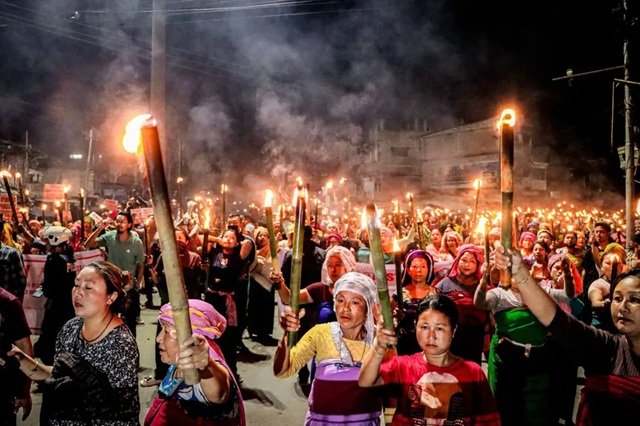
The growing insecurity also triggered a strong public response from the Kuki-Zo community. On July 4, 2026, thousands of people participated in a protest rally organised by the Committee on Tribal Unity (CoTU) in Kangpokpi District, demanding stronger security measures and action against NSCN-IM and ZUF. CoTU blamed the two outfits for the recent attacks on Kuki-Zo villages, including Phaimol in Kamjong District on July 1, and Leikot in Noney District on July 2, and urged the State and Union Governments to review the operational freedom accorded to NSCN-IM under the ceasefire arrangement.
According to partial data compiled by the South Asia Terrorism Portal (SATP), since the formation of ZUF on February 25, 2011, at least 30 armed confrontations have taken place between ZUF and NSCN-IM, resulting in 42 fatalities, including 20 ZUF cadres, 15 NSCN-IM cadres, six militants whose organisational affiliation could not be established, and one civilian caught in the crossfire. After witnessing four fatal encounters during 2023, the rivalry entered another active phase from 2024 onwards. Eight additional confrontations were reported between March 2024 and June 2026, indicating that while recent engagements have generally produced fewer fatalities, both organisations continue to retain the capacity and intent to employ violence in pursuit of territorial and political objectives.
The geographical spread of the violence is equally significant. While earlier confrontations were concentrated largely in Tamenglong District, recent incidents have increasingly occurred across Noney and Kangpokpi, reflecting an expansion of the conflict zone. The repeated disruption of movement along the Imphal-Jiribam Highway, one of Manipur’s principal supply routes, further demonstrates that the implications of the rivalry extend well beyond the immediate areas where gunfights occur.
Unlike many insurgent rivalries driven primarily by personal leadership disputes, the conflict between ZUF and NSCN-IM is rooted in competing political visions. ZUF emerged in February 2011, after a group of NSCN-IM deserters joined former NSCN-K cadres to establish an organisation dedicated to protecting the interests of the Zeliangrong community inhabiting parts of Manipur, Assam and Nagaland. Rejecting the broader Naga nationalist framework advocated by NSCN-IM, the organisation demanded the integration of Zeliangrong-inhabited areas into a separate administrative arrangement within the Union of India. NSCN-IM, by contrast, has consistently pursued the objective of integrating all Naga-inhabited areas under its concept of Greater Nagalim. These competing visions have translated into an enduring struggle for political legitimacy, territorial influence and organisational dominance across Zeliangrong areas.
The rivalry has periodically produced intense violence. Some of the deadliest confrontations occurred during the early years following ZUF’s formation, including the October 2011 clash at Leishok village in Tamenglong District that reportedly killed six NSCN-IM cadres; and the September 2012 encounter in Tamenglong District in which six militants lost their lives. Although the overall intensity subsequently declined, the renewed frequency of clashes since late 2023 suggests that the underlying causes of the conflict remain unresolved.
Several developments appear to have contributed to the latest resurgence. First, both organisations continue to compete for influence over Zeliangrong-inhabited areas where questions of political representation, ‘taxation’ networks and organisational legitimacy remain contested. The competition has intensified as both groups seek to reinforce their local support bases while negotiations with the Government remain inconclusive.
Second, the prolonged nature of ongoing peace processes has created uncertainty rather than resolution. NSCN-IM has remained under a ceasefire arrangement with GoI since 1997 and continues negotiations initiated under the 2015 Framework Agreement. ZUF, meanwhile, entered into a Cessation of Operations (CoO) Agreement with the Central and Manipur Governments on December 27, 2022. Under the Agreement, the outfit agreed to renounce violence and participate in the democratic process under mutually agreed ground rules.
The CoO Agreement, however, failed to produce organisational cohesion. Within days of its signing, a dissident faction publicly rejected the surrender of arms and reaffirmed its commitment to the Zeliangrong homeland movement. The subsequent emergence of references to ZUF-K/JK in several incidents during 2026 indicates that organisational fragmentation has persisted despite the peace process. Such fragmentation has historically complicated conflict resolution across Northeast India, where agreements with one faction frequently generate breakaway organisations that reject negotiated settlements and continue armed activities.
A third factor has been the deteriorating security environment in Manipur since the outbreak of ethnic violence in May 2023. The prolonged conflict has stretched the capacities of the State’s security apparatus and weakened governmental authority across several hill districts. Under such conditions, insurgent organisations have found greater operational space to revive dormant rivalries and consolidate territorial influence. Although the ZUF-NSCN-IM conflict predates the present ethnic violence by more than a decade, the changing security environment has created new opportunities for armed mobilisation.
The allegations surrounding the June 2026 incidents in Kangpokpi illustrate the dangers of this evolving situation. If longstanding intra-Naga rivalries increasingly overlap with the wider Meitei-Kuki conflict, localised militant confrontations could assume broader ethnic dimensions, further complicating security management and peace-building efforts. Such developments would represent a significant deterioration from earlier years, when the conflict largely remained confined to competition between rival insurgent organisations.
The persistence of armed confrontation also raises important questions regarding the implementation of ceasefire and CoO arrangements. While such agreements have undoubtedly contributed to a substantial decline in insurgent violence across the Northeast, they have frequently allowed participating organisations to retain armed structures, preserve command hierarchies and maintain influence over local populations. Consequently, rival groups continue to possess the capability to engage in armed confrontation despite their formal participation in peace negotiations.
The ZUF-NSCN-IM rivalry exemplifies this contradiction. Nearly three decades after NSCN-IM entered into a ceasefire with GoI and more than three years after ZUF signed its CoO Agreement, both organisations continue to engage in periodic armed clashes. The recurrence of such incidents indicates that the enforcement of agreed ground rules remains inconsistent and that existing monitoring mechanisms have been insufficient to prevent renewed violence.
The renewed confrontation between ZUF and NSCN-IM illustrates a broader challenge confronting conflict management in India’s Northeast. The Government has achieved considerable success in reducing the overall intensity of insurgency through sustained security operations and negotiated settlements. Nevertheless, the persistence of violent competition among organisations participating in peace processes demonstrates that ceasefire agreements alone cannot resolve deeply embedded political disputes or dismantle rival militant infrastructures. As long as armed groups retain weapons, preserve parallel organisational structures and continue to compete for territorial and political influence, periodic outbreaks of fratricidal violence are likely to persist. The recurring clashes across western Manipur thus serve as a reminder that durable peace will ultimately depend not only on negotiated agreements, but also on effective disarmament, rigorous enforcement of ground rules and credible political settlements capable of addressing the competing aspirations that continue to fuel armed mobilisation.