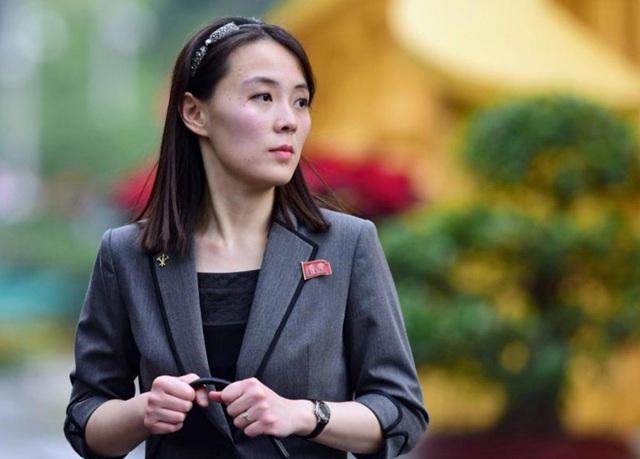
When the most powerful woman in North Korea declared earlier this week, with surgical clarity, that her nation would not return to dialogue with South Korea and would now only engage the United States on the basis of recognition as a de facto nuclear power, the geopolitical reverberations were profound. On the surface, it was a defiant reaffirmation of Pyongyang’s traditional posture. But beneath the steel language lay a significant ideological repositioning — not only in military terms, but in the very architecture of power within the Democratic People’s Republic of Korea.
Kim Yo Jong, long educated in Switzerland alongside her brother, the current Supreme Leader Kim Jong Un, is no mere figurehead or ceremonial consort to dynastic politics. Her emergence as the regime’s primary spokesperson, strategist, and steward of military-diplomatic doctrine marks the first time in decades — if not ever — that such influence has been wielded openly by a female figure in one of the world’s most patriarchal societies. It is not just her words that command attention, but the authority with which they shape the DPRK’s vision of itself and its place in a world increasingly carved by new alliances and unconventional warfare.
I was recently reminded of her presence by Teguh Santosa, an Indonesian journalist of deep insight who has maintained longstanding ties with Pyongyang. I met him some time ago in Beijing, but spoke to him again this week. He recalled an encounter that now reads as a historical prelude. “I first saw her in April 2012,” he said, “during the unveiling of their father Kim Jong Il’s statue in Pyongyang. She seemed to play a vital role in ensuring the ceremony ran smoothly. She moved freely, managing every detail — from organising the elite ranks on the platform of honour to orchestrating the precise arrangement of the military formations.”
Indeed, her strategic poise today reflects that early apprenticeship. Her command over messaging is unmistakable, whether she is warning Seoul of “irreversible rupture” or framing Washington’s overtures as “only America’s wish.” Crucially, these statements were issued unprovoked — not in reaction to sanctions or military drills, but amid conciliatory gestures from South Korea’s new administration. The timing suggests not just retaliation, but design: a pre-emptive framing of future diplomatic parameters on Pyongyang’s own terms.
What makes this pivot all the more remarkable is that it coincides with North Korea’s most accelerated military evolution in decades. Recent intelligence assessments, notably those compiled by Ukraine’s HUR agency, paint a startling picture: elite North Korean troops have fought alongside Russian forces in the Ukrainian theatre. Some 4,000 have reportedly been killed or wounded — a staggering cost — yet in return, these forces have acquired practical combat experience, technological integration, and strategic training in the dynamics of modern war. They have mastered drone deployment, improved missile guidance systems, and enhanced their ability to camouflage and manoeuvre under aerial surveillance.
Such capabilities had once been theoretical or aspirational for Pyongyang. Now, under the shadow of war and forged in alliance with Moscow, they are real and tested. Military analysts believe North Korea’s KN-23 ballistic missiles have reached a new level of accuracy, drawing comparisons to Russia’s Iskander series — a troubling development for US and South Korean defence planners.
Perhaps even more unnerving is the prospect of deeper collaboration. Russia has reportedly shared technological frameworks, including those related to nuclear submarines and decoy systems for evading missile interception. Pyongyang, once isolated by choice and necessity, now emerges as a silent partner in a global triad: Russia, Iran, and North Korea — with China always watching.
But history must never be forgotten amid these alignments. For beneath the surface of military calculus lies an untold story of betrayal and blood that still casts a shadow on Northeast Asian strategy. During the Korean War, while Chinese soldiers perished by the hundreds of thousands on Korean soil — many in bitter, frozen silence — it was Joseph Stalin who emerged victorious in strategic terms. The Soviet Union, having supplied the ideological oxygen and military blueprints for the North’s invasion of the South, deftly avoided direct entanglement.
One of the most tragic episodes of that era unfolded at what is now known as P’aro-ho Lake. Originally named Dapeng Lake for its resemblance to a roc spreading its wings, the reservoir became a site of staggering carnage in May 1951. The 6th Infantry Division of the South Korean Army, under Brigadier General Jang Do-young, decimated the Chinese People’s Volunteer Army’s 63rd Army. In what South Korean sources describe as a modern-day “Sasu Victory,” an estimated 20,000 Chinese soldiers were killed and over 2,600 captured. The bodies of the fallen were buried not with ceremony but by machinery — pushed into the lakebed to be consumed by water. The lake, some claim, turned red. When Syngman Rhee later visited the site, he renamed it “Porok” — a symbol of defeating the so-called barbarians.
This trauma, while rarely acknowledged in Chinese or North Korean discourse, has left a residual legacy in the strategic calculus of both states. The Chinese bled, and Stalin triumphed. It is a bitter history — one that may explain why Pyongyang today, under the stewardship of its most influential woman, turns not to Beijing, but to Moscow, with an almost transactional clarity. Russia gives what North Korea desires: weapons technology, battlefield experience, and diplomatic recognition — not lectures, not conditional aid.
The ideological core of the regime remains unchanged: sovereignty, security, and survival. Yet the way it navigates its external relationships has evolved dramatically. The United States, still operating on the outdated assumption that denuclearisation can be negotiated, may soon find itself playing catch-up in a theatre it no longer understands. Pyongyang does not seek dialogue; it seeks recognition. Not as a rogue state, but as a legitimate nuclear power with global alliances, economic adaptability, and battlefield credentials.
And guiding much of this recalibrated worldview is a woman — discreet yet indomitable, shaped by Western schooling yet fluent in the dialectics of Juche ideology and realist geopolitics. Her rise marks a new era in North Korean politics. Not a softening, but a sharpening. Not liberalisation, but strategic modernisation. She may not speak often, but when she does, the world would do well to listen.
This is not merely a dynastic reshuffle, nor a symbolic gesture towards gender progress. It is, quite possibly, the most radical internal development within the DPRK in half a century — one that fuses nuclear ambition, historical grievance, and feminine authority into a uniquely potent force. The implications are too significant to ignore.
The bottom line: history in this region moves slowly — but when it turns, it turns with thunder. The rise of the most powerful woman in Pyongyang, Kim Yo Jong, if sustained, is not merely potent — it is the signal of that turning.