by Luxman Aravind
As Mahinda Rajapaksa marks yet another year of life today, the silence that surrounds his legacy is both disquieting and telling. Once a towering figure in Sri Lankan politics, a man whose name reverberated with pride, authority, and the unyielding promise of a nation rebuilt after war, he now finds himself all but erased from the public discourse. There are no grand gestures of admiration, no national celebrations, no media tributes to mark the day. The man who reshaped Sri Lanka’s political structure, the very architect of the nation’s post-war recovery, seems to have faded into the shadows of history. It is as if the memory of his leadership has been swept away by the tide of time, leaving only whispers of his name in the corridors of power.
This tragic decline of a political titan is not a rare phenomenon. It is, in fact, a recurring theme in history. Great leaders, whose influence once seemed invincible, often fall into obscurity, their once-celebrated legacies tarnished by time, controversy, and the inevitable decline of their power. In history, Mahinda Rajapaksa is but another example of a leader who achieved extraordinary things, only to see his reputation crumble in the face of personal and political betrayal, ambition, and the corrosive nature of power.
The story of Rajapaksa’s rise and fall recalls the fates of other great men in history—figures whose names once stood as symbols of national strength and resilience, only to be consumed by their own hubris. In Ancient Rome, Julius Caesar, having crossed the Rubicon and becoming the dictator of Rome, epitomised the complexities of absolute power. “Veni, Vidi, Vici,” he proclaimed after a decisive military victory—his conquests were swift and decisive, his reign seemingly invulnerable. But even Caesar, despite his brilliance, was eventually undone by betrayal from within, as those closest to him conspired against him. His famous final words, “Et tu, Brute?” resonate through the ages, a reminder that even the greatest among us are vulnerable to the betrayals of those they trust the most.
In Sri Lanka, Mahinda Rajapaksa, too, was once seen as a Caesar-like figure—his strategic brilliance and determination securing the nation’s future after the long and brutal civil war. Under his leadership, Sri Lanka was freed from the grip of the Tamil Tigers (LTTE), a victory that seemed impossible to many at the time. Rajapaksa’s role in ending the war was celebrated as a defining moment in the history of the island. His words, “We have defeated terrorism, and we have saved our people from a life of fear and violence,” echoed across the country, galvanising the nation and restoring a sense of national pride.
Yet, the same man who ended a decades-long conflict found himself embroiled in a different struggle—a struggle for power, and ultimately, a struggle for relevance. For a leader who once stood tall in the face of external threats and internal divisions, Rajapaksa’s downfall came from the erosion of the very democratic principles that had helped elevate him to power. He who had once declared, “I will never let my country be divided again,” seemed willing to sacrifice the very unity of the political system to retain control. The pursuit of a third term, the removal of term limits, and the unchecked centralisation of power began to cloud his legacy. He may have defeated terrorism, but in his later years, many would argue he allowed the forces of oppression to take root.
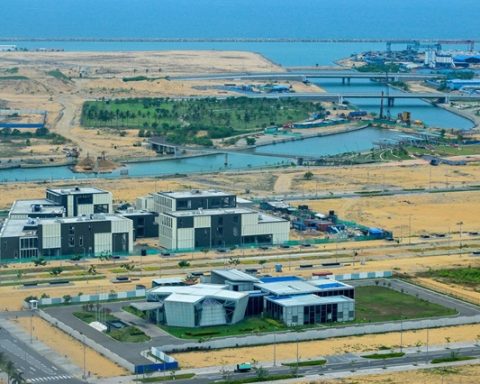
To be a leader is to walk a path fraught with contradictions. Rajapaksa’s presidency was defined by his remarkable achievements in securing peace and rebuilding the nation’s infrastructure. Highways, ports, and airports sprang up under his watch, and for many, his era symbolised progress. Yet, with this progress came a growing centralisation of power and allegations of corruption that would come to define his administration’s final years. His words, “I believe in development, in moving the country forward, no matter the cost,” now ring with the uncomfortable echo of ambition unchecked by the safeguards of democracy. His failure to relinquish power when his time was up, his attempts to extend his presidency beyond constitutional limits, marked the moment when his legacy began to fracture. The same man who had stood as a bulwark against terrorism became a symbol of the very forces that could stifle the nation’s freedoms.
Is this not the paradox of political power? In seeking to protect his legacy, Rajapaksa inadvertently began to dismantle it. History teaches us that no leader can remain untouchable forever, no matter how significant their contributions. Power, once secured, is a relentless and insidious force. As the Roman philosopher Seneca wrote, “No man has a good enough memory to be a successful liar.” Rajapaksa, despite his earlier successes, could not escape the truths that began to surface as his administration faltered. Corruption, nepotism, and oppression were alleged to have seeped into the very heart of his rule, weakening the very political structures he had once built. In the end, it was not the forces of war that brought him down, but the political forces of his own making—the erosion of democratic checks and balances, the sidelining of opposition, and the increasingly undemocratic nature of his rule.
Yet, for all the controversies that marred his later years, one cannot ignore the undeniable complexity of Rajapaksa’s legacy. As a leader, he was a rare breed in the modern world—determined, resilient, and singularly focused on the national interest. He is a figure whose rise to power was hard-won and whose fall was precipitous. And yet, for all his flaws, one cannot dismiss the extraordinary political journey he undertook. “I have faced my share of challenges, but no one can break my spirit. I fight for my country, for its future, for its people,” Rajapaksa once proclaimed. These words, too, resonate beyond the confines of his presidency. For in them lies the essence of a man who, despite his imperfections, believed in the power of leadership and the potential for transformation.
But what, then, is to be made of a man who so fundamentally reshaped a nation only to find himself overshadowed by the very forces of history that once elevated him? Is Rajapaksa merely a cautionary tale, a man who achieved great things only to be undone by the same forces he sought to control? Or is there something more profound at play—something that speaks to the very nature of political leadership itself? Perhaps it is the inevitable truth that power, no matter how well-intentioned, will always be subject to the corrosive effects of time, betrayal, and the relentless march of history.

We must not, in our rush to pass judgment, forget that Rajapaksa’s era was not one of simple triumph or failure. It was an era of both extraordinary achievement and profound disappointment. He may not be the leader many hoped he would become, but neither should he be reduced to the caricature of an authoritarian figure, divorced from the complexities of his time. His legacy, like the legacies of all great leaders, is a story of contradictions—a story of dreams realised and dreams shattered, of battles won and battles lost.
As Mahinda Rajapaksa celebrates his birthday, it is not the absence of celebration that should concern us, but the absence of reflection. For in this moment of quiet, we must ask ourselves: What becomes of a leader whose legacy fades into silence? Does history remember the man for his triumphs, or for his failings? And in the end, does any leader, no matter how great, ever truly escape the inexorable pull of time?
In the words of Winston Churchill, “To each, there comes in their lifetime a special moment when they are figuratively tapped on the shoulder and offered the chance to do a very special thing, unique to them and fit for their talents. What a tragedy if that moment finds them unprepared or unqualified for that which could have been their finest hour.” Rajapaksa’s finest hour may have passed, but it was, without question, one of the most defining in Sri Lankan history. Whether that hour will be remembered for glory or for tragedy is a question that will remain unresolved for years to come.