by Durga
Fatima Bhutto’s The Hour of the Wolf arrives disguised as a book about animals, even as it quietly dismantles that premise almost from the start. What it becomes instead is a study of vulnerability: emotional, political, bodily, and ecological. It is a memoir that understands tenderness not as a private indulgence but as a dangerous state, one that can both rescue and ruin. Bhutto writes with a voice that is at once journalistically alert and mythically saturated, moving between reportage, folklore, evolutionary biology, political memory and intimate confession without ever fully settling into one register. The effect is unsettling and deliberate. This is not a comforting book. It is a book that insists, again and again, that love — whether for men, dogs, wolves or the natural world — is never innocent.
The book opens in the long dusk of the pandemic, with Bhutto walking her pregnant dog Coco through lockdown landscapes where human society has thinned and the wild edges begin to creep back into view. Early on, Bhutto establishes the governing metaphor of the work: animals as witnesses to human moral failure. “Something eerie ties us to the world of animals,” she writes, borrowing from Barry Lopez, “you share hunger and fear with them like salt in blood.” That sentence is not ornamental. It is the ethical spine of the book. Animals in The Hour of the Wolf are not symbols to be decoded; they are parallel lives against which human conduct is measured and found wanting.
Bhutto’s writing is at its sharpest when it resists sentimentality. She refuses the fashionable language of pet-as-child, even as she admits her own proximity to it. Dogs, she reminds us, descend from wolves, sharing “99.96 percent of their DNA,” yet becoming something radically different through domestication, through intimacy with humans, through selective survival. Dogs evolved not to dominate but to attune, to read human emotion, to adapt themselves to our moods and hierarchies. That capacity for attachment, Bhutto suggests, is both their evolutionary triumph and their existential vulnerability. In learning to love us, dogs made themselves dependent on a species capable of extraordinary cruelty.
This recognition bleeds into Bhutto’s account of her own emotional life, particularly her long entrapment in a coercive relationship with a man who promises transcendence while practising control. The parallels between domestication and emotional manipulation are not laboured but quietly devastating. The man tells her he can “take the pain away forever,” that she will “smile when you think of the worst moments of your life; they’ll be gone, erased.” It is the language of salvation, of grooming disguised as care. Bhutto’s great achievement here is refusing to frame herself as naïve. Instead, she locates her vulnerability in structural loneliness — political exile, public exposure, the assassination of her father — and in the cultural myth that strong women are immune to coercion.
Animals, throughout the book, function as moral correctives. Bhutto recounts the Islamic story of Imam Reza and the deer who returns willingly to be killed after feeding her young, only for the hunter to abandon his violence in shame. “That cruelty can be interrupted,” Bhutto reflects, “that men can be shamed, that decency and surrender can bring an end to suffering.” This is not nostalgia for moral purity; it is a rebuke to modern cynicism. Bhutto insists that shame, properly directed, remains a political force. In a world that rewards domination, the animal who keeps her promise becomes the ethical centre.
The memoir is haunted by inheritance — not only familial but civilisational. Bhutto moves fluently from Pakistani politics to Inuit cosmology, from Buddhist parables to climate science, without ever presenting these traditions as interchangeable. Instead, she traces how animals recur across cultures as mediators between human arrogance and ecological consequence. Sirius, the Dog Star, appears repeatedly, named by different cultures as wolf, dog, hunter, celestial companion. It becomes a marker of grief and orientation, a way of locating the self in a universe that refuses human centrality. When Bhutto recalls believing, as a teenager, that Sirius signalled her murdered father’s presence, the moment is quietly devastating. Belief here is not superstition but survival.
If the book risks excess, it does so in its accumulation of knowledge. Bhutto is a compulsive contextualiser. She marshals studies on oxytocin release in dogs, archaeological evidence of joint human-dog burials, climate data detailing the unequal devastation wrought by global heating. At times, the density threatens to overwhelm the narrative. But this is also the point. The Hour of the Wolf resists the clean arc of memoir because Bhutto refuses the illusion that private suffering can be disentangled from collective catastrophe. The loneliness of a woman in lockdown is inseparable from the loneliness of a species that has destroyed its own habitat.
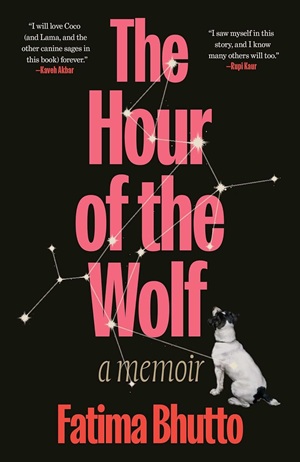
The most provocative passages are those where Bhutto confronts her desire for motherhood alongside her devotion to animals. She admits to “forgetting that they are dogs, not babies,” to projecting longing onto creatures who neither ask for nor comprehend it. This is not presented as virtue. It is presented as hunger. Bhutto refuses the moral comfort of saying that love, in any form, is automatically redemptive. Love, she suggests, can be selfish, misdirected, consuming. And yet, she does not abandon it. She insists that love remains the only force capable of countering terror. Quoting Malcolm X, she calls “the removal of fear” the greatest benediction. Only love can do that — but only if it is stripped of domination.
By the book’s end, Bhutto arrives at a chastened, unsentimental affirmation. Dogs love us “at our worst,” she writes, and in doing so remind us that redemption is possible, but not guaranteed. The wild will survive us, she suggests, until it cannot. The question is not whether animals can save us, but whether we are capable of learning what they have always known: that survival depends not on mastery, but on restraint, attentiveness, and an acceptance of our own smallness.
The Hour of the Wolf is not a comfort read. It is a book that asks the reader to sit with discomfort, to recognise themselves not as protagonist but as participant in a long history of harm and attachment. Bhutto writes with controlled fury and rare moral clarity. In an age addicted to therapeutic narratives and curated vulnerability, this memoir insists on something far riskier: accountability.