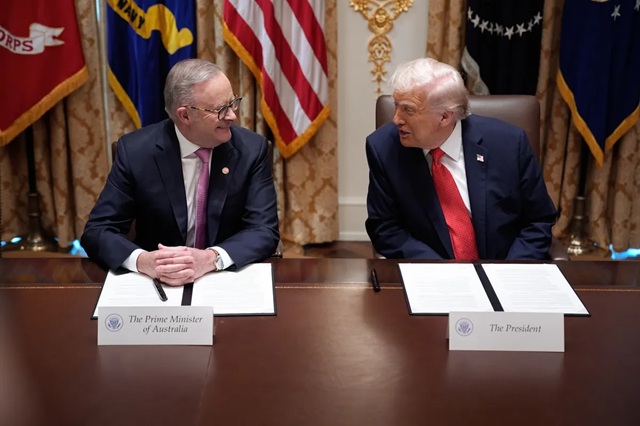
In a move signaling continuity in U.S. defense policy, former President Donald Trump expressed strong support for the Aukus security partnership during a meeting with Australian Prime Minister Anthony Albanese on October 20. The trilateral accord, originally signed in 2021 between Australia, the United Kingdom, and the United States, aims to counter China’s military expansion in the Indo-Pacific region.
Central to Aukus is a controversial, multi-decade project to develop a fleet of nuclear-powered submarines for Australia, a plan expected to cost hundreds of billions of dollars. Under the agreement, the U.S. will sell Australia three Virginia-class submarines—two from its existing fleet in 2032 and 2035, and a newly built vessel in 2038—while Australia and the UK will jointly design a next-generation submarine using American technology, projected for completion in the 2040s. The UK also plans to expand its own nuclear-powered fleet from seven to as many as 12 vessels.
The Aukus pact marked the first time the United States shared its highly sensitive submarine technology since 1965, a move that previously caused a diplomatic rift with France after a $66 billion conventional submarine contract for Australia was abruptly canceled.
The security agreement is broader than submarines, encompassing strategic technology sharing in areas such as quantum computing, artificial intelligence, and advanced weaponry, prompting interest from Japan, South Korea, and New Zealand. According to an unreleased U.S. State Department assessment made available to Bloomberg News, Japan is considered a “capable participant” in the partnership’s second pillar due to its investments in advanced defense systems, cybersecurity, and industrial capabilities.
The future of Aukus had been uncertain following Trump’s return to office, especially after his administration commissioned a review of the pact in June to determine whether it aligned with his “America First” agenda. The review has focused on ensuring the U.S. maintains naval superiority and that allies contribute a larger share to collective defense. The Australian government has indicated its commitment by announcing at least $9 billion in related defense investments and delivering a $325 million downpayment to the U.S. earlier this year.
During the October 20 meeting, Trump reassured officials that the partnership was moving “very rapidly and very well,” signaling that Aukus would continue, potentially even on an accelerated timeline.
Despite broad support from defense establishments, the pact has faced criticism. U.S. lawmaker oversight has highlighted delays and cost overruns in the Virginia-class submarine program, while former Australian Prime Ministers Paul Keating and Malcolm Turnbull have questioned its impact on national defense sovereignty. China has repeatedly condemned the agreement as a threat to nuclear non-proliferation and a contributor to regional arms tensions.
Bloomberg News previously reported that the Aukus initiative has sparked renewed interest among Indo-Pacific nations, with Japan, South Korea, and New Zealand evaluating potential participation in the strategic technology-sharing components of the pact.