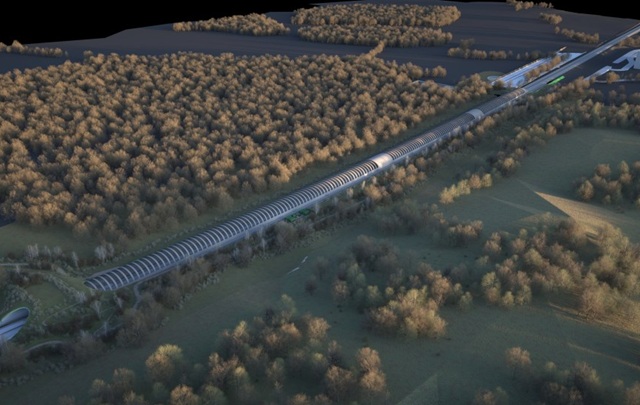
In one of the most expensive environmental projects in the UK’s history, a £100 million ($130 million USD) bat tunnel is being constructed as part of the HS2 high-speed rail project, after a 12-year-long planning process. This tunnel, officially known as the “Sheephouse Wood Bat Mitigation Structure,” aims to protect the Bechstein’s bat, an endangered species whose habitat in Buckinghamshire is threatened by the railway’s path. According to The Times, UK, the creation of this bat tunnel has sparked debates over the costs and priorities of environmental laws, and the decision to prioritize bat protection has led to a controversial outcome.
The origins of this costly initiative date back to 2013, when Bat 60, a Bechstein’s bat, was captured and tagged with a radio transmitter while foraging in the ancient woodland of Sheephouse Wood, which lies along the proposed HS2 route. As part of a conservation effort, this bat became a central figure in the planning of the HS2 railway line. The project was required to ensure that the Bechstein’s bat, along with other species in the area, would be protected from the potential hazards of the high-speed trains. Under the Wildlife and Countryside Act 1981, the Bechstein’s bat is classified as a protected species due to its rarity and international importance.
Following Bat 60’s radio-tagging, a significant challenge arose for HS2: how to build the high-speed rail line without endangering the lives of these bats. As The Times, UK, reports, the protection of the Bechstein’s bat led to numerous negotiations with various environmental agencies, such as Natural England, which mandated that HS2 ensure “no bat death is acceptable” along the proposed route. The project had to comply with this strict regulation, with officials emphasizing the need to maintain the “favourable conservation status” of the bat population in the area.
The consequences of these regulations quickly escalated into a lengthy and costly process. According to The Times, UK, over the course of a decade, HS2 explored multiple potential solutions to mitigate the impact of the rail line on the bat population. Options such as fences and acoustic deterrents to scare the bats were considered but ultimately deemed inadequate. A full tunnel for the bats was deemed too expensive, and alternative measures like rerouting the line or slowing down the trains were also dismissed.
After extensive planning, HS2 finally concluded that the only viable option was to build a kilometre-long tunnel specifically designed to allow the bats to safely cross the railway without being disturbed by the passing high-speed trains. The design chosen was a concrete and mesh arch, which would create a safe passage for the bats to fly above the trains.
However, the tunnel has come under scrutiny due to its massive cost. Originally projected at £40 million ($52 million USD), the price tag has now ballooned to £100 million ($130 million USD), a figure that has raised eyebrows among both the public and politicians. The Times, UK, highlights that this significant rise in cost has sparked debate on whether the measures taken to protect the bats are justified. The price amounts to roughly £300,000 ($380,000 USD) for each Bechstein’s bat in the region, a figure that some critics believe is excessive, particularly when the British population of Bechstein’s bats has increased dramatically in recent years, from around 1,500 individuals in 2013 to an estimated 21,600 today.
Political leaders such as Sir Keir Starmer have pointed to this project as an example of the need to reform the UK’s planning system. Starmer has described the expensive bat tunnel as a “ridiculous spectacle,” arguing that while the intentions behind it are good, the financial and regulatory consequences are deeply problematic. The Times, UK, cites this as part of a broader frustration with the lengthy and complex approval process for major infrastructure projects like HS2, which often results in excessive spending on environmental mitigation measures.
Despite the controversies, the project has moved forward, and construction is now underway. HS2 officials, including CEO Mark Wild, have defended the project, explaining that it is necessary to comply with the law to protect wildlife. Wild acknowledged that £100 million ($130 million USD) was an “extraordinary amount of money,” but emphasized that HS2’s duty was to follow environmental laws that require them to minimize harm to protected species, including the Bechstein’s bat. As he told MPs, the planning and environmental consents process comes with high costs, but they are largely out of HS2’s control.
The local community has also voiced its concerns. Buckinghamshire Council, which has long opposed the HS2 project, remains critical of the tunnel, accusing HS2 of unnecessarily damaging the environment and disrupting the lives of local residents. Despite these objections, however, the Planning Inspectorate has approved the construction of the bat tunnel. Local opposition, including a tree preservation order issued in 2023 to stop work on the structure, has delayed the project’s progress, but it is expected to be completed by the time HS2 trains begin running in 2030.
While the tunnel is set to protect Bat 60 and its fellow Bechstein’s bats, the broader implications of this project raise questions about the balance between environmental protection and economic efficiency. As The Times, UK, notes, this example illustrates how good intentions—such as ensuring the safety of endangered species—can sometimes lead to outcomes that many see as disproportionate or inefficient. With an estimated £300,000 ($380,000 USD) spent per bat, the bat tunnel has become a highly visible symbol of the tensions between environmental concerns and large-scale infrastructure development.
As HS2 prepares to complete the tunnel and begin rail services, it will be interesting to see how other high-profile projects address the challenge of balancing environmental protections with financial constraints. The bat tunnel saga serves as a cautionary tale of how planning regulations, when taken to extremes, can result in solutions that raise more questions than answers.