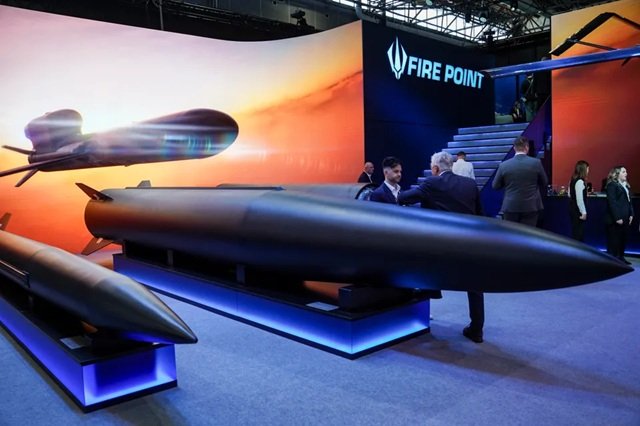
Ukraine’s domestic missile programme appears to be entering a new phase as defence manufacturer Fire Point advances the development of high-speed ballistic missiles designed to complement the country’s growing arsenal of long-range strike weapons. The latest indications came after Fire Point co-founder Denys Shtilierman published a video on 20 July showing the launch of what appeared to be a ballistic missile, describing the footage with a single word: “Beauty.”
Shtilierman did not identify the missile shown in the video, leaving open the possibility that it was one of three systems under development by the company: the FP-7, its air defence variant FP-7x, or the longer-range FP-9. Ukrainian news outlet United24 suggested the footage may have shown the first launch of the FP-9, although Fire Point declined to comment when asked about the video.
Regardless of the missile’s identity, the footage suggests continued progress in Fire Point’s effort to provide Ukraine with a capability it has previously lacked: fast-moving ballistic missiles with ranges exceeding 500 kilometres and substantial destructive power. Such weapons are expected to be significantly more difficult for Russia to intercept than drones or conventional cruise missiles, including over heavily defended areas such as Moscow.
Since its establishment in 2022, Fire Point has steadily expanded from developing combat drones to producing increasingly sophisticated long-range missile systems. The company first gained prominence through its FP-1 long-range drone, which it says can carry a 60-kilogram warhead over distances of up to 2,600 kilometres. According to Ukrainian reports, these drones have already been used in attacks on Russian oil refineries as part of Kyiv’s broader strategy of targeting Russia’s economic infrastructure.
Fire Point later introduced the FP-2, which resembles the FP-1 but is designed to carry up to 200 kilograms of explosives. The company says its latest version has a range of 370 kilometres. Ukrainian authorities recently stated that an FP-2 struck a Russian military convoy near the Crimean Peninsula.
The company’s largest operational weapon is the six-tonne FP-5 cruise missile, known as the “Flamingo”. Ukrainian President Volodymyr Zelenskyy announced in late June that several FP-5 missiles had struck the Titan-Barrikady research and production centre in Volgograd, causing a fire at the site. According to media reports, the facility manufactures launch systems for Russia’s Iskander-M short-range ballistic missile and the Yars and Topol-M intercontinental missile systems.
Fire Point says the Flamingo can carry a warhead weighing up to 1,150 kilograms and travel as far as 3,000 kilometres. However, missile specialists note that its relatively slow speed of between 700 and 900 kilometres per hour and its lack of stealth capabilities make it more vulnerable to Russian air defences than ballistic missiles. Markus Schiller, an associate researcher at the Stockholm International Peace Research Institute (SIPRI), described the missile as effectively “a small aircraft” travelling at subsonic speed.
Military analyst Fabian Hoffmann of the Norwegian Institute for Defence Studies analysed ten Flamingo operations conducted between August 2025 and July this year. His assessment concluded that only between nine and twelve of more than forty cruise missiles reached their intended targets. A separate analysis by the Ukrainian newspaper Ukrainska Pravda also suggested that Russian air defences intercepted a significant proportion of the missiles.
Analysts argue that penetrating Moscow’s layered air defence network requires a different class of weapon. More than one hundred air defence systems are reportedly deployed around the Russian capital, presenting a major obstacle for both long-range drones and cruise missiles. According to the Kyiv Independent, Fire Point co-founder Shtilierman has acknowledged the difficulty of overcoming those defences using existing systems.
Ballistic missiles present a different challenge. Unlike cruise missiles, which fly at relatively low altitudes, ballistic missiles follow a high, arcing trajectory before descending rapidly onto their targets. Military analyst Etienne Marcuz of the Fondation pour la recherche stratégique said most of the flight takes place at altitudes beyond the reach of many air defence systems, leaving only the final phase available for interception. He estimated that defenders generally have only 20 to 30 seconds to destroy an incoming ballistic missile, and if the initial interception fails, “there are no further opportunities.”
Speed further complicates interception. Fire Point says the FP-7 can exceed 5,000 kilometres per hour, roughly six times faster than the Flamingo cruise missile. The company states that the missile is based on the 48N6 interceptor used by Russia’s S-400 air defence system, while its navigation system was developed internally. The FP-7 has a reported range of 200 kilometres.
Ukraine is also reportedly developing another short-range ballistic missile known as the Hrim-2 or Sapsan through two separate Ukrainian companies. President Zelenskyy said in December 2025 that the weapon had already been used against Russian forces. Media reports indicate it has a range of around 300 kilometres, allowing strikes well behind the front lines but not as far as Moscow.
The FP-9 represents Fire Point’s most ambitious programme. According to the company, the missile is designed to travel up to 855 kilometres, bringing Moscow within range. Fire Point estimates a maximum speed of around 8,000 kilometres per hour while carrying a payload of up to 800 kilograms, giving it destructive capability comparable to the Flamingo but with substantially greater speed.
In an interview published in late June on the Ukrainian YouTube channel Pressing, Shtilierman said the FP-9 had completed nearly all major development milestones, with only ground testing of its engine remaining. “As soon as a test flight shows that everything is working perfectly, the next flight should head towards Moscow,” he said. In another interview, he expressed confidence that the missile’s high impact speed would allow some to penetrate Russian air defences, estimating that “about 25 per cent will get through and hit the target”. He also claimed the FP-9 would be faster than Russia’s Iskander missile.
According to military analyst Etienne Marcuz, Ukraine has destroyed or disabled several Russian S-400 air defence batteries in recent months, potentially making it more difficult for Russia to defend its territory against future ballistic missile attacks. He suggested that Moscow now risks facing “the same fate as Ukraine”, after Russia recently launched more than 40 missiles against Kyiv in a single night.