“The United Nations was not created in order to bring us to heaven, but in order to save us from hell.” — Dag Hammarskjöld
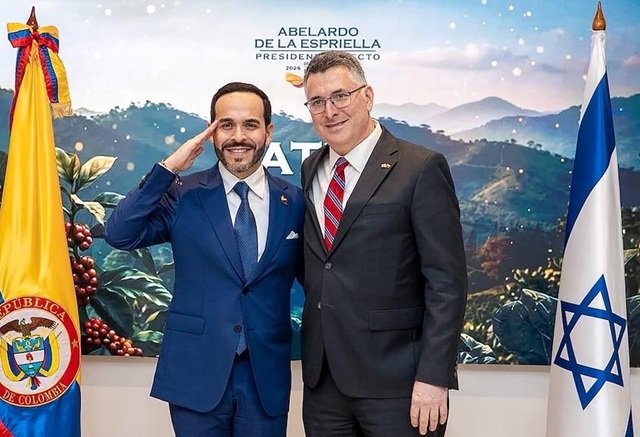
Colombia’s decision to recognise Israeli sovereignty over the occupied Syrian Golan Heights is more than an unusual diplomatic gesture. It touches on one of the clearest principles in the post-war international order: that territory cannot lawfully be acquired through force. Bogotá’s recognition decision made Colombia only the second United Nations member state, after the United States, to recognise Israeli sovereignty over the territory, a development also documented in international reporting. The Colombian government justified the move by pointing to Israel’s security needs and the strategic value of the plateau. The decision represents a striking departure from the international consensus surrounding the Golan and from Colombia’s previous multilateral approach.
Security concerns are real in the Golan. The territory overlooks northern Israel, borders a Syria that has endured years of war and political upheaval, and has long occupied a central place in Israeli military planning. Colombia’s policy shift explicitly reflects this security argument. Israel has also emphasised the strategic importance of areas around the Golan amid instability inside Syria, including through its military presence near the separation zone. Yet security concerns and sovereign title are not the same legal question. A state may regard control of commanding terrain as essential to defence, but that judgment cannot by itself transform military control into internationally recognised sovereignty.
Where International Law Draws the Line
The legal position surrounding the Golan is unusually clear. Israel captured most of the territory from Syria during the 1967 Arab-Israeli War and extended its laws, jurisdiction and administration there in 1981. Security Council Resolution 497 responded unanimously by declaring that decision null and void and without international legal effect. The resolution has never been revoked. The United Nations Charter also requires states to refrain from using force against the territorial integrity or political independence of another state. Colombia can alter its own diplomatic position. It cannot, through recognition alone, erase this established international framework. This principle is not an abstract legal preference that governments may invoke only when politically convenient.
Recognition Does Not Rewrite the Map
Colombia’s recognition therefore matters less because it immediately changes the map and more because it tests the resilience of the rules protecting maps from being changed by military power. The latest General Assembly position demonstrates how isolated such recognition remains. In December 2025, 123 states supported the Syrian Golan resolution, again rejecting Israel’s extension of its laws and administration over the territory. Meanwhile, the United Nations observer mission continues to operate under arrangements created after the 1974 disengagement between Syrian and Israeli forces. These institutions embody an international position that remains fundamentally different from Colombia’s new diplomatic stance.
This is where Pakistan’s objection acquires wider significance. Islamabad’s position is consistent with its longstanding support for Syrian sovereignty over the occupied Golan. Pakistan has previously called for the return of the Golan Heights and has backed collective Muslim positions demanding an end to occupation of Arab territories, including through the Arab and Islamic summit framework. Its rejection of Colombia’s decision should therefore be understood not as an improvised reaction but as part of an established foreign policy rooted in sovereignty, territorial integrity and respect for United Nations resolutions.
A Wider International Rejection
Pakistan is far from isolated in taking this position. Syria has rejected Colombia’s declaration and insists that the Golan remains an inseparable part of Syrian territory. These reactions demonstrate that Colombia has not generated a new international consensus. Rather, it has placed itself outside a remarkably durable multilateral position that survived Washington’s recognition in 2019 and remains embedded in United Nations practice today.
Supporters of Colombia’s decision may argue that international law cannot operate in isolation from strategic realities. They can point to instability in Syria, armed organisations operating across the region and Israel’s concerns about threats approaching its northern frontier. Such arguments deserve consideration because states possess legitimate security interests. The difficulty arises when security necessity becomes a pathway to permanent sovereignty. Almost every territorial dispute contains a security argument. If military possession can eventually mature into lawful ownership whenever enduring danger is invoked, the prohibition on territorial acquisition through force loses much of its meaning. That outcome would make international boundaries increasingly dependent upon power rather than negotiated settlement.
Why the Precedent Matters Beyond Syria
The danger reaches well beyond the Middle East. Smaller and medium-sized states depend heavily on predictable international rules because they cannot rely upon military strength to defend every territorial claim. A world in which prolonged occupation gradually becomes ownership through diplomatic recognition would reward power over law. It would also encourage states to establish irreversible realities on the ground and subsequently search for governments willing to legitimise them. Once such reasoning becomes normalised, the consequences cannot easily be confined to one disputed territory.
Negotiation anchored in international law offers a more credible route than diplomatic declarations attempting to settle disputed sovereignty unilaterally. Colombia remains free to determine its foreign-policy alignments, but other states are equally entitled to reject the implications of its decision. Pakistan’s position ultimately defends a principle that serves every sovereign state, particularly those that cannot afford an international order where borders are decided through force and validated later through political convenience.
Recommendations
The international community should reaffirm Security Council Resolution 497 and resist recognition of territorial changes created through force. It should strengthen United Nations monitoring and diplomatic pressure for compliance with existing resolutions, while supporting Syrian-Israeli negotiations that address legitimate security concerns without legitimising annexation. At the same time, territorial-integrity standards should be applied consistently across international disputes, without political double standards.