Chinese President Xi Jinping used a landmark anniversary celebration of the Chinese Communist Party to reaffirm Beijing’s longstanding claim over Taiwan, intensify his call for an uncompromising fight against corruption, and outline the priorities that continue to shape the country’s political, military and economic agenda.
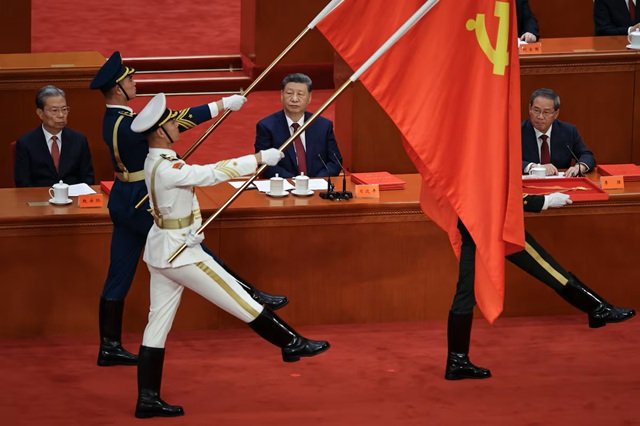
Addressing a commemorative gathering at the Great Hall of the People on the edge of Beijing’s Tiananmen Square, Xi described the “complete reunification of the motherland” as a historic mission from which the ruling party would not waver. His speech marked the 105th anniversary of the Communist Party, which has governed China since 1949, and reflected the themes that have defined Xi’s leadership since he assumed power in 2012.
“Solving the Taiwan question and achieving the complete reunification of the motherland is a historic mission to which our party remains unwaveringly committed,” Xi told party members and senior officials gathered for the ceremony. While the Chinese leader has repeatedly made similar declarations in recent years, his latest remarks come against a backdrop of heightened geopolitical tensions surrounding the self-governed island, which Beijing considers an inseparable part of its territory.
Taiwan remains one of the most sensitive issues in China’s relations with the United States, which continues to provide military support to the island. Xi’s speech repeated Beijing’s opposition to any movement toward Taiwanese independence and warned against outside involvement. He called for resolutely combating separatist forces supporting Taiwan’s independence while opposing what he described as interference by external forces. At the same time, he urged greater unity among people on both sides of the Taiwan Strait and deeper cross-strait cooperation.
The Taiwan issue has remained at the center of Xi’s diplomacy. During a meeting with U.S. President Donald Trump in Beijing in May, Xi reiterated that Taiwan represented an untouchable red line for China. Following the visit, Trump said he had no intention of encouraging any move toward formal independence for the island.
Beyond Taiwan, Xi devoted much of his address to the Chinese Communist Party itself, emphasizing discipline, unity and ideological commitment. He urged party members to promote what he described as a fighting spirit, strengthen mass leadership and continue comprehensive and rigorous governance of the organization.
Central to that message was the anti-corruption campaign that has become one of the defining features of Xi’s presidency. He pledged to continue what he called an arduous, long-term and all-out battle against corruption, portraying the effort as essential to preserving the party’s strength and authority.
According to official figures cited during the anniversary period, more than seven million public officials have been investigated and sanctioned by disciplinary inspection and supervisory bodies since Xi took office in 2012. The campaign has reached every level of government, from local officials to ministers and senior military commanders. Xi has repeatedly stressed the importance of maintaining the Communist Party’s absolute control over the People’s Liberation Army, making military discipline a central component of the broader anti-corruption drive.
The anniversary also served as a reminder of the scale and reach of the Communist Party more than a century after its creation. Founded in 1921 by Mao Zedong and 12 other delegates with Soviet backing in Shanghai’s former French Concession, the party has grown into an organization with more than 101 million members. Its influence extends throughout China’s political system and society through approximately 4.7 million party cells, while official statistics show that women account for 31.5 percent of its membership.
Today, the party continues to describe itself as Marxist-Leninist under its constitution while also embracing what it officially calls “Xi Jinping Thought on Socialism with Chinese Characteristics for a New Era,” a doctrine that has been incorporated into the party’s statutes alongside Mao Zedong’s ideological legacy.
China itself has undergone a profound transformation during the party’s century-long rise. The modest Shanghai residence where the Communist Party was founded remains preserved as a tourist destination, standing amid one of China’s most modern commercial districts. Visitors encounter a historical site surrounded by international retailers and restaurants, illustrating the country’s evolution under what its leadership describes as socialism with Chinese characteristics.
Xi’s speech also addressed the country’s economic priorities as China seeks to adapt to changing domestic and global conditions. The world’s second-largest economy, home to more than 1.4 billion people, has experienced slower growth following the collapse of a major property boom. Even so, China’s economy continues to expand at a pace that remains higher than many other leading economies.
The country has also become an export powerhouse, recording a trade surplus that has exceeded one trillion euros for the first time. At the same time, that imbalance has created challenges for trading partners and intensified international attention on China’s export-driven economy.
Against that backdrop, Xi emphasized the need to build a new engine of growth centered on technological innovation. He called for accelerating the establishment of a new development pattern while vigorously promoting what he described as high-quality development, signaling the leadership’s continued focus on advanced industries as the country adjusts to slower property-led expansion.
The anniversary ceremony reflected both continuity and change within China’s ruling party. More than a century after its founding, the organization remains the country’s dominant political force, overseeing every level of government while shaping national policy on issues ranging from economic modernization to military development and territorial claims.
Xi’s address brought those priorities together in a single message, reaffirming the party’s commitment to national reunification, continued anti-corruption efforts, strict control of the military and economic transformation through technological advancement. As the Chinese Communist Party enters its 106th year, those themes remain at the center of the leadership’s agenda and continue to define the direction outlined by its general secretary.