Tensions are rising across the Asia-Pacific region after U.S. President Donald Trump referred to North Korea as a “nuclear power,” a statement that has raised concerns about a potential shift in U.S. foreign policy. His remarks have sparked alarm among key allies in the region, especially as they signal a potential break from diplomatic precedent and could imply acceptance of North Korea’s nuclear arsenal.
In December 2023, North Korea test-fired the Hwasong-18, an intercontinental ballistic missile capable of carrying a nuclear warhead to the U.S. mainland. Despite this, the U.S. and its allies have traditionally avoided officially recognizing North Korea as a nuclear state. However, in a recent interview, Trump referred to North Korean leader Kim Jong-un as “a nuclear power,” an acknowledgement that diverges from long-standing diplomatic norms.
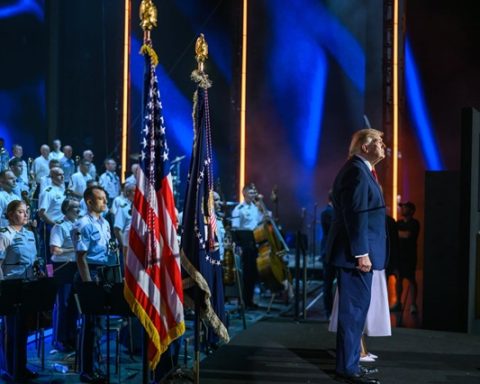
Trump’s statement, made during a conversation with reporters on Monday, included a remark about his relationship with Kim Jong-un. “He liked me, I liked him. We got along very well… He is a nuclear power. We got along. I think he will be happy to see me coming back,” Trump said, signaling his belief that he could resume diplomacy with the North Korean leader if re-elected.
This comment comes amid growing concern among U.S. allies in Asia. The foreign ministers of the Quad nations—Australia, India, Japan, and the United States—met in Washington, reaffirming their commitment to maintaining a free and open Indo-Pacific. Their solidarity is largely motivated by the rising assertiveness of China, but Trump’s remarks have cast doubt on his administration’s approach to regional security, particularly regarding North Korea.
The use of the term “nuclear power” in diplomatic discourse has significant implications, as it is generally reserved for established nuclear-armed states such as the U.S., Russia, China, France, and Britain. By referring to North Korea in this way, Trump appears to accept the country’s nuclear capabilities, undermining decades of U.S. policy that sought to prevent North Korea from being recognized as a nuclear state.
The implications of Trump’s comments are further compounded by his skepticism about the U.S.-South Korea alliance. He has previously threatened to reduce the number of U.S. troops stationed in South Korea or force the country to pay more for their presence. This stance has prompted concerns that Trump may be willing to strike a deal with Kim that focuses on limiting North Korea’s long-range nuclear missiles—those capable of targeting the U.S.—while tolerating shorter-range weapons that pose a direct threat to South Korea and Japan.
South Korea’s response to this evolving situation is crucial. Editorials in South Korean media, such as the Dong-A Ilbo, have expressed concern over Trump’s remarks, warning that they represent a significant deviation from the U.S.’s longstanding position of not officially recognizing North Korea as a nuclear power. Some South Korean lawmakers have even suggested that this shift could lead to calls for South Korea to develop its own nuclear arsenal, with MP Yoon Sang-hyun noting that “the moment North Korea is recognised as a nuclear power, and the moment there is the big deal between North Korea and the United States, South Korea will become nuclear-armed.”