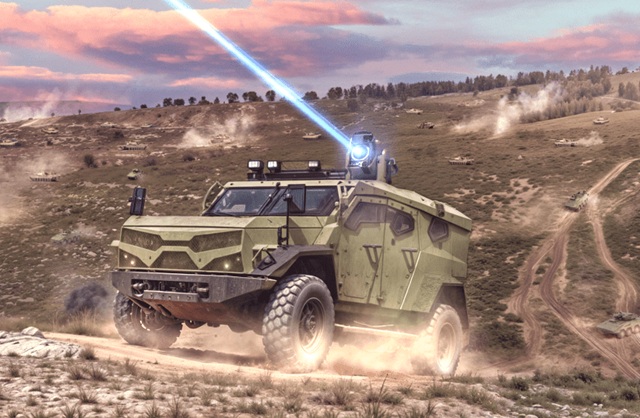
It was a big surprise to defense experts when, this last week of May, 2025, Israel’s Defense Force, the IDF, revealed that it had a new, small tactical laser already deployed on command posts and some tanks facing Hezbollah in the north and Hamas in the south. The IDF said that the laser, a system still without a name, knocked out dozens of Hezbollah drones and was very effective. The IDF also said that it has integrated the new laser with its Trophy active defense system, so it could enhance Trophy in knocking out drones and mortars.
The US Army should consider the Israeli laser linked to the Trophy active defense system, and for overseas command posts and forward operating bases.
Active defense is an important innovation for tanks and armored vehicles. The system can detect and destroy incoming threats. There are a number of active defense platforms out there, but the only one proven under combat conditions is Israel’s Trophy. Russia, for example, has a new system called Afganit for its new Armata tanks, and another, heavily promoted system, called Arena (and Arena M), which so far has not been deployed.
The IDF laser story and a video released by the IDF filled Israeli news publications and quickly spread abroad.
The IDF did not provide much in the way of details. It did not say the type of laser or anything about its frequency, how it selected targets, nothing about its cost, only that the system performed well and was even effective in poor weather (a significant problem for lasers which, after all, are high intensity light beams).
Israel already has deployed a high powered laser system called Iron Beam. The new tactical laser is much smaller and far more mobile.
There was no comment from the Pentagon about the tactical laser.
The US Army has deployed at least five different tactical lasers, although there is, as yet, no evidence they have been used against active threats. The Army has deployed a 50 Kw laser, called DE-M-SHORAD, on some Stryker armored vehicles which are under evaluation at CENTCOM.
The US Navy also has a number of laser systems, some deployed. One of them, HELCAP (High Energy Laser Countermeasure and Protection), is optimized against cruise missiles.
It isn’t clear if lasers were used by the Navy against Houthi missiles in the Red and Arabia seas for fleet protection. The Navy is still working out deployment issues, including the ability to supply enough power to operate the lasers they have. One report says “Simply put, most of the U.S. Navy’s warships don’t have the power output for a laser that could instantly destroy a missile. It will likely require nuclear reactors – like those on the Nimitz-class and Gerald R. Ford-class supercarriers. Lasers also need to remain locked on a target, which could be a problem for warships moving at high speeds in rough seas.”
It looks like Israel has taken a somewhat different approach. The Israelis are not trying to knock out missiles with lasers –they use their air defenses, starting with Iron Dome, to do that. Instead, the Israeli approach is to differentiate threats and match the system to the threat. That is why the decision to link the Trophy active defense system to the new laser is especially interesting, as it can use Trophy to deal with anti tank missiles and let the laser go after drones and mortar rounds.
This lesson should be of interest to the US Army. While the Army seems hell-bent on replacing the current-day Abrams M-1 tank with “something new,” it could significantly improve the protection of the existing tank force if it wanted to do so.
Unfortunately the Army has been adverse to foreign technology, even when it works. For example, despite the huge success of Israel’s Iron Dome, the Army only bought a couple of batteries, under pressure from Congress, and then trashed the program.
Not only is Iron Dome effective, but in the era of missile defenses, it is amongst the lowest cost per round. An interceptor missile for Iron Dome, called Tamir, costs around $55,000. Not cheap, obviously, but a lot less than the NASAMS (a joint US-Norway air defense program) that uses the AIM-120 air to air missile in a ground launched role. That missile costs between $1.09 and $1.37 million per round.
For the record, the US Marines decided to adopt the Tamir missile for its new Medium Range Intercept Capability, unlike the Army.
Lasers, of course, are the cheapest yet, since a single shot costs only a few dollars, and that cost is mostly for electricity.
The Army has also decided not to go forward with the Trophy system because it is “too heavy” and “not integrated” with other defenses. This explanation does not pass the giggle test, but it is typical for the Army to disregard available and proven solutions, jacking up the cost of acquisition and betting, a pig and a poke, that something new will work better.
The Army already purchased 336 Trophy systems (without any plan to acquire more for its active fleet of 2,300 tanks). Even if the Army gets the money to develop a new tank, a new active defense system, and maybe a new laser, the timeline for that is at least 8 to 10 years. It would make sense to make a deal with Israel for the new laser, integrate it with existing Trophy deployments, and give our troops some protection if they get into any firefight where drones are used heavily by a potential enemy.