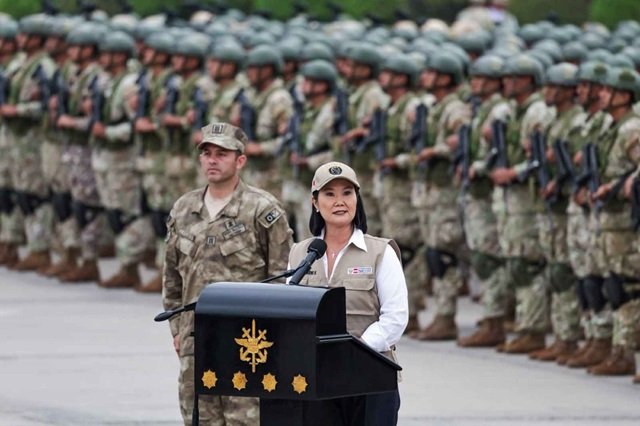
Peruvian President Keiko Fujimori has announced the creation of a unified command integrating the Armed Forces and National Police to combat organised crime, ordering security forces to conduct joint operations, arrests and searches as the government seeks to respond to a surge in public concern over violence.
Fujimori made the announcement on Wednesday during a meeting of the National Security and Defense Council, known as COSEDENA, at the Army General Headquarters in Lima’s San Borja district. The new command will operate from a large control and operations centre at the headquarters and will direct actions by the military and police.
“I announce the establishment of a unified command to confront and defeat crime. Here, at the Army Headquarters, we will establish a large control and operations center to direct all actions,” Fujimori said.
The president, who is also supreme commander of the Armed Forces, said the government had taken “a major change” in its approach to organised crime. She said the Executive Branch, Army, Navy, Air Force and National Police had made decisions intended to protect the population and promised to use what she described as the full legitimate force of the State within the Constitution.
“The Peruvian people are desperate because they go out to work every day afraid of being extorted or killed in a shooting,” Fujimori said. She also criticised previous governments, saying Peruvians were disappointed that authorities had done little to defeat crime over the past 26 years.
The new security structure will include a special elite group comprising police and Armed Forces personnel for special operations. Fujimori said security forces would “appear where they least expect us” to conduct searches and make immediate arrests. She also announced plans to deport foreigners who, she said, had entered Peru to commit crimes and attack Peruvians.
The government will also seek to retake control of prisons and isolate inmates who continue to conduct criminal operations from inside them. A Special Commission Against Crime will coordinate the effort with government ministries, public institutions and, where necessary, private institutions. The Financial Intelligence Unit, National Intelligence Directorate, telecommunications regulator Osiptel and telecommunications companies will also participate.
Official figures cited in the announcement indicate that 2,147 homicides were recorded nationwide over the previous 12 months by the National Computerized Death System. Of those deaths, 169 occurred in August, the first month of Fujimori’s administration.
The security measures come as the president’s approval rating has declined sharply. Pollster Datum recorded an 18-point fall between August and September, while Ipsos recorded a 15-point decline, leaving Fujimori with 42% approval in both surveys. The Instituto de Estudios Peruanos recorded approval at 37%, with disapproval exceeding support across all three studies. Some analysts attributed the decline to the lack of effective measures against organised crime.
Fujimori called on political forces, the justice system and private companies to support the campaign, while asking foreign governments to provide experience, technology, information and other resources in combating transnational crime.
“I invite foreign governments to share their experience, technology, information, and resources in the fight against crime. The defense of citizens’ lives has no flag,” she said.
She also reiterated her support for the National Police and Armed Forces while demanding professionalism, legality, discipline, discretion and respect for democracy and human rights in carrying out their duties.