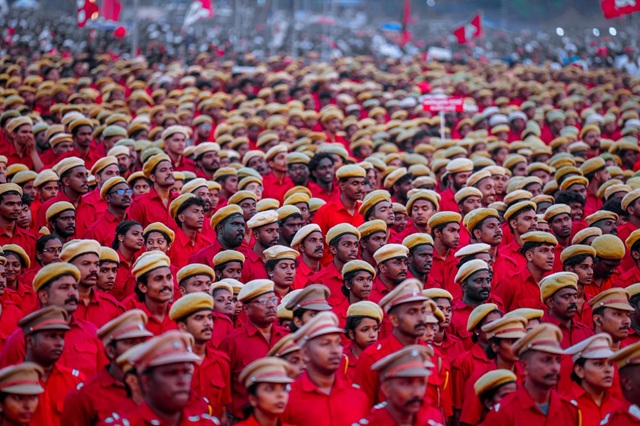
In the present times, it appears that communist philosophy, as evolved and propagated by great thinkers like Karl Marx and other communist thought leaders over the decades, has lost its sheen. Discerning observers are of the view that the aims and strategies of communist parties around the world have now become irrelevant.
Today, in almost all countries of the world, there is no significant presence of communist parties or communist philosophy, as understood over the years.
China claims that it has a communist government, but a deeper and more careful look into its style of governance clearly highlights the fact that what is practised today in China is a combination of the worst aspects of communism and the best aspects of capitalism.
In other words, typical of the communist style of governance, freedom of speech and personal liberty are denied to citizens, which is the most negative aspect of communist methods. At the same time, China permits and encourages free enterprise promoted and managed by the private sector and multinational companies, which is the hallmark of capitalism. It is widely believed that China’s spectacular growth in recent years has been due to governance combining these two extreme aspects of communism and capitalism. In such circumstances, instead of terming the governance in China as communism, it would be more appropriate to describe it as “Chineism”, a unique model adopted by China.
Cuba is another country that claims to have a communist government, but less said the better about the so-called communism practised there.
In India, communists had a strong foothold in the past but are now steadily losing strength and popularity.
When India attained independence in 1947, communist philosophy remained popular to some extent, and the Communist Party won democratic elections in West Bengal, Tripura, and Kerala. At that time, this victory of the Communist Party in democratically conducted elections was hailed as vindication of the strength and value of communist philosophy, and it was expected that communism would flourish in democratic societies in the future as well. But it was not to be.
Over the years, however, the Communist Party lost its mandate from the people in several elections and lost power in the states of West Bengal and Tripura. In Kerala, a Marxist-led government is in power, but this is a coalition government, where the communists have no hesitation in aligning with caste- and religion-based and family-controlled parties.
What is the reason for such a steady decline in the fortunes of the Communist Party in India?
There were serious differences of opinion among the party leadership, which eventually led to a split. Further, some violence-prone extremist groups have also started claiming allegiance to Marxism and Karl Marx’s philosophy. But this is not the main or sole reason for the decline in the fortunes of the Communist Party.
In several states, the Communist Party has no hesitation in aligning with family-controlled parties or parties with narrow sectarian outlooks in electoral battles, which means that the lofty objectives of communism have been given scant regard by the Communist Party in India.
Another major reason for the decline in the popularity of the Communist Party is that Karl Marx’s original objective of freeing labour from atrocities—and his famous statement that “workers have nothing to lose except their chains”—has already been achieved to a considerable extent across the world. The type of labour exploitation that Karl Marx spoke about, and which communists highlighted in the past, no longer exists in India.
In order to maintain its image as the champion of labour, trade unions belonging to the Communist Party and their cadres have resorted to violence in the name of protecting labour interests and organising agitations by adopting coercive tactics against management and organisations. In a scenario where labour exploitation is largely a thing of the past and several rules and regulations exist to protect labour interests, such trade union movements are today viewed in India as counterproductive anachronisms with no real justification.
All said and done, the large sections of labour for whom communists claim to fight are not deprived or poor people, but include highly paid bank employees, state and central government employees, and others. In several public and private sector organisations, the organised class of employees is well paid and, by no stretch of imagination, can be described as deprived sections of society.
Recently, a strike was organised by the Communist Party in a factory run by a multinational organisation in Chennai, where the take-home pay of employees is far higher than the middle-income level. This strike was disapproved by a large section of the population and did not enhance the image of the Communist Party. Another instance is the recent nationwide strike launched by well-paid bank employees demanding a five-day working week, which is an unacceptable justification for going on strike. The Communist Party, among other parties that backed the strike, lost considerable goodwill in the country.
In short, the Communist Party in India has failed to mature in tune with changes in technology and the industrial and management environment, and continues to adopt policies and programmes evolved several decades ago that have now become outdated.
While class conflict in economic terms is no longer a significant issue, with people largely getting their due based on capability in a competitive environment, several other kinds of conflicts exist in India today that require close attention from the Communist Party and where a case exists for active intervention against injustice.
There are caste conflicts in India, corruption in government administration, educational institutions, and even religious bodies, all of which cause considerable problems in day-to-day life. There are also vested interests disturbing the progress of society in several other ways.
In India today, there are only two political parties—the BJP and the Communist Party—that are not family-controlled or proprietary in nature. This distinction provides the Communist Party with a strong opportunity to involve itself in fighting such negative forces.
If and when the Communist Party realises this potential and aligns itself with the needs and aspirations of the people, it can re-emerge strongly in vote-bank politics and capture power.
Thus, it can establish a new standard and performance yardstick for the communist movement around the world.