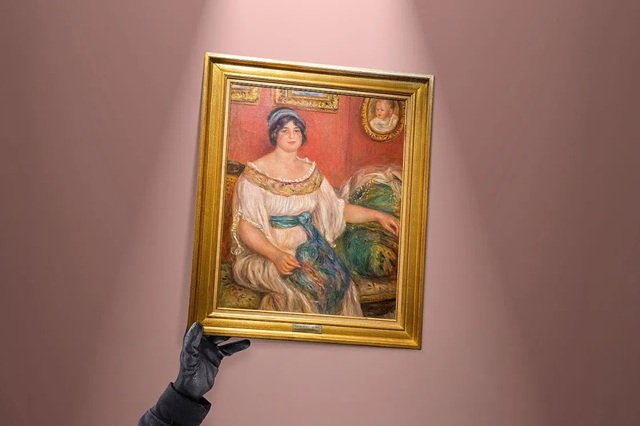
The theft of two paintings by the impressionist painter Pierre-Auguste Renoir from a museum in Cagnes-sur-Mer last week has highlighted an emerging threat in the international art world: the use of artificial intelligence by criminals to plan thefts, assess the value of stolen works and manufacture documents designed to make them appear legitimate.
Experts in stolen art say AI tools are increasingly being used across the criminal process. Chatbots can identify small museums with limited security, determine which valuable works they contain, estimate the worth of objects that have been stolen and generate apparently convincing provenance documents to support their sale.
It is not yet clear whether AI played any role in the Cagnes-sur-Mer theft. But Christopher Marinello, an expert in recovering stolen art, said the operation fitted a pattern in which criminals target small, poorly secured galleries containing valuable works.
“If I go onto ChatGPT and ask what small museums are in my vicinity, I get a whole list. And then I can ask what treasures are in these small museums. Do they have any gold? Do they have any gems? Any Picassos and Renoirs?” he said.
The two stolen paintings, Portrait of Madame Colonna Romano and Young Woman at the Well, were taken from the museum in Cagnes-sur-Mer in an operation that the town’s mayor, Bryan Masson, described as the work of thieves who were “well-informed, they were well-equipped… they did it very quickly and very well”.
Marinello described such robberies as little more than “glorified smash and grabs”. The thieves initially attempted to take four paintings but were forced to abandon two in the museum garden.
Yet the apparent simplicity of the crime should not obscure the planning involved. Art thieves targeting museums need to minimise the time between entering and leaving a building. The ideal target is a small museum with limited security, while the criminals also need to know how they will escape before police arrive.
According to Marinello, AI can rapidly provide much of that information.
The technology also presents a problem after a theft has taken place. A stolen masterpiece may be highly recognisable, but recognition alone does not make it commercially useful. On the black market, works of art depend on claims of authenticity and provenance if criminals hope to establish their value.
Nick Knights, who investigates art thefts for the private security firm Sentinel Apex, said insurance companies employing him had reported “a rise in AI-generated provenance documents” being used to authenticate stolen goods.
Knights considers the paperwork one of the most important elements of an art theft. The quality of fraudulent documents, he said, has improved dramatically with the assistance of AI chatbots.
“They are using this to bolster the collateral value of these items through generated provenance,” he said.
That development threatens to complicate an already difficult process for investigators and negotiators attempting to recover stolen works. When stolen goods are identified, specialists such as Julian Radcliffe may become involved in efforts to secure their return. A former hostage negotiator, Radcliffe now runs the Art Loss Register.
He acknowledges that AI has changed the balance of power in negotiations. Previously, criminals might have struggled to establish the precise value of unusual or obscure works. With access to chatbots, however, they can obtain more accurate valuations.
Criminals therefore have a new source of information at precisely the point where uncertainty once gave investigators and intermediaries an advantage. Radcliffe says criminals now “know accurately the values of items which would not have been easy to value before”.
But the theft of famous works such as the Renoirs presents a different problem. According to the experts The Observer spoke to, such paintings are unlikely to be sold openly on the traditional art market. Their visibility and recognisability make a conventional sale extremely difficult.
Instead, stolen masterpieces can acquire a different kind of value within organised crime. They may become bargaining chips or be exchanged for weapons or drugs. Criminal gangs may also acquire stolen art as an asset they can use in negotiations if they become the subject of criminal investigations.
The history of major art thefts provides examples of how this underground market can operate. In 2016, two paintings by Vincent van Gogh that had been stolen from the Van Gogh Museum in Amsterdam years earlier were recovered from a property owned by Raffaele Imperiale, a drug trafficker linked to the Camorra mafia.
The paintings had circulated on the black market for more than a decade before Imperiale acquired them. He eventually revealed their location after his arrest on drugs charges, hoping that doing so would contribute to a reduced sentence.
The episode illustrates why the disappearance of a famous painting does not necessarily mean that the work will simply appear for sale somewhere in the conventional art world. Some stolen works can disappear into criminal networks for years, acquiring value not because they can be openly sold but because they can be used as assets in dealings between criminals.
Arthur Brand, an art detective who recovered another stolen Van Gogh in 2023, has also challenged the popular image of the art thief as a wealthy criminal collector secretly surrounding himself with stolen masterpieces.
“There [are] no characters from the movies, like [the] villain who has this secret room full of stolen art,” Brand said.
The emergence of AI adds another dimension to that already complicated world. Criminals no longer need to rely entirely on specialist knowledge, personal contacts or laborious research to identify potentially valuable targets. Chatbots can provide information about museums, artworks and valuations rapidly, while the same technology can assist in creating documents intended to give stolen objects a more credible history.
The result is not necessarily a new type of art thief, but a potentially more capable version of an old one. The basic objectives remain familiar: identify valuable objects, overcome security, escape quickly and find a way to extract value from what has been stolen.
What is changing is the information available to criminals before and after the theft.
The Cagnes-sur-Mer robbery demonstrates that the traditional vulnerabilities of small museums remain relevant. The attempted theft of four Renoirs, even though only two were successfully taken, also shows that an operation does not need the sophistication of a cinematic heist to cause serious losses.
Yet the growing use of AI means that even relatively straightforward crimes can potentially be supported by increasingly sophisticated research, valuation and document production.
For investigators and art-recovery specialists, that creates a new challenge. Recovering a stolen painting has always required patience, expertise and negotiation. But when criminals can use the same technology to understand the value of their assets and construct apparently credible documentation, the battle over stolen art is increasingly becoming a battle over information itself.
The paintings may remain hidden, sometimes for years. But the tools used to find them, value them and disguise their origins are becoming easier for criminals to access.
And in the world of stolen art, that may prove to be one of AI’s most valuable services.